 Add to Chrome
 Add to Firefox
 Add to Edge
Spurious Correlation-Aware Embedding Regularization for Worst-Group Robustness
Nov 06, 2025
Deep learning models achieve strong performance across various domains but often rely on spurious correlations, making them vulnerable to distribution shifts. This issue is particularly severe in subpopulation shift scenarios, where models struggle in underrepresented groups. While existing methods have made progress in mitigating this issue, their performance gains are still constrained. They lack a rigorous theoretical framework connecting the embedding space representations with worst-group error. To address this limitation, we propose Spurious Correlation-Aware Embedding Regularization for Worst-Group Robustness (SCER), a novel approach that directly regularizes feature representations to suppress spurious cues. We show theoretically that worst-group error is influenced by how strongly the classifier relies on spurious versus core directions, identified from differences in group-wise mean embeddings across domains and classes. By imposing theoretical constraints at the embedding level, SCER encourages models to focus on core features while reducing sensitivity to spurious patterns. Through systematic evaluation on multiple vision and language, we show that SCER outperforms prior state-of-the-art studies in worst-group accuracy. Our code is available at \href{https://github.com/MLAI-Yonsei/SCER}{https://github.com/MLAI-Yonsei/SCER}.

Benchmarking Foundation Models on Exceptional Cases: Dataset Creation and Validation
Oct 23, 2024Foundation models (FMs) have achieved significant success across various tasks, leading to research on benchmarks for reasoning abilities. However, there is a lack of studies on FMs performance in exceptional scenarios, which we define as out-of-distribution (OOD) reasoning tasks. This paper is the first to address these cases, developing a novel dataset for evaluation of FMs across multiple modalities, including graphic novels, calligraphy, news articles, and lyrics. It includes tasks for instance classification, character recognition, token prediction, and text generation. The paper also proposes prompt engineering techniques like Chain-of-Thought (CoT) and CoT+Few-Shot to enhance performance. Validation of FMs using various methods revealed improvements. The code repository is accessible at: https://github.com/MLAI-Yonsei/ExceptionalBenchmark
Exploring the Effects of AI-assisted Emotional Support Processes in Online Mental Health Community
Feb 21, 2022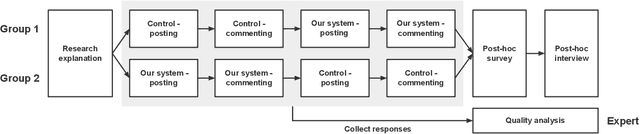
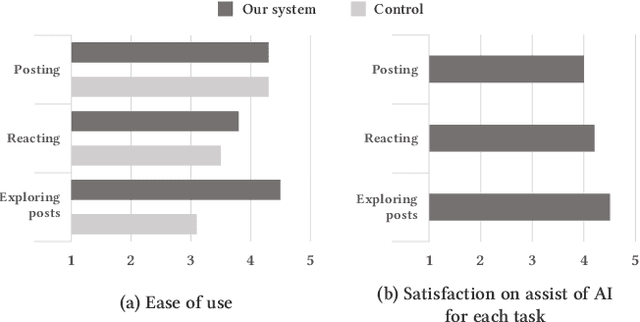
Social support in online mental health communities (OMHCs) is an effective and accessible way of managing mental wellbeing. In this process, sharing emotional supports is considered crucial to the thriving social supports in OMHCs, yet often difficult for both seekers and providers. To support empathetic interactions, we design an AI-infused workflow that allows users to write emotional supporting messages to other users' posts based on the elicitation of the seeker's emotion and contextual keywords from writing. Based on a preliminary user study (N = 10), we identified that the system helped seekers to clarify emotion and describe text concretely while writing a post. Providers could also learn how to react empathetically to the post. Based on these results, we suggest design implications for our proposed system.