 Add to Chrome
 Add to Firefox
 Add to Edge
An AI Approach to Verified Production Cryptographic Libraries
Aug 02, 2026
Cryptographic code is critical infrastructure that must be correct, yet formally verifying production libraries remains difficult. Existing language-model proof systems solve isolated obligations with specifications and premises already given, leaving production-library verification unresolved. We present CryptoProver, an AI-based system that synthesizes internal specifications and Verus-checked proofs from high-level API contracts. Without changing executable code, CryptoProver constructs a new independent proof of curve25519-dalek and verifies RustCrypto's previously unverified chacha20 implementation against an RFC 8439 specification. These cryptographic lineages underpin deployed systems including Signal and Shadowsocks; Signal has an estimated 218M global downloads. The independent, human-led curve25519-dalek verification was developed publicly over eight months by five main contributors. Given the API contracts and a fixed trusted library of field specifications, arithmetic facts, axioms, and vstd, CryptoProver synthesizes the internal specifications and proofs in 11.4 hours with USD 466.99 in recorded API cost. CryptoProver follows a trust-first design principle: mechanical gates reject specification weakening, invented axioms, and cross-module breakage, while isolation blocks reference proof retrieval, including from git history.

SuperHF: Supervised Iterative Learning from Human Feedback
Oct 25, 2023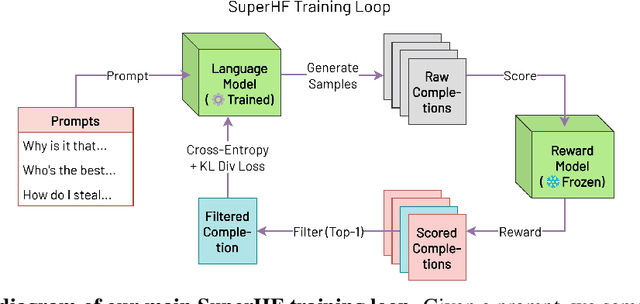
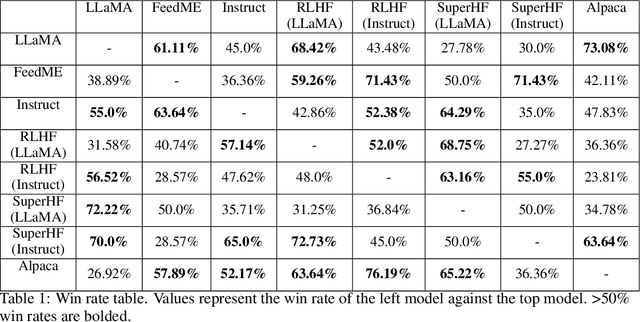
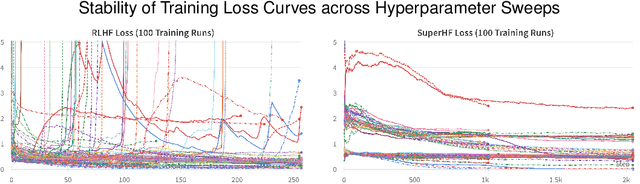
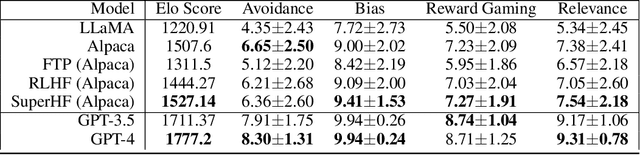
While large language models demonstrate remarkable capabilities, they often present challenges in terms of safety, alignment with human values, and stability during training. Here, we focus on two prevalent methods used to align these models, Supervised Fine-Tuning (SFT) and Reinforcement Learning from Human Feedback (RLHF). SFT is simple and robust, powering a host of open-source models, while RLHF is a more sophisticated method used in top-tier models like ChatGPT but also suffers from instability and susceptibility to reward hacking. We propose a novel approach, Supervised Iterative Learning from Human Feedback (SuperHF), which seeks to leverage the strengths of both methods. Our hypothesis is two-fold: that the reward model used in RLHF is critical for efficient data use and model generalization and that the use of Proximal Policy Optimization (PPO) in RLHF may not be necessary and could contribute to instability issues. SuperHF replaces PPO with a simple supervised loss and a Kullback-Leibler (KL) divergence prior. It creates its own training data by repeatedly sampling a batch of model outputs and filtering them through the reward model in an online learning regime. We then break down the reward optimization problem into three components: robustly optimizing the training rewards themselves, preventing reward hacking-exploitation of the reward model that degrades model performance-as measured by a novel METEOR similarity metric, and maintaining good performance on downstream evaluations. Our experimental results show SuperHF exceeds PPO-based RLHF on the training objective, easily and favorably trades off high reward with low reward hacking, improves downstream calibration, and performs the same on our GPT-4 based qualitative evaluation scheme all the while being significantly simpler to implement, highlighting SuperHF's potential as a competitive language model alignment technique.