 Add to Chrome
 Add to Firefox
 Add to Edge
Allometric Scaling Laws for Bipedal Robots
Mar 23, 2026
Scaling the design of robots up or down remains a fundamental challenge. While biological systems follow well-established isometric and allometric scaling laws relating mass, stride frequency, velocity, and torque, it is unclear how these relationships translate to robotic systems. In this paper, we generate similar allometric scaling laws for bipedal robots across three orders of magnitude in leg length. First, we conduct a review of legged robots from the literature and extract empirical relationships between leg length (L), body length, mass, and speed. These data show that robot mass scales more closely to L^2, in contrast to the L^3 scaling predicted by isometric scaling. We then perform controlled simulation studies in Drake using three variants of real quasi-passive, hip-actuated walkers with different foot geometries and control strategies. We evaluate the performance of each design scaled with leg length, L. Across all robots, walking velocity follows the expected L^(1/2) trend from dynamic similarity. Minimum required torque scales more closely with m*L than the isometric model of m*L^2. Foot geometry scaled proportionally with L^1. These results provide new insight into how robot designs allometrically scale to different sizes, and how that scaling is different from isometric or biological scaling laws.

Zippy: The smallest power-autonomous bipedal robot
May 08, 2025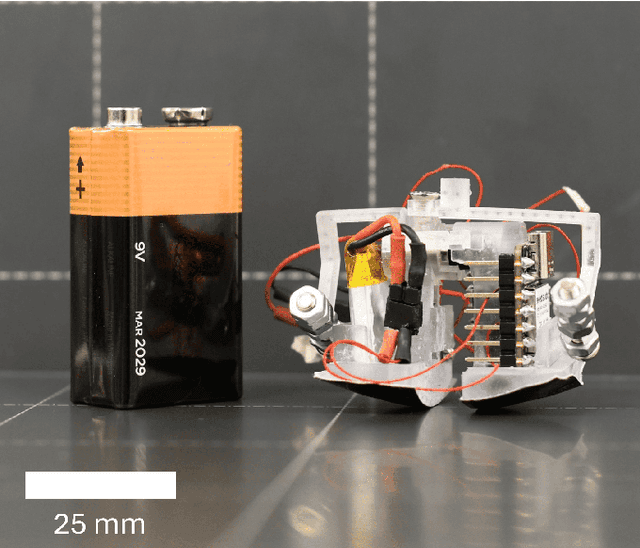
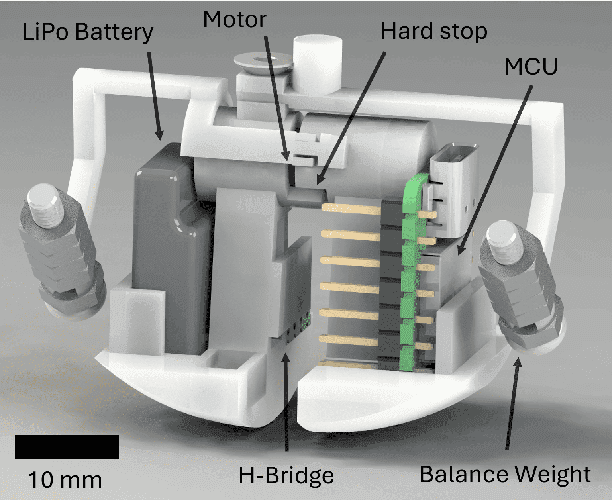
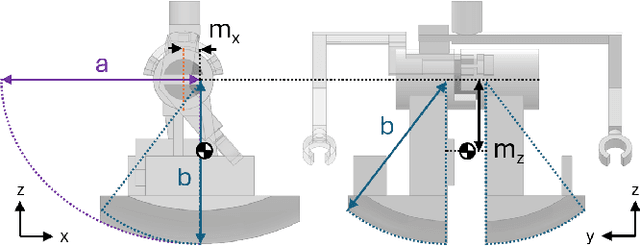
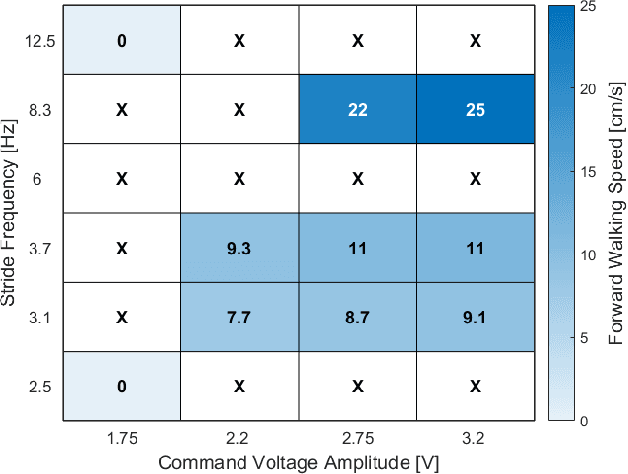
Miniaturizing legged robot platforms is challenging due to hardware limitations that constrain the number, power density, and precision of actuators at that size. By leveraging design principles of quasi-passive walking robots at any scale, stable locomotion and steering can be achieved with simple mechanisms and open-loop control. Here, we present the design and control of "Zippy", the smallest self-contained bipedal walking robot at only 3.6 cm tall. Zippy has rounded feet, a single motor without feedback control, and is capable of turning, skipping, and ascending steps. At its fastest pace, the robot achieves a forward walking speed of 25 cm/s, which is 10 leg lengths per second, the fastest biped robot of any size by that metric. This work explores the design and performance of the robot and compares it to similar dynamic walking robots at larger scales.