 Add to Chrome
 Add to Firefox
 Add to Edge
Leak-Free Cross-Validated Stacking with Per-Architecture Calibration for Sand-Boil Segmentation in Earthen Levees
Jul 28, 2026
Sand boils, points where water seeping beneath an earthen levee re-emerges at the surface, are early warnings of internal erosion, and deep segmentation networks are increasingly used to find them in inspection photographs. Annotated examples are scarce, and two common ways of working around that scarcity quietly inflate reported accuracy: tuning ensemble weights on the same images later used to score them, and training on synthetic images derived from the very photographs held out for testing. We present a sand-boil segmentation framework that closes both loopholes. Every synthetic image carries a pointer to its real parent, and a per-fold filter excludes any image whose parent is held out; five encoder-decoder backbones are trained under five-fold cross-validation, calibrated by one temperature scalar each, and combined by a per-pixel meta-learner fitted only on out-of-fold predictions. On the held-out test set the proposed Updated SandBoilNet reaches an intersection-over-union of 0.707 over three seeds, against 0.608 for the published original re-evaluated on the same split. Under the stacking protocol the calibrated stack reaches 0.681 against 0.694 for the strongest fold-averaged member, so it does not improve on the best single model; eight meta-learner families reproduce that outcome, which we trace to a mean pairwise error correlation of 0.894 among members. A synthetic pool filtered for label fidelity lifts the champion to 0.718 over three seeds against a 0.707 control. We also introduce a mask-conditioned synthesis route that makes the conditioning mask the label by construction, giving labelled training images at zero annotation cost.

Imbalance-Aware Culvert-Sewer Defect Segmentation Using an Enhanced Feature Pyramid Network
Aug 19, 2024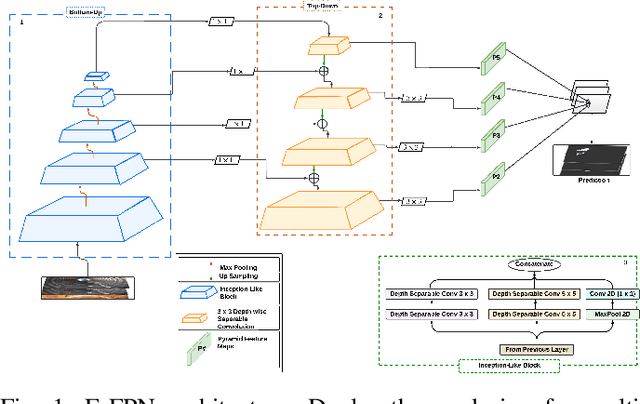
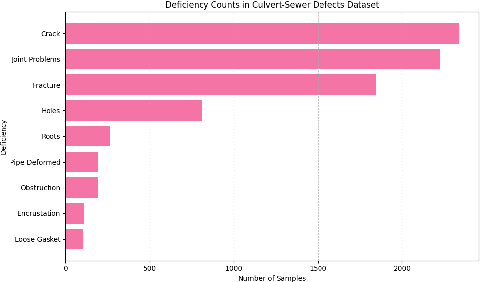
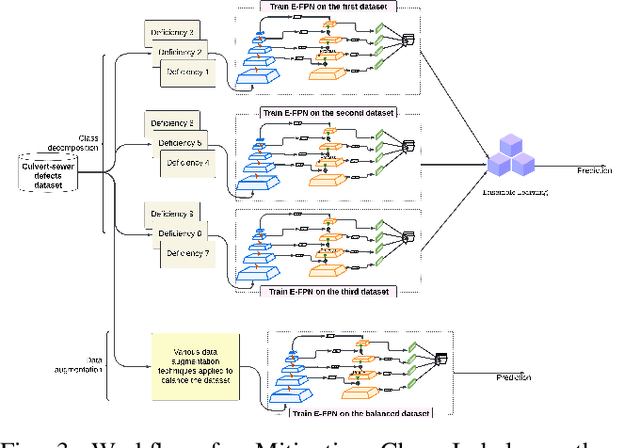

Imbalanced datasets are a significant challenge in real-world scenarios. They lead to models that underperform on underrepresented classes, which is a critical issue in infrastructure inspection. This paper introduces the Enhanced Feature Pyramid Network (E-FPN), a deep learning model for the semantic segmentation of culverts and sewer pipes within imbalanced datasets. The E-FPN incorporates architectural innovations like sparsely connected blocks and depth-wise separable convolutions to improve feature extraction and handle object variations. To address dataset imbalance, the model employs strategies like class decomposition and data augmentation. Experimental results on the culvert-sewer defects dataset and a benchmark aerial semantic segmentation drone dataset show that the E-FPN outperforms state-of-the-art methods, achieving an average Intersection over Union (IoU) improvement of 13.8% and 27.2%, respectively. Additionally, class decomposition and data augmentation together boost the model's performance by approximately 6.9% IoU. The proposed E-FPN presents a promising solution for enhancing object segmentation in challenging, multi-class real-world datasets, with potential applications extending beyond culvert-sewer defect detection.
SHARP-Net: A Refined Pyramid Network for Deficiency Segmentation in Culverts and Sewer Pipes
Aug 02, 2024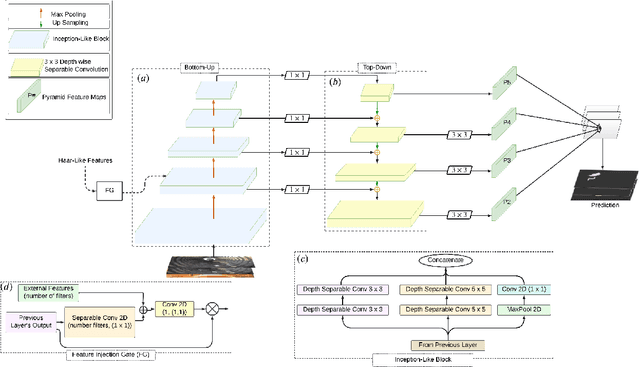
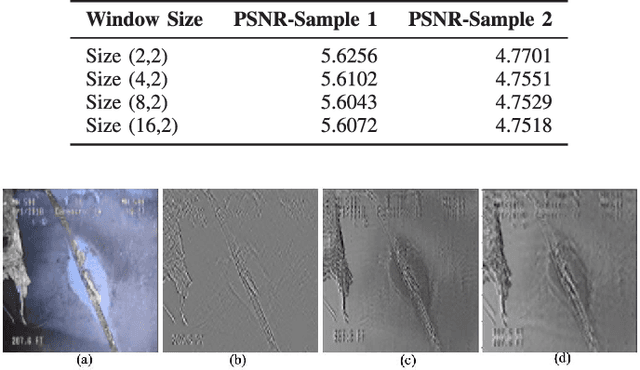
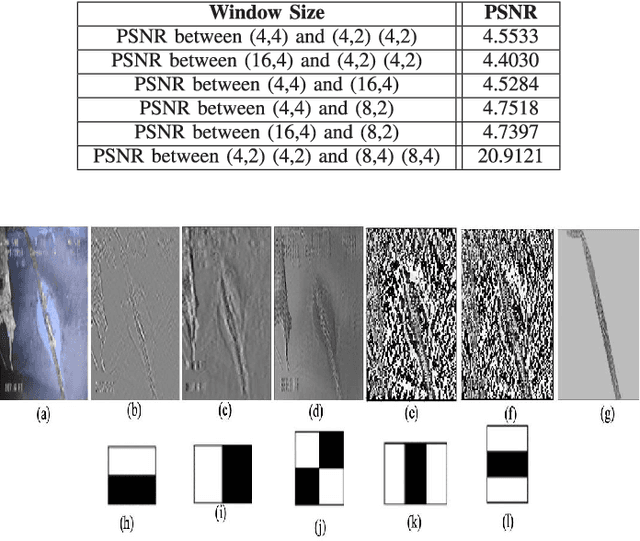
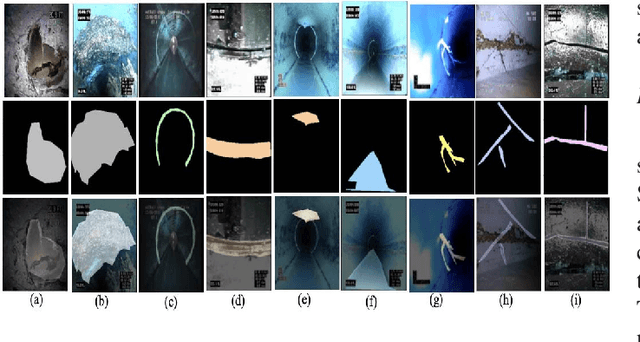
This paper introduces Semantic Haar-Adaptive Refined Pyramid Network (SHARP-Net), a novel architecture for semantic segmentation. SHARP-Net integrates a bottom-up pathway featuring Inception-like blocks with varying filter sizes (3x3$ and 5x5), parallel max-pooling, and additional spatial detection layers. This design captures multi-scale features and fine structural details. Throughout the network, depth-wise separable convolutions are used to reduce complexity. The top-down pathway of SHARP-Net focuses on generating high-resolution features through upsampling and information fusion using $1\times1$ and $3\times3$ depth-wise separable convolutions. We evaluated our model using our developed challenging Culvert-Sewer Defects dataset and the benchmark DeepGlobe Land Cover dataset. Our experimental evaluation demonstrated the base model's (excluding Haar-like features) effectiveness in handling irregular defect shapes, occlusions, and class imbalances. It outperformed state-of-the-art methods, including U-Net, CBAM U-Net, ASCU-Net, FPN, and SegFormer, achieving average improvements of 14.4% and 12.1% on the Culvert-Sewer Defects and DeepGlobe Land Cover datasets, respectively, with IoU scores of 77.2% and 70.6%. Additionally, the training time was reduced. Furthermore, the integration of carefully selected and fine-tuned Haar-like features enhanced the performance of deep learning models by at least 20%. The proposed SHARP-Net, incorporating Haar-like features, achieved an impressive IoU of 94.75%, representing a 22.74% improvement over the base model. These features were also applied to other deep learning models, showing a 35.0% improvement, proving their versatility and effectiveness. SHARP-Net thus provides a powerful and efficient solution for accurate semantic segmentation in challenging real-world scenarios.