 Add to Chrome
 Add to Firefox
 Add to Edge
Design and Integration of Thermal and Vibrotactile Feedback for Lifelike Touch in Social Robots
Dec 19, 2025
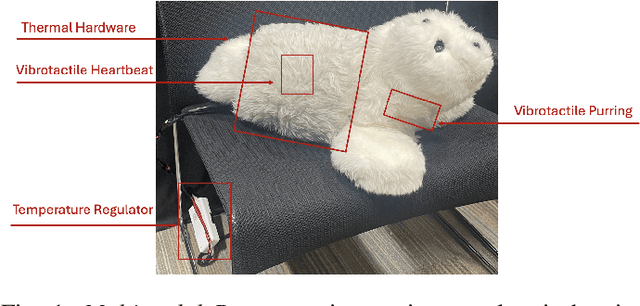
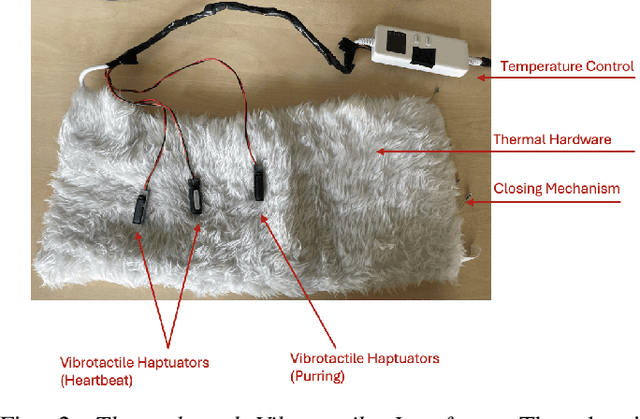
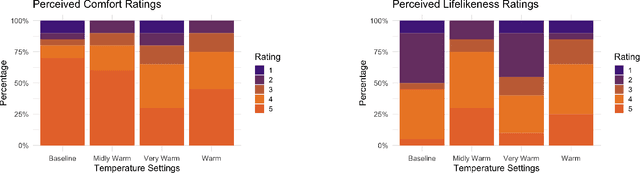
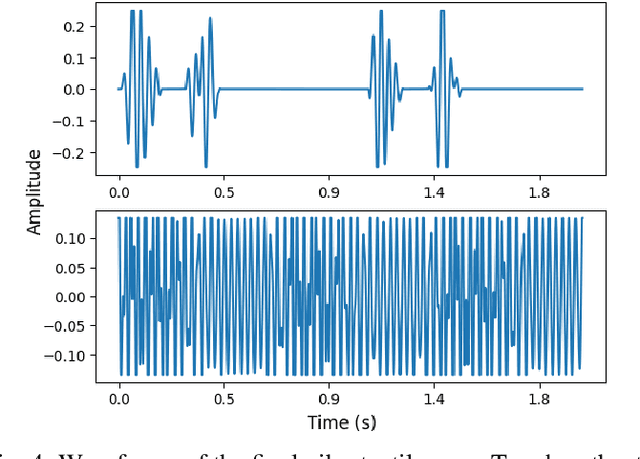
Zoomorphic Socially Assistive Robots (SARs) offer an alternative source of social touch for individuals who cannot access animal companionship. However, current SARs provide only limited, passive touch-based interactions and lack the rich haptic cues, such as warmth, heartbeat or purring, that are characteristic of human-animal touch. This limits their ability to evoke emotionally engaging, life-like physical interactions. We present a multimodal tactile prototype, which was used to augment the established PARO robot, integrating thermal and vibrotactile feedback to simulate feeling biophysiological signals. A flexible heating interface delivers body-like warmth, while embedded actuators generate heartbeat-like rhythms and continuous purring sensations. These cues were iteratively designed and calibrated with input from users and haptics experts. We outline the design process and offer reproducible guidelines to support the development of emotionally resonant and biologically plausible touch interactions with SARs.

Artificially Synthesising Data for Audio Classification and Segmentation to Improve Speech and Music Detection in Radio Broadcast
Feb 19, 2021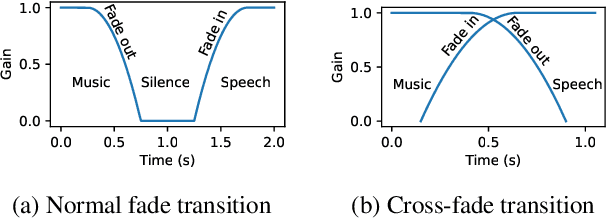
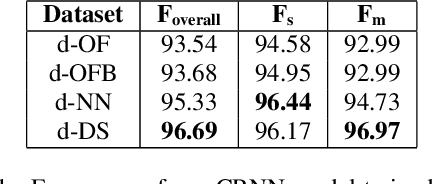
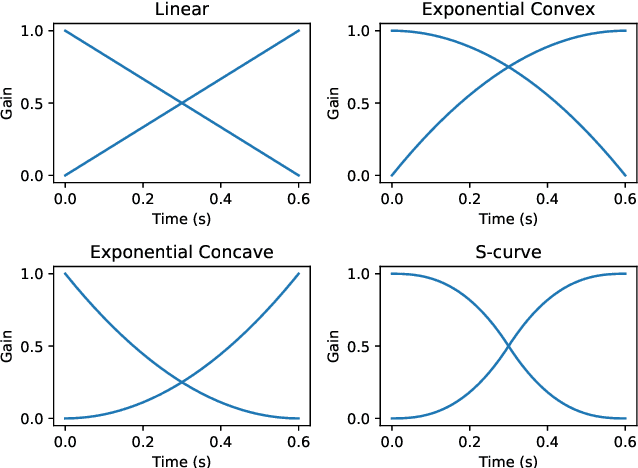
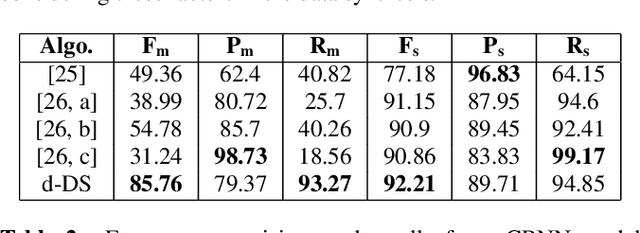
Segmenting audio into homogeneous sections such as music and speech helps us understand the content of audio. It is useful as a pre-processing step to index, store, and modify audio recordings, radio broadcasts and TV programmes. Deep learning models for segmentation are generally trained on copyrighted material, which cannot be shared. Annotating these datasets is time-consuming and expensive and therefore, it significantly slows down research progress. In this study, we present a novel procedure that artificially synthesises data that resembles radio signals. We replicate the workflow of a radio DJ in mixing audio and investigate parameters like fade curves and audio ducking. We trained a Convolutional Recurrent Neural Network (CRNN) on this synthesised data and outperformed state-of-the-art algorithms for music-speech detection. This paper demonstrates the data synthesis procedure as a highly effective technique to generate large datasets to train deep neural networks for audio segmentation.