 Add to Chrome
 Add to Firefox
 Add to Edge
RoboPhD: Evolving Diverse Complex Agents Under Tight Evaluation Budgets
Apr 06, 2026
2026 has brought an explosion of interest in LLM-guided evolution of agentic artifacts, with systems like GEPA and Autoresearch demonstrating that LLMs can iteratively improve prompts, code, and agent architectures across diverse domains. As adoption accelerates, a central question emerges: given the same information, the same seed agent, and the same objective, which optimization algorithm yields the best results under the same evaluation budget? This question becomes critical when evaluations are expensive, such as when they require human judgment or multiple LLM calls. We present the first systematic comparison of three optimization paradigms -- Elo tournament selection (RoboPhD), Pareto-based selection (GEPA), and greedy hill-climbing (Autoresearch) -- across four benchmarks spanning abstract reasoning, cloud scheduling, SQL generation, and financial QA, all under a fixed budget of 1,500 evaluations. RoboPhD introduces validation-free evolution: instead of splitting the budget between training and validation, it uses Elo competition on training data to simultaneously evaluate agents and drive evolution. All three systems receive seed agents with diagnostic print() statements that evolution can grow, enabling self-instrumenting agents that develop increasingly informative diagnostics for the benefit of their evolutionary successors. Using a single default configuration, RoboPhD outperforms both GEPA and Autoresearch on three of four benchmarks, losing only on the simplest task, where the winning solution (from our Autoresearch adaptation) required under 90 lines of code. On ARC-AGI, RoboPhD evolves a 22-line seed agent into a 1,013-line multi-strategy system, improving accuracy from 27.8% to 65.8% using Gemini 3.1 Flash Lite as the solver. We release RoboPhD as a versatile toolkit under the MIT license with a simple optimize_anything() API for evolving diverse complex agents.

RoboPhD: Self-Improving Text-to-SQL Through Autonomous Agent Evolution
Jan 03, 2026We present RoboPhD, a system where AI agents autonomously conduct research to improve Text-to-SQL performance. RoboPhD implements a closed-loop evolution cycle with two coordinated components: a SQL Generation agent composed of a database analysis script and SQL generation instructions, and an Evolution agent that designs new versions based on performance feedback. Central to the framework is an ELO-based selection mechanism enabling survival-of-the-fittest dynamics while handling non-transitivity in performance. Starting from a naive 70-line baseline, RoboPhD evolves agents through iterative cross-pollination, discovering effective techniques without any external guidance on the Text-to-SQL domain. Our best agent, evolved to 1500 lines over 18 iterations, autonomously discovered strategies such as size-adaptive database analysis that adjusts depth based on schema complexity and SQL generation patterns for column selection, evidence interpretation, and aggregation. Evolution provides the largest gains on cheaper models: while we improve by 2.3 points over a strong Claude Opus 4.5 naive baseline, we show an improvement of 8.9 points over the weaker Claude Haiku model. This enables 'skip a tier' deployment: evolved Haiku exceeds naive Sonnet accuracy, and evolved Sonnet exceeds naive Opus, both at lower cost. The full system achieves 73.67% accuracy on the BIRD test set, demonstrating that AI can autonomously build a strong agentic system with only a trivial human-provided starting point.
UNITE: A Unified Benchmark for Text-to-SQL Evaluation
May 26, 2023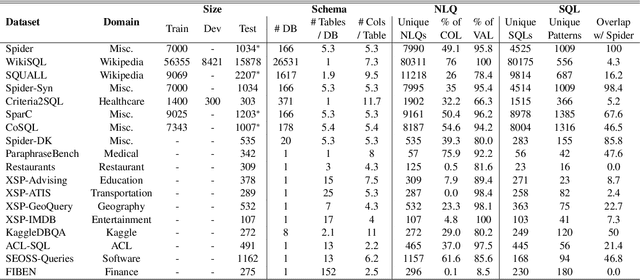
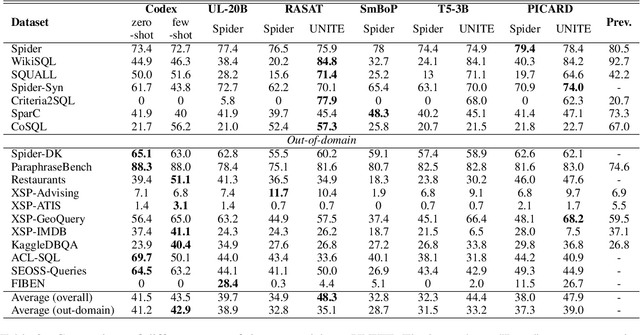
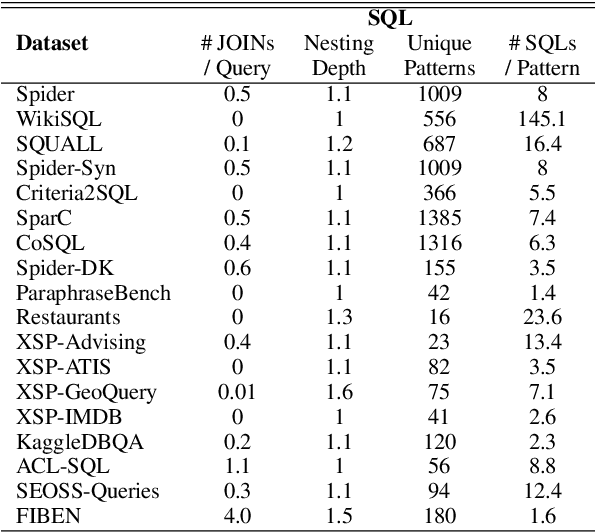
A practical text-to-SQL system should generalize well on a wide variety of natural language questions, unseen database schemas, and novel SQL query structures. To comprehensively evaluate text-to-SQL systems, we introduce a \textbf{UNI}fied benchmark for \textbf{T}ext-to-SQL \textbf{E}valuation (UNITE). It is composed of publicly available text-to-SQL datasets, containing natural language questions from more than 12 domains, SQL queries from more than 3.9K patterns, and 29K databases. Compared to the widely used Spider benchmark \cite{yu-etal-2018-spider}, we introduce $\sim$120K additional examples and a threefold increase in SQL patterns, such as comparative and boolean questions. We conduct a systematic study of six state-of-the-art (SOTA) text-to-SQL parsers on our new benchmark and show that: 1) Codex performs surprisingly well on out-of-domain datasets; 2) specially designed decoding methods (e.g. constrained beam search) can improve performance for both in-domain and out-of-domain settings; 3) explicitly modeling the relationship between questions and schemas further improves the Seq2Seq models. More importantly, our benchmark presents key challenges towards compositional generalization and robustness issues -- which these SOTA models cannot address well. \footnote{Our code and data processing script will be available at \url{https://github.com/XXXX.}}
Design Challenges in Named Entity Transliteration
Aug 07, 2018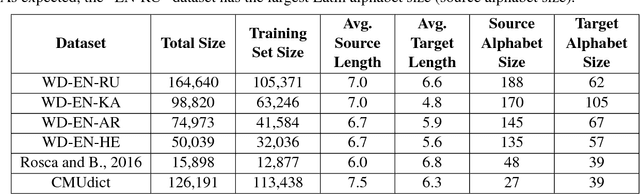
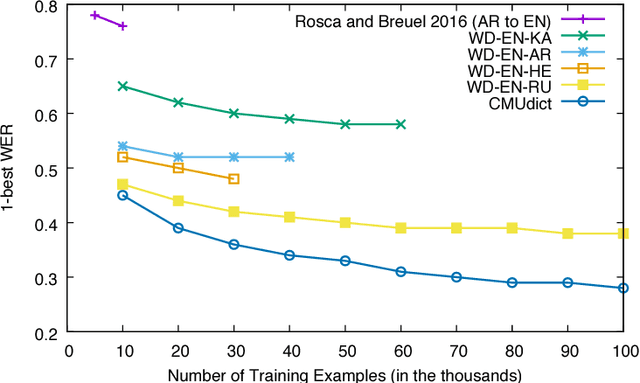
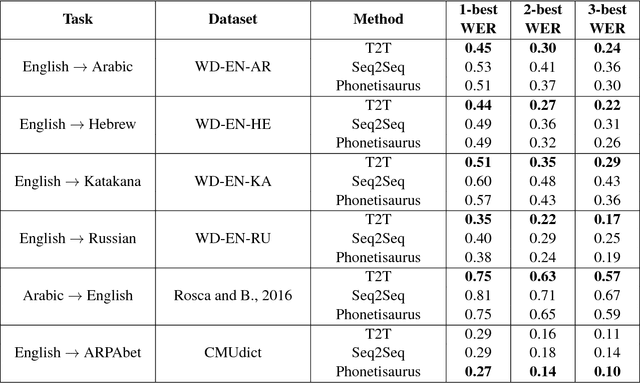
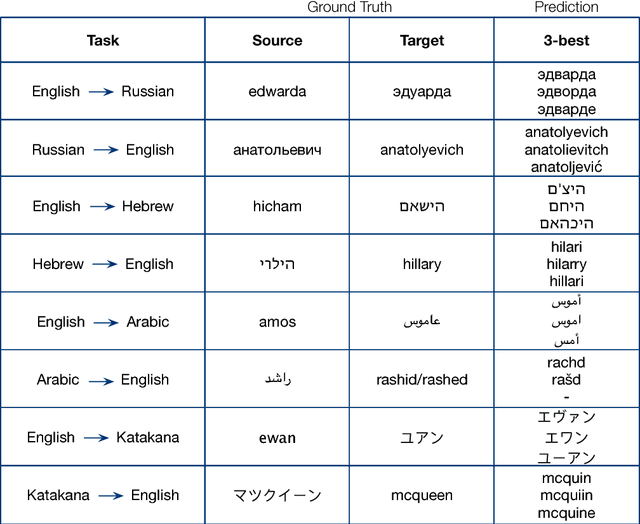
We analyze some of the fundamental design challenges that impact the development of a multilingual state-of-the-art named entity transliteration system, including curating bilingual named entity datasets and evaluation of multiple transliteration methods. We empirically evaluate the transliteration task using traditional weighted finite state transducer (WFST) approach against two neural approaches: the encoder-decoder recurrent neural network method and the recent, non-sequential Transformer method. In order to improve availability of bilingual named entity transliteration datasets, we release personal name bilingual dictionaries minded from Wikidata for English to Russian, Hebrew, Arabic and Japanese Katakana. Our code and dictionaries are publicly available.