 Add to Chrome
 Add to Firefox
 Add to Edge
A Cognitively Motivated Multidimensional Framework for Evaluating Metaphor Explanations
Aug 16, 2026
Current evaluation of metaphor explanations relies mainly on holistic quality ratings, revealing little about how explanation quality is structured or where human judgments agree and diverge. We introduce a cognitively motivated framework that decomposes metaphor explanation quality into six theoretically grounded dimensions. In a dense annotation study (11,200 ratings), we find that: {\bfseries(i)} explanation quality is genuinely multidimensional; {\bfseries(ii)} annotator disagreement is systematic rather than random; and {\bfseries(iii)} the six dimensions collapse into a shared cluster and two independent axes of judgment. An exploratory feasibility study further shows that a standard automatic evaluation pipeline can recover parts of this structure, predicting the most discriminative dimensions well while its errors correlate human (dis)agreement. Together, these results suggest that multidimensional evaluation offers richer diagnostic insight than holistic ratings, and that automatic evaluators for open-ended generation tasks should be judged on how well they preserve the structure of human judgment.

Leveraging Large Language Models to Geolocate Linguistic Variations in Social Media Posts
Jul 22, 2024Geolocalization of social media content is the task of determining the geographical location of a user based on textual data, that may show linguistic variations and informal language. In this project, we address the GeoLingIt challenge of geolocalizing tweets written in Italian by leveraging large language models (LLMs). GeoLingIt requires the prediction of both the region and the precise coordinates of the tweet. Our approach involves fine-tuning pre-trained LLMs to simultaneously predict these geolocalization aspects. By integrating innovative methodologies, we enhance the models' ability to understand the nuances of Italian social media text to improve the state-of-the-art in this domain. This work is conducted as part of the Large Language Models course at the Bertinoro International Spring School 2024. We make our code publicly available on GitHub https://github.com/dawoz/geolingit-biss2024.
A Commonsense Reasoning Framework for Explanatory Emotion Attribution, Generation and Re-classification
Jan 11, 2021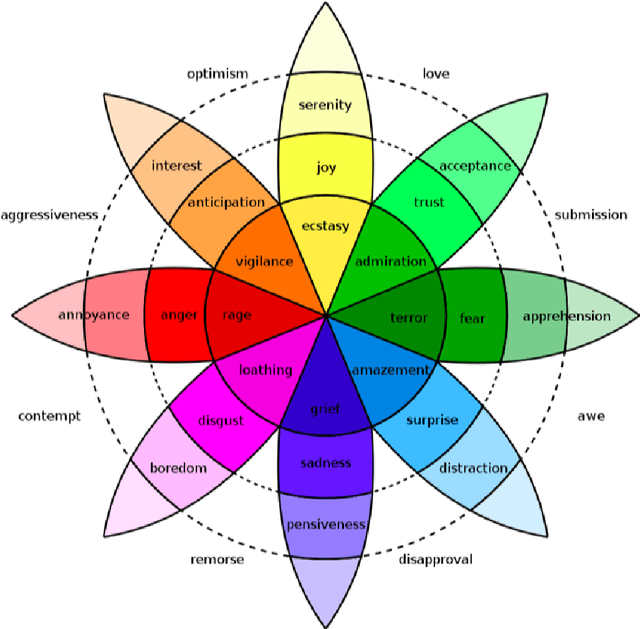
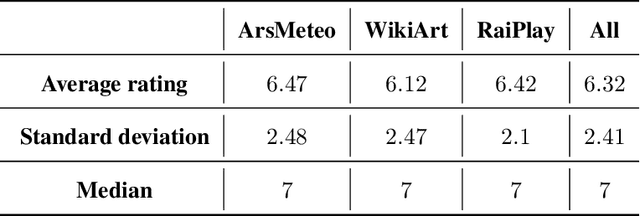
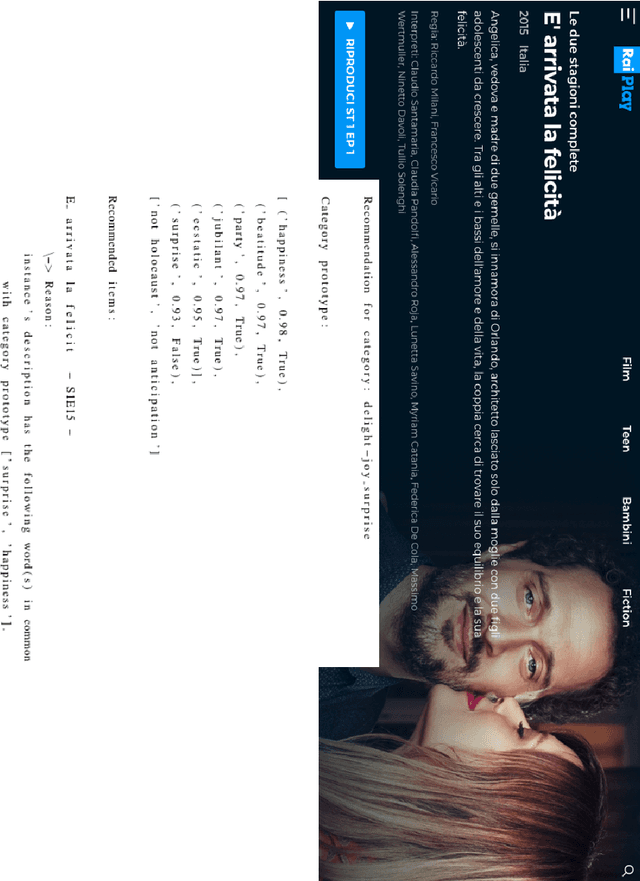
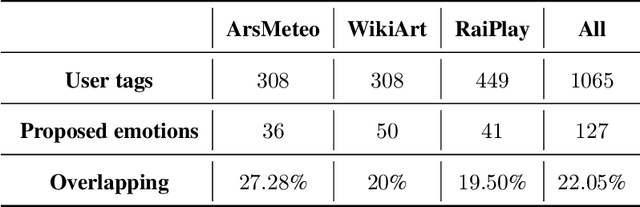
In this work we present an explainable system for emotion attribution and recommendation (called DEGARI) relying on a recently introduced commonsense reasoning framework (the TCL logic) which is based on a human-like procedure for the automatic generation of novel concepts in a Description Logics knowledge base. Starting from an ontological formalization of emotions (known as ArsEmotica), the system exploits the logic TCL to automatically generate novel commonsense semantic representations of compound emotions (e.g. Love as derived from the combination of Joy and Trust according to the ArsEmotica model). The generated emotions correspond to prototypes, i.e. commonsense representations of given concepts, and have been used to reclassify emotion-related contents in a variety of artistic domains, ranging from art datasets to the editorial content available in RaiPlay, the online multimedia platform of RAI Radiotelevisione Italiana (the Italian public broadcasting company). We have tested our system (1) by reclassifying the available contents in the tested dataset with respect to the new generated compound emotions (2) with an evaluation, in the form of a controlled user study experiment, of the feasibility of using the obtained reclassifications as recommended emotional content. The obtained results are encouraging and pave the way to many possible further improvements and research directions.