 Add to Chrome
 Add to Firefox
 Add to Edge
How Intelligence Emerges: A Minimal Theory of Dynamic Adaptive Coordination
Mar 12, 2026
This paper develops a dynamical theory of adaptive coordination in multi-agent systems. Rather than analyzing coordination through equilibrium optimization or agent-centric learning alone, the framework models agents, incentives, and environment as a recursively closed feedback architecture. A persistent environment stores accumulated coordination signals, a distributed incentive field transmits those signals locally, and adaptive agents update in response. Coordination is thus treated as a structural property of coupled dynamics rather than as the solution to a centralized objective. The paper establishes three structural results. First, under dissipativity assumptions, the induced closed-loop system admits a bounded forward-invariant region, ensuring viability without requiring global optimality. Second, when incentive signals depend non-trivially on persistent environmental memory, the resulting dynamics generically cannot be reduced to a static global objective defined solely over the agent state space. Third, persistent environmental state induces history sensitivity unless the system is globally contracting. A minimal linear specification illustrates how coupling, persistence, and dissipation govern local stability and oscillatory regimes through spectral conditions on the Jacobian. The results establish structural conditions under which intelligent coordination dynamics emerge from incentive-mediated adaptive interaction within a persistent environment, without presuming welfare maximization, rational expectations, or centralized design.

Mechanism-Based Intelligence (MBI): Differentiable Incentives for Rational Coordination and Guaranteed Alignment in Multi-Agent Systems
Dec 22, 2025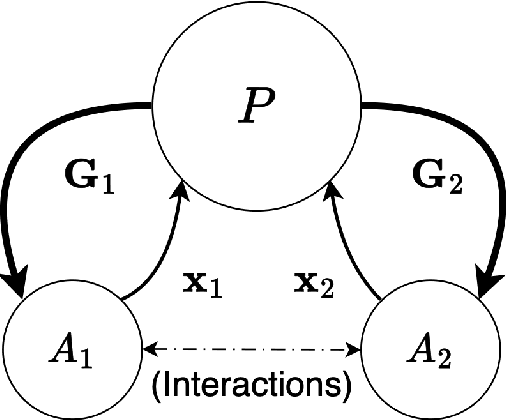
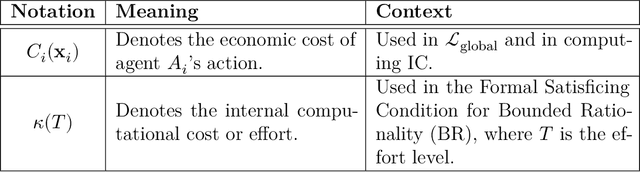
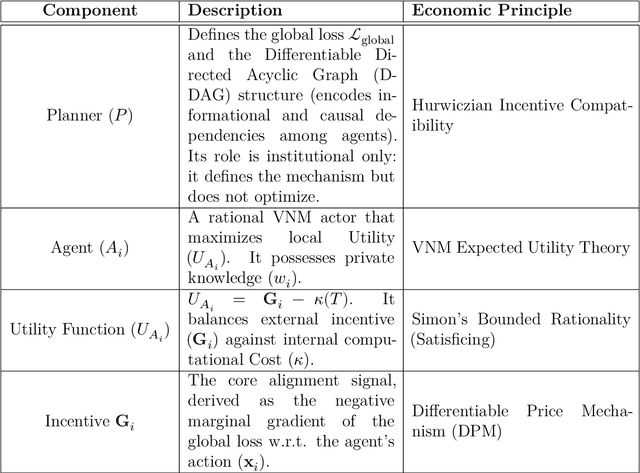
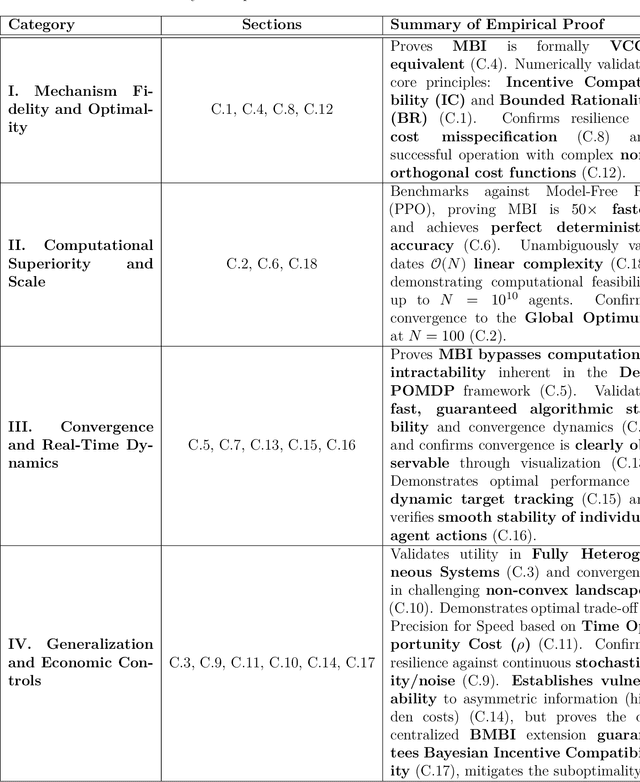
Autonomous multi-agent systems are fundamentally fragile: they struggle to solve the Hayekian Information problem (eliciting dispersed private knowledge) and the Hurwiczian Incentive problem (aligning local actions with global objectives), making coordination computationally intractable. I introduce Mechanism-Based Intelligence (MBI), a paradigm that reconceptualizes intelligence as emergent from the coordination of multiple "brains", rather than a single one. At its core, the Differentiable Price Mechanism (DPM) computes the exact loss gradient $$ \mathbf{G}_i = - \frac{\partial \mathcal{L}}{\partial \mathbf{x}_i} $$ as a dynamic, VCG-equivalent incentive signal, guaranteeing Dominant Strategy Incentive Compatibility (DSIC) and convergence to the global optimum. A Bayesian extension ensures incentive compatibility under asymmetric information (BIC). The framework scales linearly ($\mathcal{O}(N)$) with the number of agents, bypassing the combinatorial complexity of Dec-POMDPs and is empirically 50x faster than Model-Free Reinforcement Learning. By structurally aligning agent self-interest with collective objectives, it provides a provably efficient, auditable and generalizable approach to coordinated, trustworthy and scalable multi-agent intelligence grounded in economic principles.
Sentiment Classification of Thai Central Bank Press Releases Using Supervised Learning
Mar 28, 2025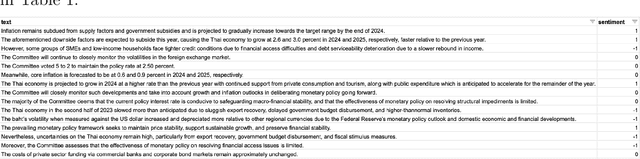
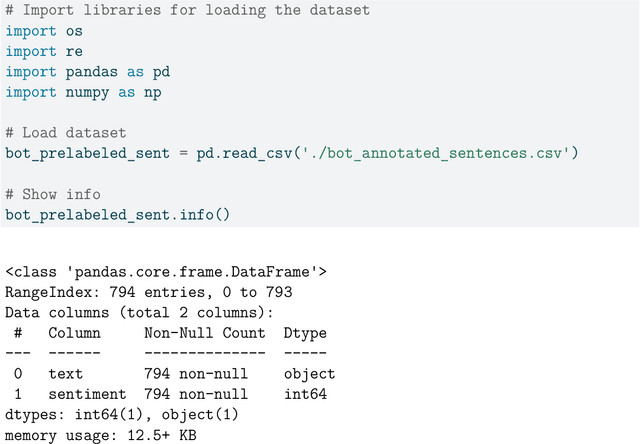
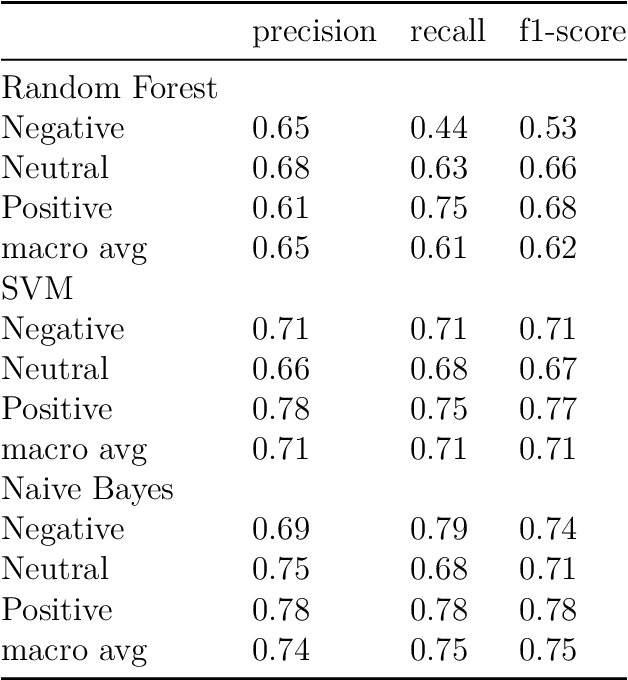
Central bank communication plays a critical role in shaping economic expectations and monetary policy effectiveness. This study applies supervised machine learning techniques to classify the sentiment of press releases from the Bank of Thailand, addressing gaps in research that primarily focus on lexicon-based approaches. My findings show that supervised learning can be an effective method, even with smaller datasets, and serves as a starting point for further automation. However, achieving higher accuracy and better generalization requires a substantial amount of labeled data, which is time-consuming and demands expertise. Using models such as Na\"ive Bayes, Random Forest and SVM, this study demonstrates the applicability of machine learning for central bank sentiment analysis, with English-language communications from the Thai Central Bank as a case study.