 Add to Chrome
 Add to Firefox
 Add to Edge
Mechanism-Based Intelligence (MBI): Differentiable Incentives for Rational Coordination and Guaranteed Alignment in Multi-Agent Systems
Paper and Code
Dec 22, 2025
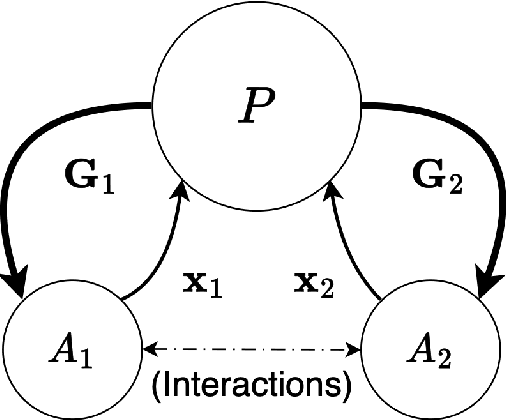
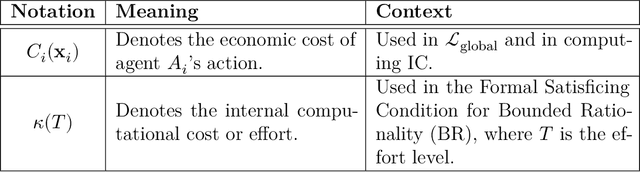
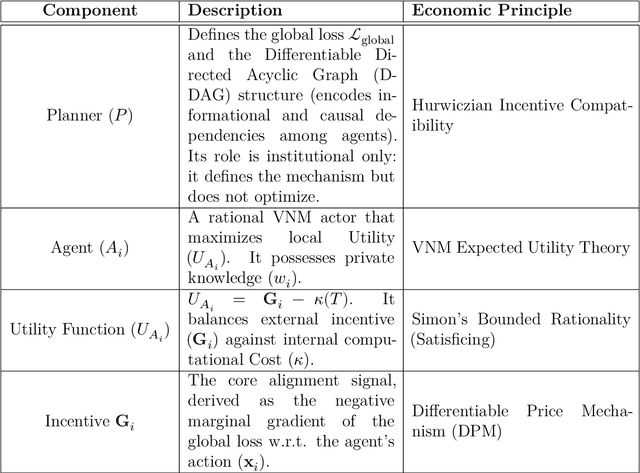
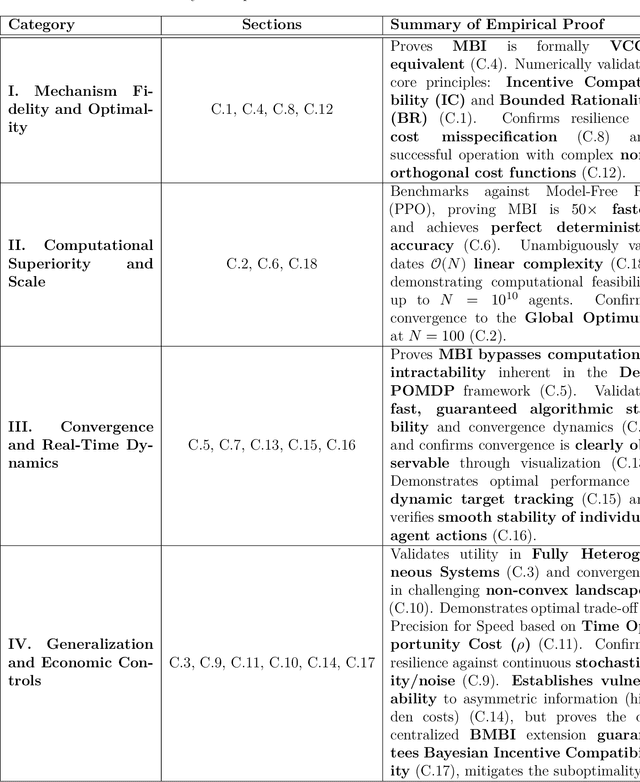
Autonomous multi-agent systems are fundamentally fragile: they struggle to solve the Hayekian Information problem (eliciting dispersed private knowledge) and the Hurwiczian Incentive problem (aligning local actions with global objectives), making coordination computationally intractable. I introduce Mechanism-Based Intelligence (MBI), a paradigm that reconceptualizes intelligence as emergent from the coordination of multiple "brains", rather than a single one. At its core, the Differentiable Price Mechanism (DPM) computes the exact loss gradient $$ \mathbf{G}_i = - \frac{\partial \mathcal{L}}{\partial \mathbf{x}_i} $$ as a dynamic, VCG-equivalent incentive signal, guaranteeing Dominant Strategy Incentive Compatibility (DSIC) and convergence to the global optimum. A Bayesian extension ensures incentive compatibility under asymmetric information (BIC). The framework scales linearly ($\mathcal{O}(N)$) with the number of agents, bypassing the combinatorial complexity of Dec-POMDPs and is empirically 50x faster than Model-Free Reinforcement Learning. By structurally aligning agent self-interest with collective objectives, it provides a provably efficient, auditable and generalizable approach to coordinated, trustworthy and scalable multi-agent intelligence grounded in economic principles.
