 Add to Chrome
 Add to Firefox
 Add to Edge
From Beats to Breaches:How Offensive AI Infers Sensitive User Information from Playlists
May 06, 2026
The pervasive integration of AI has enabled Offensive AI: the exploitation of AI for malicious ends across the cyber-kill chain. A critical manifestation is the user attribute inference attack, where AI infers sensitive Personally Identifiable Information (PII) from innocuous public data. We explore how music streaming ecosystems, where users routinely release public playlists, can be exploited for Offensive AI. To quantify this threat, we developed musicPIIrate. This novel tool leverages deep learning architectures that utilize both standalone data representations and the structural information embedded in a user's playlist collection. Our design explores set-based approaches (e.g., Deep Sets) and methodologies modeling relationships between playlists (e.g., Graph Neural Networks), which we also combine to leverage both perspectives. Our approach addresses feature extraction from unordered, variable-length set data, enabling accurate PII prediction. Empirical evaluation demonstrates that musicPIIrate achieves state-of-the-art inference accuracy. The tool successfully infers a wide array of attributes, including: Demographics (Age, Country, Gender), Habits (Alcohol, Smoke, Sport), and Personality Traits (OCEAN scores). musicPIIrate outperforms existing methods, beating baselines in 9 out of 15 attribute inference tasks. To counter this vulnerability, we propose JamShield, a lightweight defensive framework. JamShield strategically injects dummy playlists into an account to dilute the PII-carrying signal. Our analysis indicates that JamShield represents a promising defense, lowering inference F1-scores by an average of 10%. This work provides an initial Offensive-AI benchmark for playlist-based PII inference using architectures that leverage set- and graph-structured data and introduces a defense showing encouraging mitigation effects.

Hand Me Your PIN! Inferring ATM PINs of Users Typing with a Covered Hand
Oct 21, 2021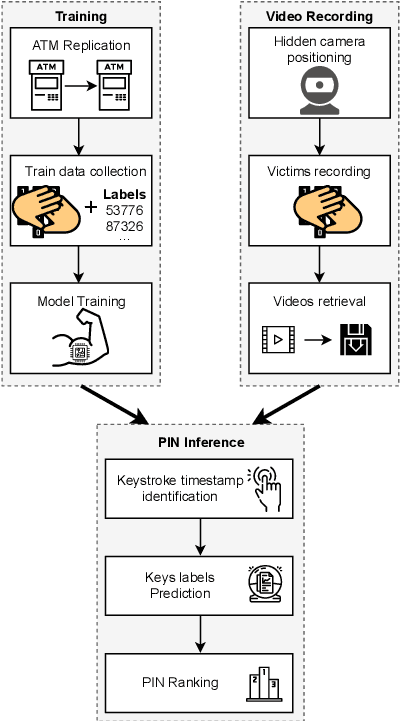
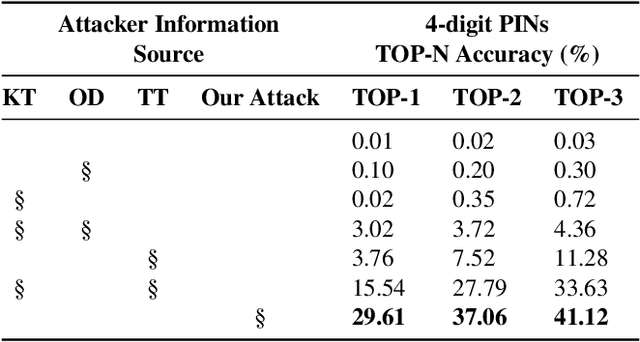
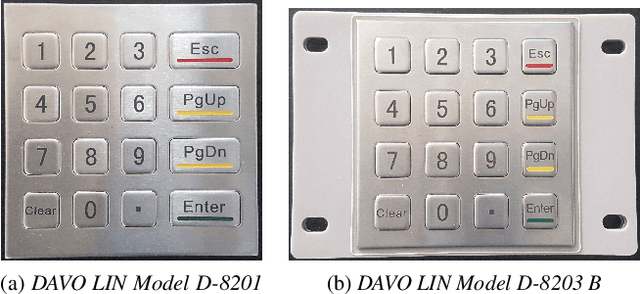
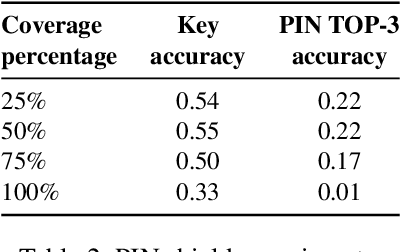
Automated Teller Machines (ATMs) represent the most used system for withdrawing cash. The European Central Bank reported more than 11 billion cash withdrawals and loading/unloading transactions on the European ATMs in 2019. Although ATMs have undergone various technological evolutions, Personal Identification Numbers (PINs) are still the most common authentication method for these devices. Unfortunately, the PIN mechanism is vulnerable to shoulder-surfing attacks performed via hidden cameras installed near the ATM to catch the PIN pad. To overcome this problem, people get used to covering the typing hand with the other hand. While such users probably believe this behavior is safe enough to protect against mentioned attacks, there is no clear assessment of this countermeasure in the scientific literature. This paper proposes a novel attack to reconstruct PINs entered by victims covering the typing hand with the other hand. We consider the setting where the attacker can access an ATM PIN pad of the same brand/model as the target one. Afterward, the attacker uses that model to infer the digits pressed by the victim while entering the PIN. Our attack owes its success to a carefully selected deep learning architecture that can infer the PIN from the typing hand position and movements. We run a detailed experimental analysis including 58 users. With our approach, we can guess 30% of the 5-digit PINs within three attempts -- the ones usually allowed by ATM before blocking the card. We also conducted a survey with 78 users that managed to reach an accuracy of only 7.92% on average for the same setting. Finally, we evaluate a shielding countermeasure that proved to be rather inefficient unless the whole keypad is shielded.