 Add to Chrome
 Add to Firefox
 Add to Edge
Compass: Optimizing Compound AI Workflows for Dynamic Adaptation
Mar 21, 2026
Compound AI is a distributed intelligence approach that represents a unified system orchestrating specialized AI/ML models with engineered software components into AI workflows. Compound AI production deployments must satisfy accuracy, latency, and cost objectives under varying loads. However, many deployments operate on fixed infrastructure where horizontal scaling is not viable. Existing approaches optimize solely for accuracy and do not consider changes in workload conditions. We observe that compound AI systems can switch between configurations to fit infrastructure capacity, trading accuracy for latency based on current load. This requires discovering multiple Pareto-optimal configurations from a combinatorial search space and determining when to switch between them at runtime. We present Compass, a novel framework that enables dynamic configuration switching through offline optimization and online adaptation. Compass consists of three components: COMPASS-V algorithm for configuration discovery, Planner for switching policy derivation, and Elastico Controller for runtime adaptation. COMPASS-V discovers accuracy-feasible configurations using finite-difference guided search and a combination of hill-climbing and lateral expansion. Planner profiles these configurations on target hardware and derives switching policies using a queuing theory based model. Elastico monitors queue depth and switches configurations based on derived thresholds. Across two compound AI workflows, COMPASS-V achieves 100% recall while reducing configuration evaluations by 57.5% on average compared to exhaustive search, with efficiency gains reaching 95.3% at tight accuracy thresholds. Runtime adaptation achieves 90-98% SLO compliance under dynamic load patterns, improving SLO compliance by 71.6% over static high-accuracy baselines, while simultaneously improving accuracy by 3-5% over static fast baselines.

ProbSelect: Stochastic Client Selection for GPU-Accelerated Compute Devices in the 3D Continuum
Nov 11, 2025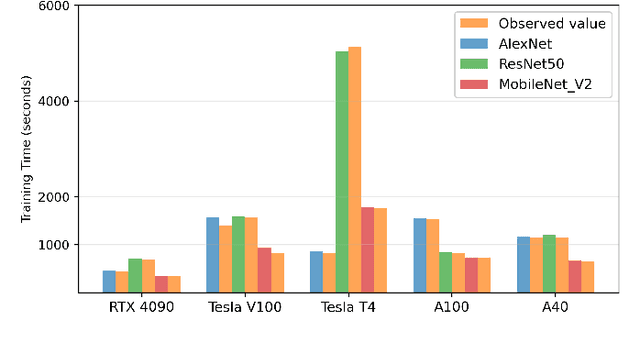
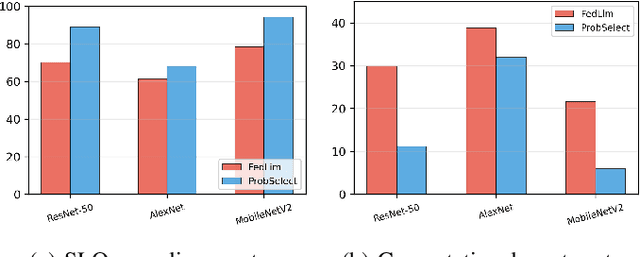
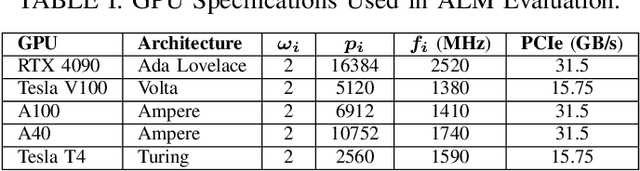

Integration of edge, cloud and space devices into a unified 3D continuum imposes significant challenges for client selection in federated learning systems. Traditional approaches rely on continuous monitoring and historical data collection, which becomes impractical in dynamic environments where satellites and mobile devices frequently change operational conditions. Furthermore, existing solutions primarily consider CPU-based computation, failing to capture complex characteristics of GPU-accelerated training that is prevalent across the 3D continuum. This paper introduces ProbSelect, a novel approach utilizing analytical modeling and probabilistic forecasting for client selection on GPU-accelerated devices, without requiring historical data or continuous monitoring. We model client selection within user-defined SLOs. Extensive evaluation across diverse GPU architectures and workloads demonstrates that ProbSelect improves SLO compliance by 13.77% on average while achieving 72.5% computational waste reduction compared to baseline approaches.
FedCCL: Federated Clustered Continual Learning Framework for Privacy-focused Energy Forecasting
Apr 28, 2025Privacy-preserving distributed model training is crucial for modern machine learning applications, yet existing Federated Learning approaches struggle with heterogeneous data distributions and varying computational capabilities. Traditional solutions either treat all participants uniformly or require costly dynamic clustering during training, leading to reduced efficiency and delayed model specialization. We present FedCCL (Federated Clustered Continual Learning), a framework specifically designed for environments with static organizational characteristics but dynamic client availability. By combining static pre-training clustering with an adapted asynchronous FedAvg algorithm, FedCCL enables new clients to immediately profit from specialized models without prior exposure to their data distribution, while maintaining reduced coordination overhead and resilience to client disconnections. Our approach implements an asynchronous Federated Learning protocol with a three-tier model topology - global, cluster-specific, and local models - that efficiently manages knowledge sharing across heterogeneous participants. Evaluation using photovoltaic installations across central Europe demonstrates that FedCCL's location-based clustering achieves an energy prediction error of 3.93% (+-0.21%), while maintaining data privacy and showing that the framework maintains stability for population-independent deployments, with 0.14 percentage point degradation in performance for new installations. The results demonstrate that FedCCL offers an effective framework for privacy-preserving distributed learning, maintaining high accuracy and adaptability even with dynamic participant populations.