 Add to Chrome
 Add to Firefox
 Add to Edge
PLAIground: SLO-Driven Runtime Model Selection for Compound AI Systems in the Edge-Cloud-Space Continuum
Jun 12, 2026
Applications in the 3D Computing Continuum, which unifies edge, cloud, and space, require combining multiple AI tasks such as object detection, time-series analytics, and natural language processing into Compound AI systems. These systems must satisfy stringent Service Level Objectives (SLOs) on accuracy, latency, and cost. A key mechanism for maintaining SLO compliance of Compound AI systems is runtime model selection, where AI models are dynamically switched for each workflow task. However, existing distributed and compound AI frameworks do not natively support runtime model selection. We present PLAIground, a framework that enables runtime model selection for Compound AI systems. PLAIground introduces Compoundable AI Model (CAIM) abstraction, which decouples task semantics from AI model implementations via Task and Data Contracts, enabling model switching without workflow changes. Additionally, PLAIground introduces Pixie, an SLO-driven runtime model selection algorithm, which dynamically selects the most suitable model for each task during execution. Our evaluation on two realistic Compound AI workflows demonstrates that Pixie achieves up to 91.3% accuracy while maintaining SLO compliance where fixed-model strategies either violate cost and latency budgets up to 21x or miss accuracy targets by 4%.

Design Methodology and Performance Trade-offs Management for Distributed and Compound AI Systems
Jun 12, 2026Artificial Intelligence (AI) systems must typically satisfy service-level objectives including accuracy, latency, and cost. The prevailing model-centric approaches select a monolithic model at design time and apply identical computation regardless of input difficulty, cannot decompose tasks across specialized components, and have knowledge that is fixed at training time. During runtime, this can lead to performance degradation and increasing costs. Because the model is the main design variable, it determines the majority of system behavior, coupling operational objectives to a single design-time choice. Addressing these limitations requires shifting from model-centric to system-centric design. Compound AI systems realize this shift by orchestrating multiple models, algorithms, and tools as distributed AI systems through explicit control logic. The performance of such systems depends on their workflow topology, the models assigned to each task, and the parameters governing runtime behavior. We present a design methodology that organizes this space along two dimensions, workflow topology and configuration selection, and identifies eight design patterns, each consolidating techniques to address a specific limitation of monolithic deployment. We validate our methodology through three case studies. Across our case studies, Compound AI configurations approach accuracy of monolithic models within 2.5 to 4 percentage points while reducing latency by up to 60% and cost by up to 71%. We show that model selection and parameter configuration jointly determine system performance, but the resulting design space grows combinatorially, as workflows compose more patterns and components. Thus, we identify five open challenges that define a roadmap from manually configured prototypes towards systems that automatically discover and maintain SLO-compliance in Compound and Distributed AI systems.
ProbSelect: Stochastic Client Selection for GPU-Accelerated Compute Devices in the 3D Continuum
Nov 11, 2025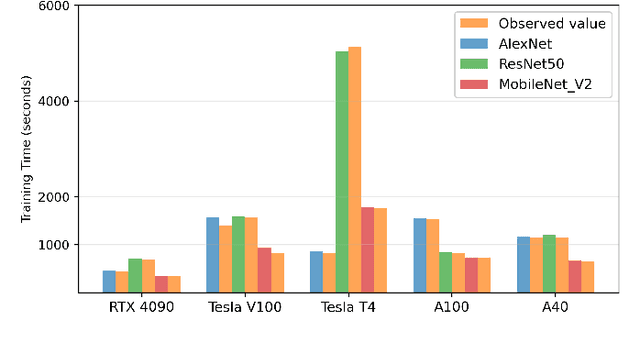
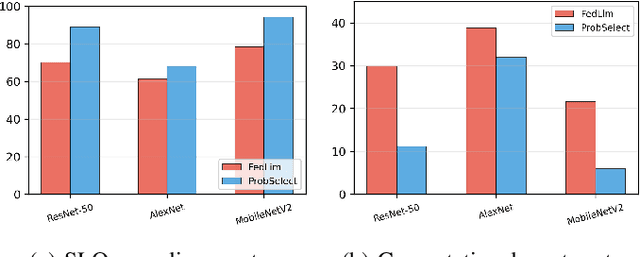
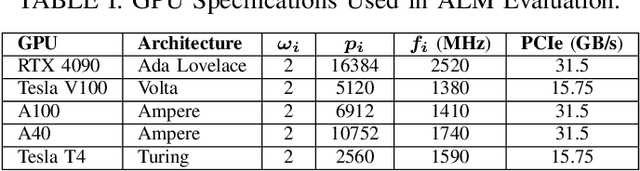

Integration of edge, cloud and space devices into a unified 3D continuum imposes significant challenges for client selection in federated learning systems. Traditional approaches rely on continuous monitoring and historical data collection, which becomes impractical in dynamic environments where satellites and mobile devices frequently change operational conditions. Furthermore, existing solutions primarily consider CPU-based computation, failing to capture complex characteristics of GPU-accelerated training that is prevalent across the 3D continuum. This paper introduces ProbSelect, a novel approach utilizing analytical modeling and probabilistic forecasting for client selection on GPU-accelerated devices, without requiring historical data or continuous monitoring. We model client selection within user-defined SLOs. Extensive evaluation across diverse GPU architectures and workloads demonstrates that ProbSelect improves SLO compliance by 13.77% on average while achieving 72.5% computational waste reduction compared to baseline approaches.