 Add to Chrome
 Add to Firefox
 Add to Edge
Utilizing Inpainting for Keypoint Detection for Vision-Based Control of Robotic Manipulators
Apr 14, 2026
In this paper we present a novel visual servoing framework to control a robotic manipulator in the configuration space by using purely natural visual features. Our goal is to develop methods that can robustly detect and track natural features or keypoints on robotic manipulators that would be used for vision-based control, especially for scenarios where placing external markers on the robot is not feasible or preferred at runtime. For the model training process of our data driven approach, we create a data collection pipeline where we attach ArUco markers along the robot's body, label their centers as keypoints, and then utilize an inpainting method to remove the markers and reconstruct the occluded regions. By doing so, we generate natural (markerless) robot images that are automatically labeled with the marker locations. These images are used to train a keypoint detection algorithm, which is used to control the robot configuration using natural features of the robot. Unlike the prior methods that rely on accurate camera calibration and robot models for labeling training images, our approach eliminates these dependencies through inpainting. To achieve robust keypoint detection even in the presence of occlusion, we introduce a second inpainting model, this time to utilize during runtime, that reconstructs occluded regions of the robot in real time, enabling continuous keypoint detection. To further enhance the consistency and robustness of keypoint predictions, we integrate an Unscented Kalman Filter (UKF) that refines the keypoint estimates over time, adding to stable and reliable control performance. We obtained successful control results with this model-free and purely vision-based control strategy, utilizing natural robot features in the runtime, both under full visibility and partial occlusion.

Image-Based Roadmaps for Vision-Only Planning and Control of Robotic Manipulators
Feb 26, 2025
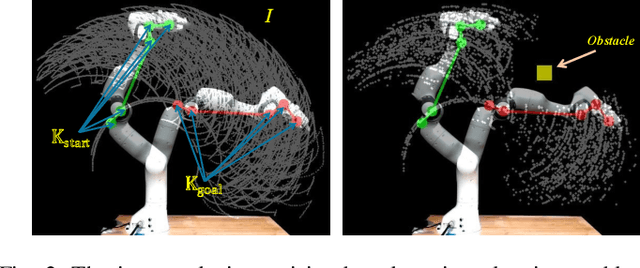
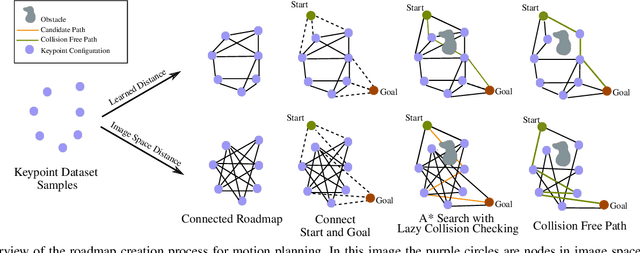
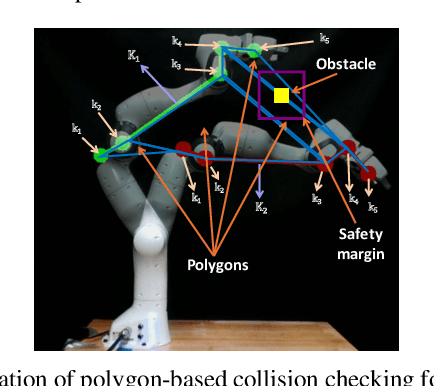
This work presents a motion planning framework for robotic manipulators that computes collision-free paths directly in image space. The generated paths can then be tracked using vision-based control, eliminating the need for an explicit robot model or proprioceptive sensing. At the core of our approach is the construction of a roadmap entirely in image space. To achieve this, we explicitly define sampling, nearest-neighbor selection, and collision checking based on visual features rather than geometric models. We first collect a set of image-space samples by moving the robot within its workspace, capturing keypoints along its body at different configurations. These samples serve as nodes in the roadmap, which we construct using either learned or predefined distance metrics. At runtime, the roadmap generates collision-free paths directly in image space, removing the need for a robot model or joint encoders. We validate our approach through an experimental study in which a robotic arm follows planned paths using an adaptive vision-based control scheme to avoid obstacles. The results show that paths generated with the learned-distance roadmap achieved 100% success in control convergence, whereas the predefined image-space distance roadmap enabled faster transient responses but had a lower success rate in convergence.