 Add to Chrome
 Add to Firefox
 Add to Edge
Non-frontal face recognition using GANs and memristor-based classifiers
Jun 10, 2026
Face recognition systems have advanced significantly through deep learning techniques, delivering high performance and robustness in complex scenarios. However, these approaches incur substantial computational overhead, limiting their in situ applicability in resource-constrained platforms such as drones, where they can address challenges including non-frontal facial imagery. Memristor-based neuromorphic systems have emerged as a compelling approach for edge AI applications, combining biologically inspired processing with efficient and scalable computation. In this work, we propose a facial recognition framework that addresses non-frontal pose variations by integrating lightweight generative adversarial network (GAN)-based pose frontalisation with memristor-based neuromorphic recognition. The experimental results on two datasets demonstrate the effectiveness of combining adversarial learning with memristive technology, achieving up to 96% identification accuracy. The proposed approach alleviates the computational bottlenecks of conventional AI and offers a scalable, efficient solution for face recognition in dynamic real-world environments.

Text Classification in Memristor-based Spiking Neural Networks
Jul 31, 2022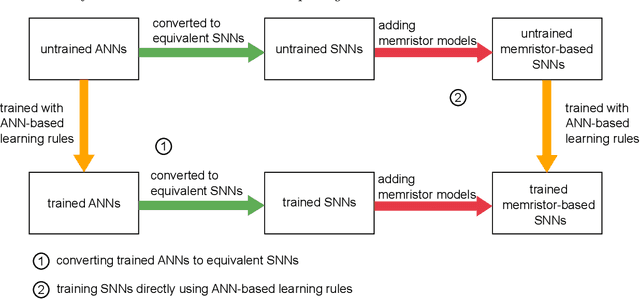

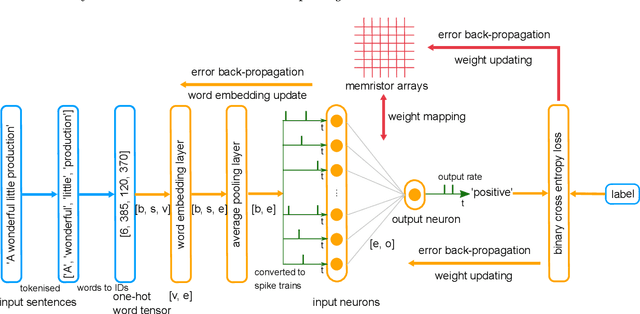
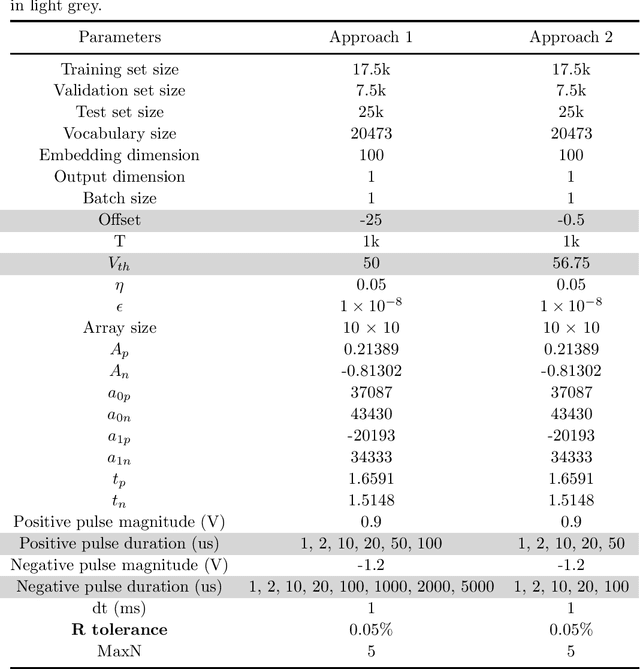
Memristors, emerging non-volatile memory devices, have shown promising potential in neuromorphic hardware designs, especially in spiking neural network (SNN) hardware implementation. Memristor-based SNNs have been successfully applied in a wide range of various applications, including image classification and pattern recognition. However, implementing memristor-based SNNs in text classification is still under exploration. One of the main reasons is that training memristor-based SNNs for text classification is costly due to the lack of efficient learning rules and memristor non-idealities. To address these issues and accelerate the research of exploring memristor-based spiking neural networks in text classification applications, we develop a simulation framework with a virtual memristor array using an empirical memristor model. We use this framework to demonstrate a sentiment analysis task in the IMDB movie reviews dataset. We take two approaches to obtain trained spiking neural networks with memristor models: 1) by converting a pre-trained artificial neural network (ANN) to a memristor-based SNN, or 2) by training a memristor-based SNN directly. These two approaches can be applied in two scenarios: offline classification and online training. We achieve the classification accuracy of 85.88% by converting a pre-trained ANN to a memristor-based SNN and 84.86% by training the memristor-based SNN directly, given that the baseline training accuracy of the equivalent ANN is 86.02%. We conclude that it is possible to achieve similar classification accuracy in simulation from ANNs to SNNs and from non-memristive synapses to data-driven memristive synapses. We also investigate how global parameters such as spike train length, the read noise, and the weight updating stop conditions affect the neural networks in both approaches.
A tool for emulating neuromorphic architectures with memristive models and devices
Jul 16, 2022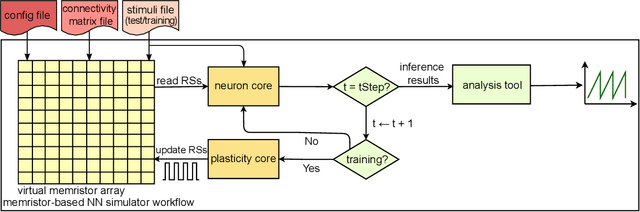
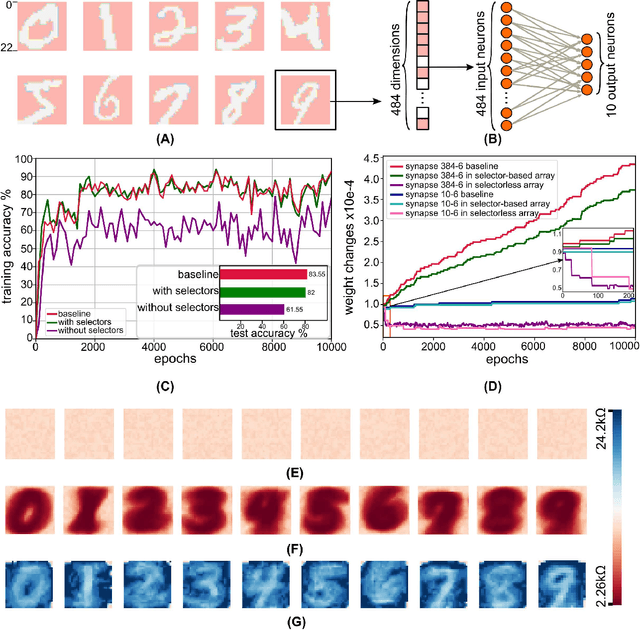
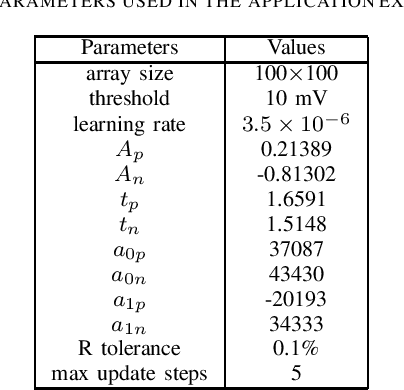
Memristors have shown promising features for enhancing neuromorphic computing concepts and AI hardware accelerators. In this paper, we present a user-friendly software infrastructure that allows emulating a wide range of neuromorphic architectures with memristor models. This tool empowers studies that exploit memristors for online learning and online classification tasks, predicting memristor resistive state changes during the training process. The versatility of the tool is showcased through the capability for users to customise parameters in the employed memristor and neuronal models as well as the employed learning rules. This further allows users to validate concepts and their sensitivity across a wide range of parameters. We demonstrate the use of the tool via an MNIST classification task. Finally, we show how this tool can also be used to emulate the concepts under study in-silico with practical memristive devices via appropriate interfacing with commercially available characterisation tools.
An FPGA-based System for Generalised Electron Devices Testing
Feb 01, 2022Electronic systems are becoming more and more ubiquitous as our world digitises. Simultaneously, even basic components are experiencing a wave of improvements with new transistors, memristors, voltage/current references, data converters, etc, being designed every year by hundreds of R&D groups world-wide. To date, the workhorse for testing all these designs has been a suite of lab instruments including oscilloscopes and signal generators, to mention the most popular. However, as components become more complex and pin numbers soar, the need for more parallel and versatile testing tools also becomes more pressing. In this work, we describe and benchmark an FPGA system developed that addresses this need. This general purpose testing system features a 64-channel source-meter unit (SMU), and 2x banks of 32 digital pins for digital I/O. We demonstrate that this bench-top system can obtain $170 pA$ current noise floor, $40 ns$ pulse delivery at $\pm13.5 V$ and $12 mA$ maximum current drive/channel. We then showcase the instrument's use in performing a selection of three characteristic measurement tasks: a) current-voltage (IV) characterisation of a diode and a transistor, b) fully parallel read-out of a memristor crossbar array and c) an integral non-linearity (INL) test on a DAC. This work introduces a down-scaled electronics laboratory packaged in a single instrument which provides a shift towards more affordable, reliable, compact and multi-functional instrumentation for emerging electronic technologies.