 Add to Chrome
 Add to Firefox
 Add to Edge
Non-frontal face recognition using GANs and memristor-based classifiers
Jun 10, 2026
Face recognition systems have advanced significantly through deep learning techniques, delivering high performance and robustness in complex scenarios. However, these approaches incur substantial computational overhead, limiting their in situ applicability in resource-constrained platforms such as drones, where they can address challenges including non-frontal facial imagery. Memristor-based neuromorphic systems have emerged as a compelling approach for edge AI applications, combining biologically inspired processing with efficient and scalable computation. In this work, we propose a facial recognition framework that addresses non-frontal pose variations by integrating lightweight generative adversarial network (GAN)-based pose frontalisation with memristor-based neuromorphic recognition. The experimental results on two datasets demonstrate the effectiveness of combining adversarial learning with memristive technology, achieving up to 96% identification accuracy. The proposed approach alleviates the computational bottlenecks of conventional AI and offers a scalable, efficient solution for face recognition in dynamic real-world environments.

TrIM: Triangular Input Movement Systolic Array for Convolutional Neural Networks -- Part I: Dataflow and Analytical Modelling
Aug 02, 2024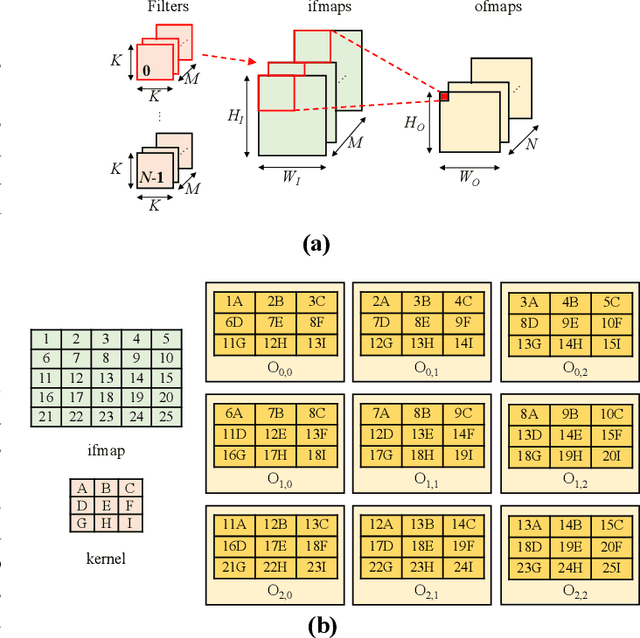
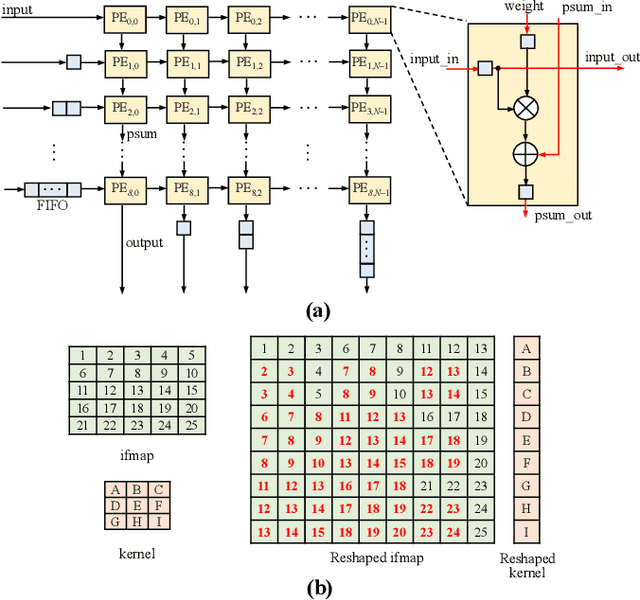
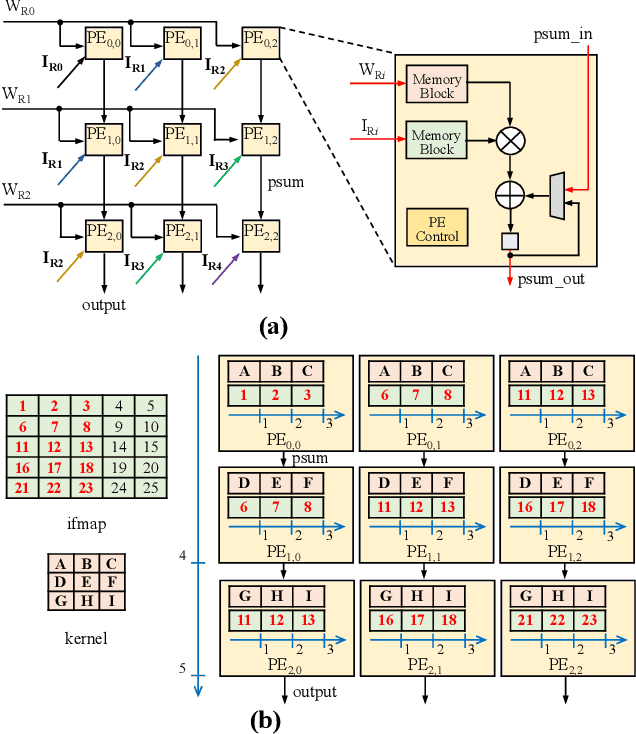
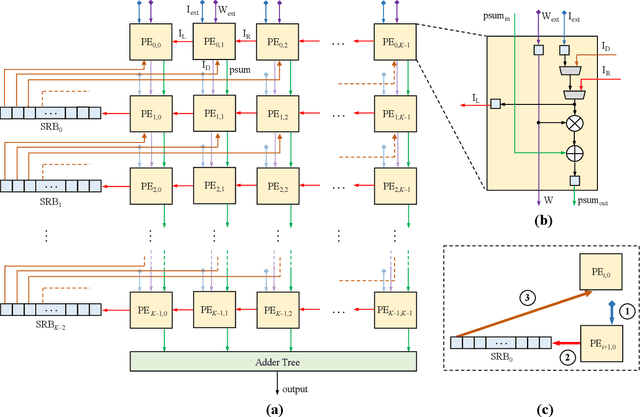
In order to follow the ever-growing computational complexity and data intensity of state-of-the-art AI models, new computing paradigms are being proposed. These paradigms aim at achieving high energy efficiency, by mitigating the Von Neumann bottleneck that relates to the energy cost of moving data between the processing cores and the memory. Convolutional Neural Networks (CNNs) are particularly susceptible to this bottleneck, given the massive data they have to manage. Systolic Arrays (SAs) are promising architectures to mitigate the data transmission cost, thanks to high data utilization carried out by an array of Processing Elements (PEs). These PEs continuously exchange and process data locally based on specific dataflows (like weight stationary and row stationary), in turn reducing the number of memory accesses to the main memory. The hardware specialization of SAs can meet different workloads, ranging from matrix multiplications to multi-dimensional convolutions. In this paper, we propose TrIM: a novel dataflow for SAs based on a Triangular Input Movement and compatible with CNN computing. When compared to state-of-the-art SA dataflows, like weight stationary and row stationary, the high data utilization offered by TrIM guarantees ~10x less memory access. Furthermore, considering that PEs continuously overlap multiplications and accumulations, TrIM achieves high throughput (up to 81.8% higher than row stationary), other than requiring a limited number of registers (up to 15.6x fewer registers than row stationary).