 Add to Chrome
 Add to Firefox
 Add to Edge
Preference Conditioned Multi-Objective Reinforcement Learning: Decomposed, Diversity-Driven Policy Optimization
Feb 08, 2026
Multi-objective reinforcement learning (MORL) seeks to learn policies that balance multiple, often conflicting objectives. Although a single preference-conditioned policy is the most flexible and scalable solution, existing approaches remain brittle in practice, frequently failing to recover complete Pareto fronts. We show that this failure stems from two structural issues in current methods: destructive gradient interference caused by premature scalarization and representational collapse across the preference space. We introduce $D^3PO$, a PPO-based framework that reorganizes multi-objective policy optimization to address these issues directly. $D^3PO$ preserves per-objective learning signals through a decomposed optimization pipeline and integrates preferences only after stabilization, enabling reliable credit assignment. In addition, a scaled diversity regularizer enforces sensitivity of policy behavior to preference changes, preventing collapse. Across standard MORL benchmarks, including high-dimensional and many-objective control tasks, $D^3PO$ consistently discovers broader and higher-quality Pareto fronts than prior single- and multi-policy methods, matching or exceeding state-of-the-art hypervolume and expected utility while using a single deployable policy.

A Formal Framework for Assessing and Mitigating Emergent Security Risks in Generative AI Models: Bridging Theory and Dynamic Risk Mitigation
Oct 15, 2024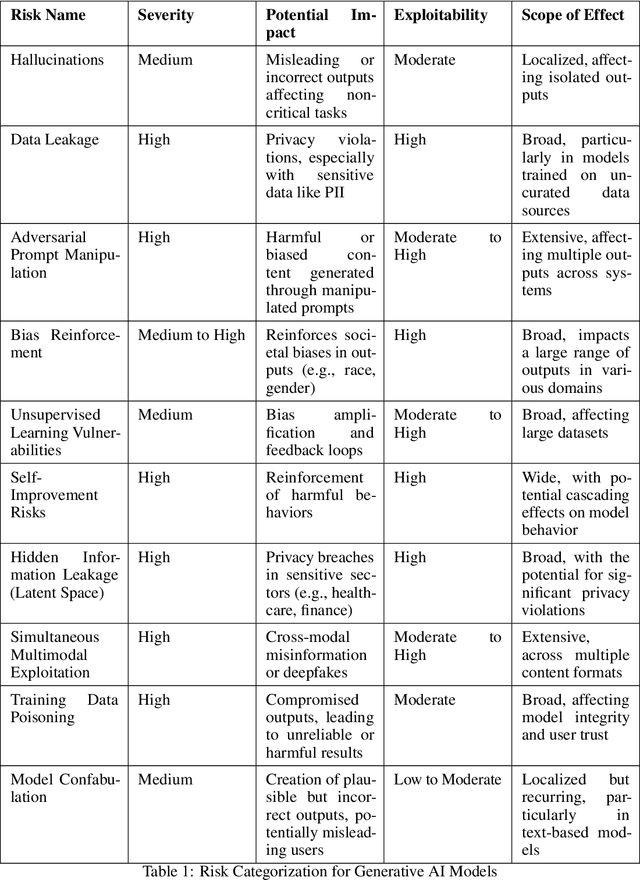
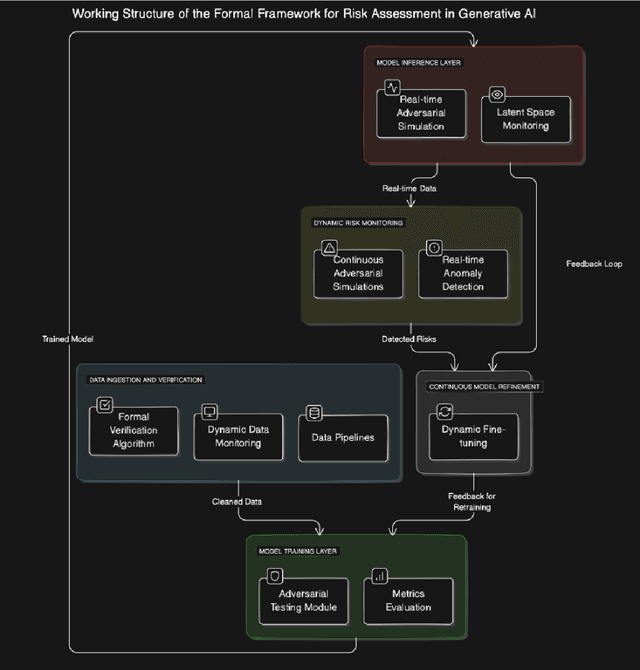
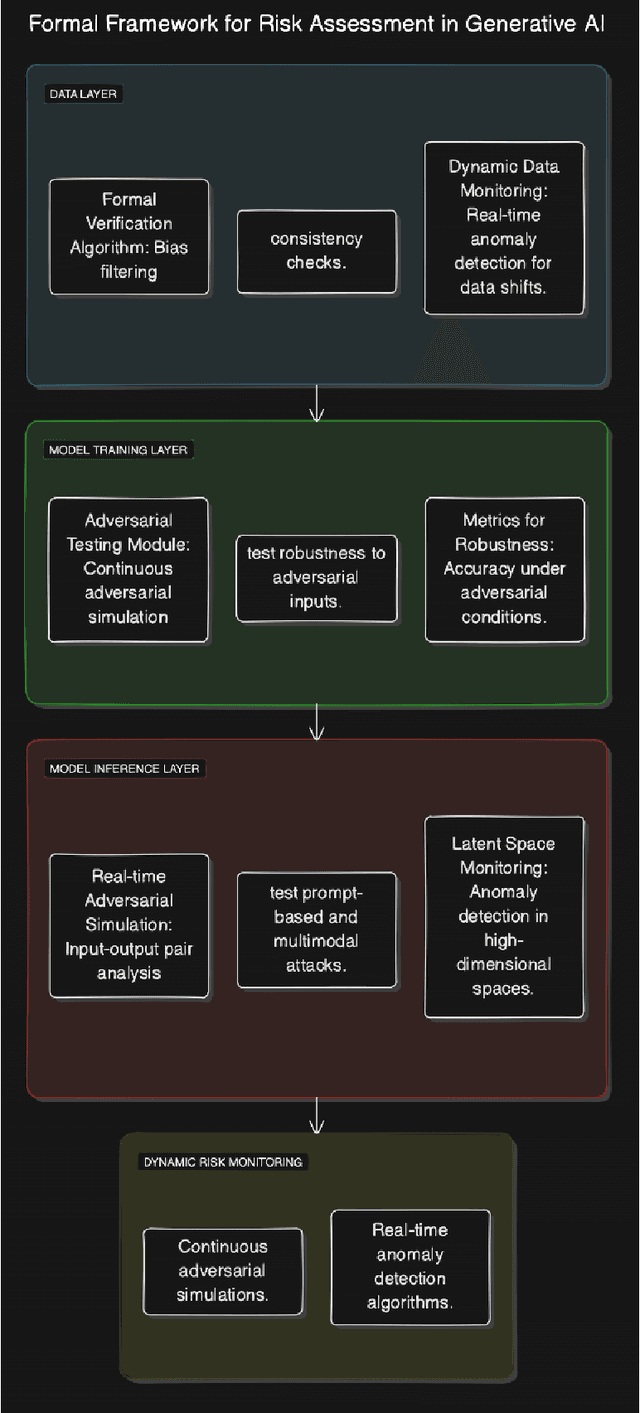
As generative AI systems, including large language models (LLMs) and diffusion models, advance rapidly, their growing adoption has led to new and complex security risks often overlooked in traditional AI risk assessment frameworks. This paper introduces a novel formal framework for categorizing and mitigating these emergent security risks by integrating adaptive, real-time monitoring, and dynamic risk mitigation strategies tailored to generative models' unique vulnerabilities. We identify previously under-explored risks, including latent space exploitation, multi-modal cross-attack vectors, and feedback-loop-induced model degradation. Our framework employs a layered approach, incorporating anomaly detection, continuous red-teaming, and real-time adversarial simulation to mitigate these risks. We focus on formal verification methods to ensure model robustness and scalability in the face of evolving threats. Though theoretical, this work sets the stage for future empirical validation by establishing a detailed methodology and metrics for evaluating the performance of risk mitigation strategies in generative AI systems. This framework addresses existing gaps in AI safety, offering a comprehensive road map for future research and implementation.