 Add to Chrome
 Add to Firefox
 Add to Edge
Quantifying Catastrophic Forgetting in IoT Intrusion Detection Systems
Feb 27, 2026
Distribution shifts in attack patterns within RPL-based IoT networks pose a critical threat to the reliability and security of large-scale connected systems. Intrusion Detection Systems (IDS) trained on static datasets often fail to generalize to unseen threats and suffer from catastrophic forgetting when updated with new attacks. Ensuring continual adaptability of IDS is therefore essential for maintaining robust IoT network defence. In this focused study, we formulate intrusion detection as a domain continual learning problem and propose a method-agnostic IDS framework that can integrate diverse continual learning strategies. We systematically benchmark five representative approaches across multiple domain-ordering sequences using a comprehensive multi-attack dataset comprising 48 domains. Results show that continual learning mitigates catastrophic forgetting while maintaining a balance between plasticity, stability, and efficiency, a crucial aspect for resource-constrained IoT environments. Among the methods, Replay-based approaches achieve the best overall performance, while Synaptic Intelligence (SI) delivers near-zero forgetting with high training efficiency, demonstrating strong potential for stable and sustainable IDS deployment in dynamic IoT networks.

Federated Frank-Wolfe Algorithm
Aug 19, 2024Federated learning (FL) has gained a lot of attention in recent years for building privacy-preserving collaborative learning systems. However, FL algorithms for constrained machine learning problems are still limited, particularly when the projection step is costly. To this end, we propose a Federated Frank-Wolfe Algorithm (FedFW). FedFW features data privacy, low per-iteration cost, and communication of sparse signals. In the deterministic setting, FedFW achieves an $\varepsilon$-suboptimal solution within $O(\varepsilon^{-2})$ iterations for smooth and convex objectives, and $O(\varepsilon^{-3})$ iterations for smooth but non-convex objectives. Furthermore, we present a stochastic variant of FedFW and show that it finds a solution within $O(\varepsilon^{-3})$ iterations in the convex setting. We demonstrate the empirical performance of FedFW on several machine learning tasks.
Personalized Multi-tier Federated Learning
Jul 19, 2024


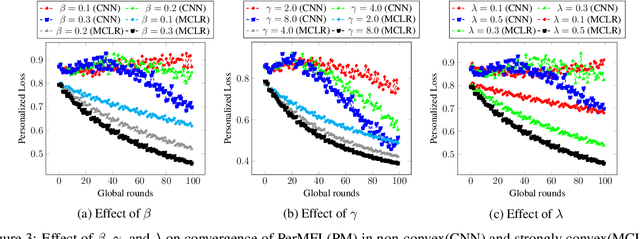
The key challenge of personalized federated learning (PerFL) is to capture the statistical heterogeneity properties of data with inexpensive communications and gain customized performance for participating devices. To address these, we introduced personalized federated learning in multi-tier architecture (PerMFL) to obtain optimized and personalized local models when there are known team structures across devices. We provide theoretical guarantees of PerMFL, which offers linear convergence rates for smooth strongly convex problems and sub-linear convergence rates for smooth non-convex problems. We conduct numerical experiments demonstrating the robust empirical performance of PerMFL, outperforming the state-of-the-art in multiple personalized federated learning tasks.