 Add to Chrome
 Add to Firefox
 Add to Edge
PlantDiseaseNet-RT50: A Fine-tuned ResNet50 Architecture for High-Accuracy Plant Disease Detection Beyond Standard CNNs
Dec 20, 2025
Plant diseases pose a significant threat to agricultural productivity and global food security, accounting for 70-80% of crop losses worldwide. Traditional detection methods rely heavily on expert visual inspection, which is time-consuming, labour-intensive, and often impractical for large-scale farming operations. In this paper, we present PlantDiseaseNet-RT50, a novel fine-tuned deep learning architecture based on ResNet50 for automated plant disease detection. Our model features strategically unfrozen layers, a custom classification head with regularization mechanisms, and dynamic learning rate scheduling through cosine decay. Using a comprehensive dataset of distinct plant disease categories across multiple crop species, PlantDiseaseNet-RT50 achieves exceptional performance with approximately 98% accuracy, precision, and recall. Our architectural modifications and optimization protocol demonstrate how targeted fine-tuning can transform a standard pretrained model into a specialized agricultural diagnostic tool. We provide a detailed account of our methodology, including the systematic unfreezing of terminal layers, implementation of batch normalization and dropout regularization and application of advanced training techniques. PlantDiseaseNet-RT50 represents a significant advancement in AI-driven agricultural tools, offering a computationally efficient solution for rapid and accurate plant disease diagnosis that can be readily implemented in practical farming contexts to support timely interventions and reduce crop losses.
* This work is published in 2025 IEEE International Conference on Advances in Computing Research On Science Engineering and Technology (ACROSET). 6 pages, 2 figures, 2 tables

Factual Inconsistency in Data-to-Text Generation Scales Exponentially with LLM Size: A Statistical Validation
Feb 17, 2025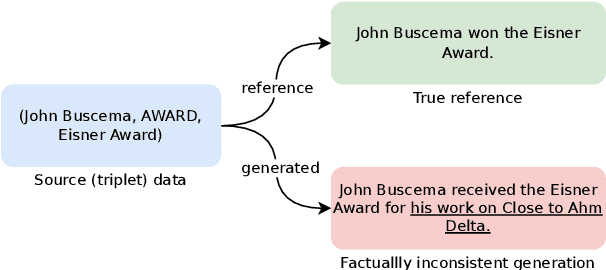
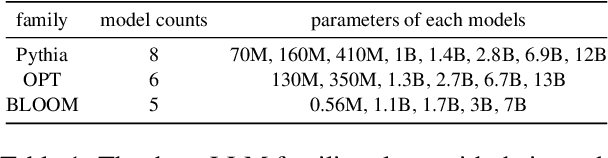
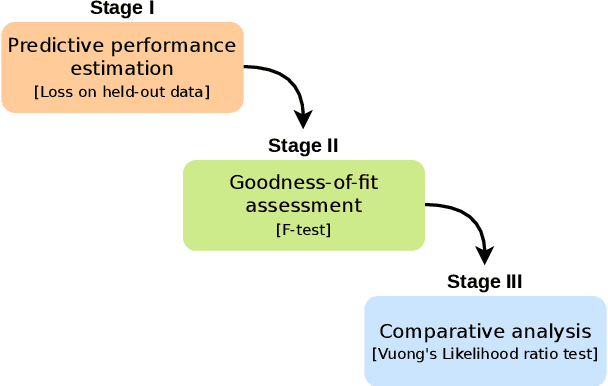
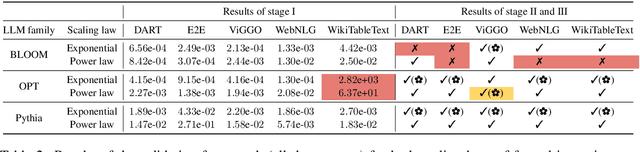
Monitoring factual inconsistency is essential for ensuring trustworthiness in data-to-text generation (D2T). While large language models (LLMs) have demonstrated exceptional performance across various D2T tasks, previous studies on scaling laws have primarily focused on generalization error through power law scaling to LLM size (i.e., the number of model parameters). However, no research has examined the impact of LLM size on factual inconsistency in D2T. In this paper, we investigate how factual inconsistency in D2T scales with LLM size by exploring two scaling laws: power law and exponential scaling. To rigorously evaluate and compare these scaling laws, we employ a statistical validation framework consisting of three key stages: predictive performance estimation, goodness-of-fit assessment, and comparative analysis. For a comprehensive empirical study, we analyze three popular LLM families across five D2T datasets, measuring factual inconsistency inversely using four state-of-the-art consistency metrics. Our findings, based on exhaustive empirical results and validated through our framework, reveal that, contrary to the widely assumed power law scaling, factual inconsistency in D2T follows an exponential scaling with LLM size.