 Add to Chrome
 Add to Firefox
 Add to Edge
Multimodal RGB-HSI Feature Fusion with Patient-Aware Incremental Heuristic Meta-Learning for Oral Lesion Classification
Nov 15, 2025
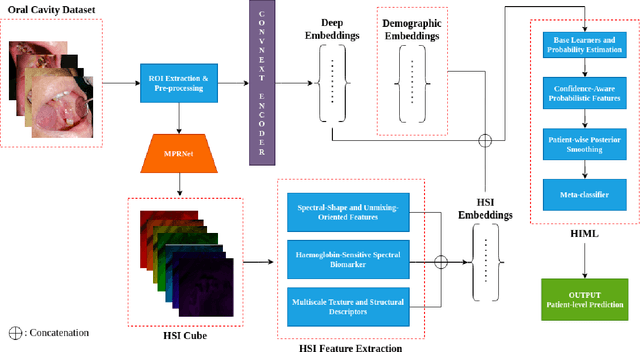
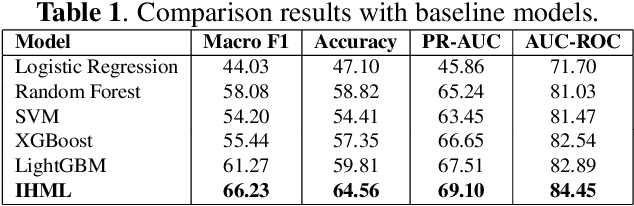
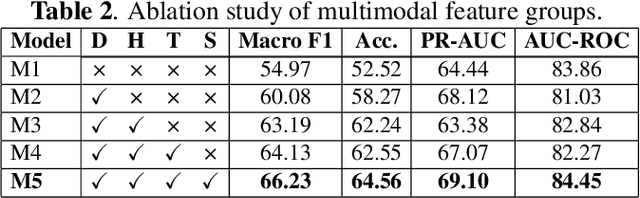
Early detection of oral cancer and potentially malignant disorders is challenging in low-resource settings due to limited annotated data. We present a unified four-class oral lesion classifier that integrates deep RGB embeddings, hyperspectral reconstruction, handcrafted spectral-textural descriptors, and demographic metadata. A pathologist-verified subset of oral cavity images was curated and processed using a fine-tuned ConvNeXt-v2 encoder, followed by RGB-to-HSI reconstruction into 31-band hyperspectral cubes. Haemoglobin-sensitive indices, texture features, and spectral-shape measures were extracted and fused with deep and clinical features. Multiple machine-learning models were assessed with patient-wise validation. We further introduce an incremental heuristic meta-learner (IHML) that combines calibrated base classifiers through probabilistic stacking and patient-level posterior smoothing. On an unseen patient split, the proposed framework achieved a macro F1 of 66.23% and an accuracy of 64.56%. Results demonstrate that hyperspectral reconstruction and uncertainty-aware meta-learning substantially improve robustness for real-world oral lesion screening.

RAA-MIL: A Novel Framework for Classification of Oral Cytology
Nov 15, 2025Cytology is a valuable tool for early detection of oral squamous cell carcinoma (OSCC). However, manual examination of cytology whole slide images (WSIs) is slow, subjective, and depends heavily on expert pathologists. To address this, we introduce the first weakly supervised deep learning framework for patient-level diagnosis of oral cytology whole slide images, leveraging the newly released Oral Cytology Dataset [1], which provides annotated cytology WSIs from ten medical centres across India. Each patient case is represented as a bag of cytology patches and assigned a diagnosis label (Healthy, Benign, Oral Potentially Malignant Disorders (OPMD), OSCC) by an in-house expert pathologist. These patient-level weak labels form a new extension to the dataset. We evaluate a baseline multiple-instance learning (MIL) model and a proposed Region-Affinity Attention MIL (RAA-MIL) that models spatial relationships between regions within each slide. The RAA-MIL achieves an average accuracy of 72.7%, weighted F1-score of 0.69 on an unseen test set, outperforming the baseline. This study establishes the first patient-level weakly supervised benchmark for oral cytology and moves toward reliable AI-assisted digital pathology.
Graph Guided Modulo Recovery of EEG Signals
Oct 30, 2025Electroencephalography (EEG) often shows significant variability among people. This fluctuation disrupts reliable acquisition and may result in distortion or clipping. Modulo sampling is now a promising solution to this problem, by folding signals instead of saturating them. Recovery of the original waveform from folded observations is a highly ill-posed problem. In this work, we propose a method based on a graph neural network, referred to as GraphUnwrapNet, for the modulo recovery of EEG signals. Our core idea is to represent an EEG signal as an organized graph whose channels and temporal connections establish underlying interdependence. One of our key contributions is in introducing a pre-estimation guided feature injection module to provide coarse folding indicators that enhance stability during recovery at wrap boundaries. This design integrates structural information with folding priors into an integrated framework. We performed comprehensive experiments on the Simultaneous Task EEG Workload (STEW) dataset. The results demonstrate consistent enhancements over traditional optimization techniques and competitive accuracy relative to current deep learning models. Our findings emphasize the potential of graph-based methodology for robust modulo EEG recovery.