 Add to Chrome
 Add to Firefox
 Add to Edge
Dichotomy of Feature Learning and Unlearning: Fast-Slow Analysis on Neural Networks with Stochastic Gradient Descent
Feb 07, 2026
The dynamics of gradient-based training in neural networks often exhibit nontrivial structures; hence, understanding them remains a central challenge in theoretical machine learning. In particular, a concept of feature unlearning, in which a neural network progressively loses previously learned features over long training, has gained attention. In this study, we consider the infinite-width limit of a two-layer neural network updated with a large-batch stochastic gradient, then derive differential equations with different time scales, revealing the mechanism and conditions for feature unlearning to occur. Specifically, we utilize the fast-slow dynamics: while an alignment of first-layer weights develops rapidly, the second-layer weights develop slowly. The direction of a flow on a critical manifold, determined by the slow dynamics, decides whether feature unlearning occurs. We give numerical validation of the result, and derive theoretical grounding and scaling laws of the feature unlearning. Our results yield the following insights: (i) the strength of the primary nonlinear term in data induces the feature unlearning, and (ii) an initial scale of the second-layer weights mitigates the feature unlearning. Technically, our analysis utilizes Tensor Programs and the singular perturbation theory.

High-Dimensional Limit of Stochastic Gradient Flow via Dynamical Mean-Field Theory
Feb 06, 2026Modern machine learning models are typically trained via multi-pass stochastic gradient descent (SGD) with small batch sizes, and understanding their dynamics in high dimensions is of great interest. However, an analytical framework for describing the high-dimensional asymptotic behavior of multi-pass SGD with small batch sizes for nonlinear models is currently missing. In this study, we address this gap by analyzing the high-dimensional dynamics of a stochastic differential equation called a \emph{stochastic gradient flow} (SGF), which approximates multi-pass SGD in this regime. In the limit where the number of data samples $n$ and the dimension $d$ grow proportionally, we derive a closed system of low-dimensional and continuous-time equations and prove that it characterizes the asymptotic distribution of the SGF parameters. Our theory is based on the dynamical mean-field theory (DMFT) and is applicable to a wide range of models encompassing generalized linear models and two-layer neural networks. We further show that the resulting DMFT equations recover several existing high-dimensional descriptions of SGD dynamics as special cases, thereby providing a unifying perspective on prior frameworks such as online SGD and high-dimensional linear regression. Our proof builds on the existing DMFT technique for gradient flow and extends it to handle the stochasticity in SGF using tools from stochastic calculus.
Precise Dynamics of Diagonal Linear Networks: A Unifying Analysis by Dynamical Mean-Field Theory
Oct 02, 2025Diagonal linear networks (DLNs) are a tractable model that captures several nontrivial behaviors in neural network training, such as initialization-dependent solutions and incremental learning. These phenomena are typically studied in isolation, leaving the overall dynamics insufficiently understood. In this work, we present a unified analysis of various phenomena in the gradient flow dynamics of DLNs. Using Dynamical Mean-Field Theory (DMFT), we derive a low-dimensional effective process that captures the asymptotic gradient flow dynamics in high dimensions. Analyzing this effective process yields new insights into DLN dynamics, including loss convergence rates and their trade-off with generalization, and systematically reproduces many of the previously observed phenomena. These findings deepen our understanding of DLNs and demonstrate the effectiveness of the DMFT approach in analyzing high-dimensional learning dynamics of neural networks.
Solution space and storage capacity of fully connected two-layer neural networks with generic activation functions
Apr 20, 2024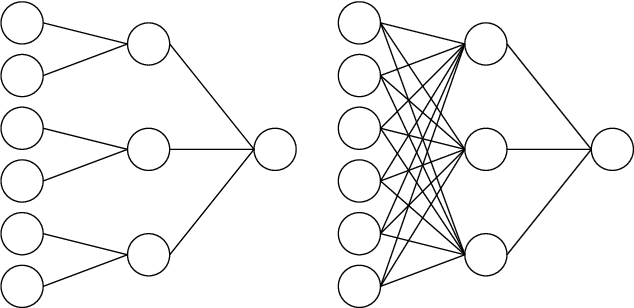
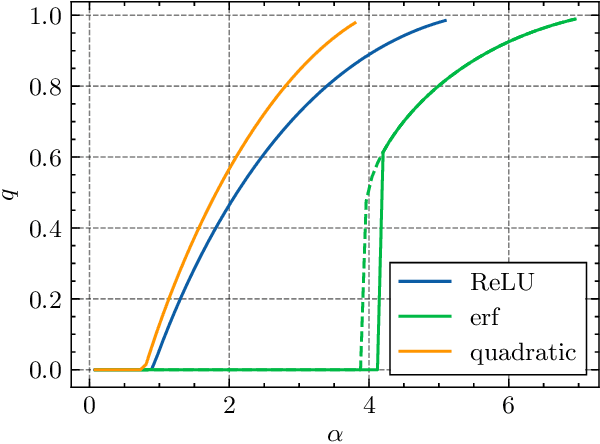
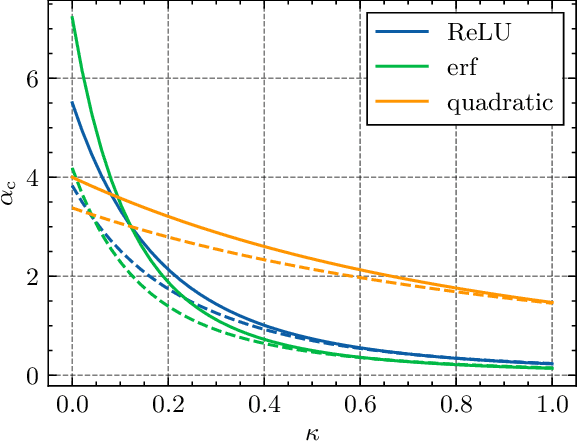
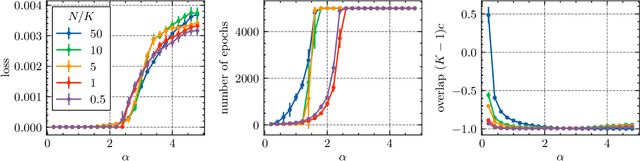
The storage capacity of a binary classification model is the maximum number of random input-output pairs per parameter that the model can learn. It is one of the indicators of the expressive power of machine learning models and is important for comparing the performance of various models. In this study, we analyze the structure of the solution space and the storage capacity of fully connected two-layer neural networks with general activation functions using the replica method from statistical physics. Our results demonstrate that the storage capacity per parameter remains finite even with infinite width and that the weights of the network exhibit negative correlations, leading to a 'division of labor'. In addition, we find that increasing the dataset size triggers a phase transition at a certain transition point where the permutation symmetry of weights is broken, resulting in the solution space splitting into disjoint regions. We identify the dependence of this transition point and the storage capacity on the choice of activation function. These findings contribute to understanding the influence of activation functions and the number of parameters on the structure of the solution space, potentially offering insights for selecting appropriate architectures based on specific objectives.