 Add to Chrome
 Add to Firefox
 Add to Edge
SCALE: Semantic- and Confidence-Aware Conditional Variational Autoencoder for Zero-shot Skeleton-based Action Recognition
Apr 02, 2026
Zero-shot skeleton-based action recognition (ZSAR) aims to recognize action classes without any training skeletons from those classes, relying instead on auxiliary semantics from text. Existing approaches frequently depend on explicit skeleton-text alignment, which can be brittle when action names underspecify fine-grained dynamics and when unseen classes are semantically confusable. We propose SCALE, a lightweight and deterministic Semantic- and Confidence-Aware Listwise Energy-based framework that formulates ZSAR as class-conditional energy ranking. SCALE builds a text-conditioned Conditional Variational Autoencoder where frozen text representations parameterize both the latent prior and the decoder, enabling likelihood-based evaluation for unseen classes without generating samples at test time. To separate competing hypotheses, we introduce a semantic- and confidence-aware listwise energy loss that emphasizes semantically similar hard negatives and incorporates posterior uncertainty to adapt decision margins and reweight ambiguous training instances. Additionally, we utilize a latent prototype contrast objective to align posterior means with text-derived latent prototypes, improving semantic organization and class separability without direct feature matching. Experiments on NTU-60 and NTU-120 datasets show that SCALE consistently improves over prior VAE- and alignment-based baselines while remaining competitive with diffusion-based methods.

LSTC-MDA: A Unified Framework for Long-Short Term Temporal Convolution and Mixed Data Augmentation in Skeleton-Based Action Recognition
Sep 18, 2025Skeleton-based action recognition faces two longstanding challenges: the scarcity of labeled training samples and difficulty modeling short- and long-range temporal dependencies. To address these issues, we propose a unified framework, LSTC-MDA, which simultaneously improves temporal modeling and data diversity. We introduce a novel Long-Short Term Temporal Convolution (LSTC) module with parallel short- and long-term branches, these two feature branches are then aligned and fused adaptively using learned similarity weights to preserve critical long-range cues lost by conventional stride-2 temporal convolutions. We also extend Joint Mixing Data Augmentation (JMDA) with an Additive Mixup at the input level, diversifying training samples and restricting mixup operations to the same camera view to avoid distribution shifts. Ablation studies confirm each component contributes. LSTC-MDA achieves state-of-the-art results: 94.1% and 97.5% on NTU 60 (X-Sub and X-View), 90.4% and 92.0% on NTU 120 (X-Sub and X-Set),97.2% on NW-UCLA. Code: https://github.com/xiaobaoxia/LSTC-MDA.
LORTSAR: Low-Rank Transformer for Skeleton-based Action Recognition
Jul 19, 2024
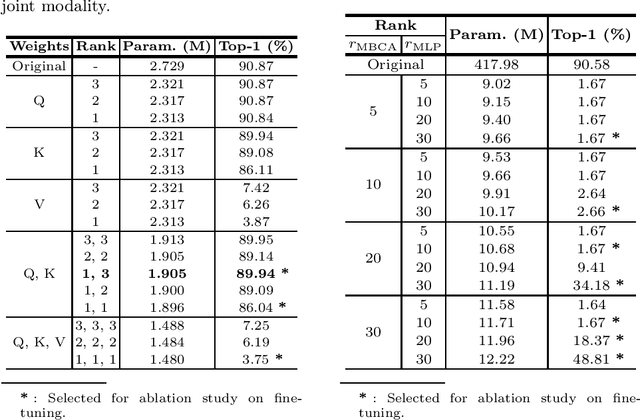
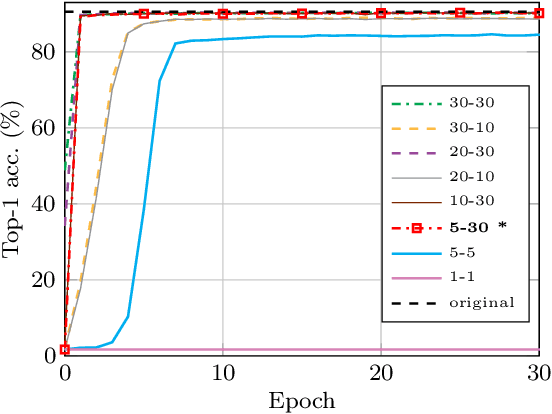
The complexity of state-of-the-art Transformer-based models for skeleton-based action recognition poses significant challenges in terms of computational efficiency and resource utilization. In this paper, we explore the application of Singular Value Decomposition (SVD) to effectively reduce the model sizes of these pre-trained models, aiming to minimize their resource consumption while preserving accuracy. Our method, LORTSAR (LOw-Rank Transformer for Skeleton-based Action Recognition), also includes a fine-tuning step to compensate for any potential accuracy degradation caused by model compression, and is applied to two leading Transformer-based models, "Hyperformer" and "STEP-CATFormer". Experimental results on the "NTU RGB+D" and "NTU RGB+D 120" datasets show that our method can reduce the number of model parameters substantially with negligible degradation or even performance increase in recognition accuracy. This confirms that SVD combined with post-compression fine-tuning can boost model efficiency, paving the way for more sustainable, lightweight, and high-performance technologies in human action recognition.