 Add to Chrome
 Add to Firefox
 Add to Edge
GPU-friendly and Linearly Convergent First-order Methods for Certifying Optimal $k$-sparse GLMs
Mar 01, 2026
We investigate the problem of certifying optimality for sparse generalized linear models (GLMs), where sparsity is enforced through a cardinality constraint. While Branch-and-Bound (BnB) frameworks can certify optimality using perspective relaxations, existing methods for solving these relaxations are computationally intensive, limiting their scalability. To address this challenge, we reformulate the relaxations as composite optimization problems and develop a unified proximal framework that is both linearly convergent and computationally efficient. Under specific geometric regularity conditions, our analysis links primal quadratic growth to dual quadratic decay, yielding error bounds that make the Fenchel duality gap a sharp proxy for progress towards the solution set. This leads to a duality gap-based restart scheme that upgrades a broad class of sublinear proximal methods to provably linearly convergent methods, and applies beyond the sparse GLM setting. For the implicit perspective regularizer, we further derive specialized routines to evaluate the regularizer and its proximal operator exactly in log-linear time, avoiding costly generic conic solvers. The resulting iterations are dominated by matrix--vector multiplications, which enables GPU acceleration. Experiments on synthetic and real-world datasets show orders-of-magnitude faster dual-bound computations and substantially improved BnB scalability on large instances.

Wasserstein Distributionally Robust Online Learning
Feb 23, 2026We study distributionally robust online learning, where a risk-averse learner updates decisions sequentially to guard against worst-case distributions drawn from a Wasserstein ambiguity set centered at past observations. While this paradigm is well understood in the offline setting through Wasserstein Distributionally Robust Optimization (DRO), its online extension poses significant challenges in both convergence and computation. In this paper, we address these challenges. First, we formulate the problem as an online saddle-point stochastic game between a decision maker and an adversary selecting worst-case distributions, and propose a general framework that converges to a robust Nash equilibrium coinciding with the solution of the corresponding offline Wasserstein DRO problem. Second, we address the main computational bottleneck, which is the repeated solution of worst-case expectation problems. For the important class of piecewise concave loss functions, we propose a tailored algorithm that exploits problem geometry to achieve substantial speedups over state-of-the-art solvers such as Gurobi. The key insight is a novel connection between the worst-case expectation problem, an inherently infinite-dimensional optimization problem, and a classical and tractable budget allocation problem, which is of independent interest.
Scalable First-order Method for Certifying Optimal k-Sparse GLMs
Feb 13, 2025This paper investigates the problem of certifying optimality for sparse generalized linear models (GLMs), where sparsity is enforced through an $\ell_0$ cardinality constraint. While branch-and-bound (BnB) frameworks can certify optimality by pruning nodes using dual bounds, existing methods for computing these bounds are either computationally intensive or exhibit slow convergence, limiting their scalability to large-scale problems. To address this challenge, we propose a first-order proximal gradient algorithm designed to solve the perspective relaxation of the problem within a BnB framework. Specifically, we formulate the relaxed problem as a composite optimization problem and demonstrate that the proximal operator of the non-smooth component can be computed exactly in log-linear time complexity, eliminating the need to solve a computationally expensive second-order cone program. Furthermore, we introduce a simple restart strategy that enhances convergence speed while maintaining low per-iteration complexity. Extensive experiments on synthetic and real-world datasets show that our approach significantly accelerates dual bound computations and is highly effective in providing optimality certificates for large-scale problems.
Robust Distribution Learning with Local and Global Adversarial Corruptions
Jun 10, 2024We consider learning in an adversarial environment, where an $\varepsilon$-fraction of samples from a distribution $P$ are arbitrarily modified (*global* corruptions) and the remaining perturbations have average magnitude bounded by $\rho$ (*local* corruptions). Given access to $n$ such corrupted samples, we seek a computationally efficient estimator $\hat{P}_n$ that minimizes the Wasserstein distance $\mathsf{W}_1(\hat{P}_n,P)$. In fact, we attack the fine-grained task of minimizing $\mathsf{W}_1(\Pi_\# \hat{P}_n, \Pi_\# P)$ for all orthogonal projections $\Pi \in \mathbb{R}^{d \times d}$, with performance scaling with $\mathrm{rank}(\Pi) = k$. This allows us to account simultaneously for mean estimation ($k=1$), distribution estimation ($k=d$), as well as the settings interpolating between these two extremes. We characterize the optimal population-limit risk for this task and then develop an efficient finite-sample algorithm with error bounded by $\sqrt{\varepsilon k} + \rho + d^{O(1)}\tilde{O}(n^{-1/k})$ when $P$ has bounded moments of order $2+\delta$, for constant $\delta > 0$. For data distributions with bounded covariance, our finite-sample bounds match the minimax population-level optimum for large sample sizes. Our efficient procedure relies on a novel trace norm approximation of an ideal yet intractable 2-Wasserstein projection estimator. We apply this algorithm to robust stochastic optimization, and, in the process, uncover a new method for overcoming the curse of dimensionality in Wasserstein distributionally robust optimization.
Outlier-Robust Wasserstein DRO
Nov 09, 2023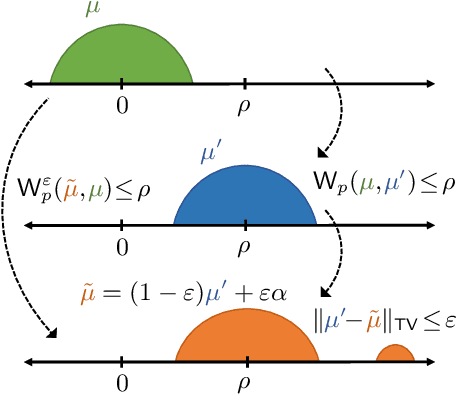
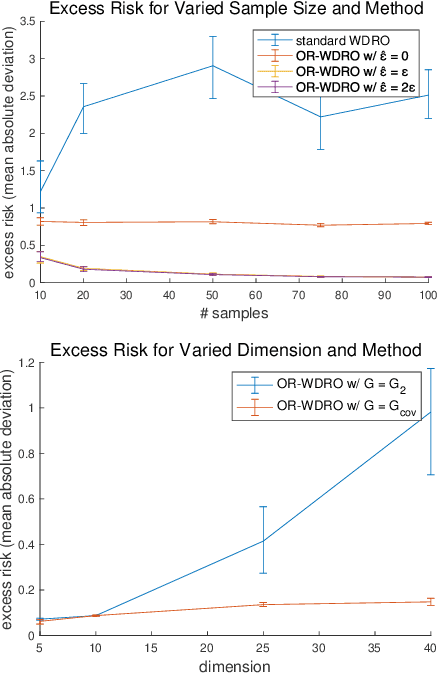
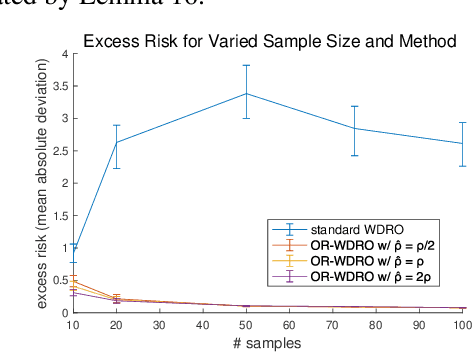
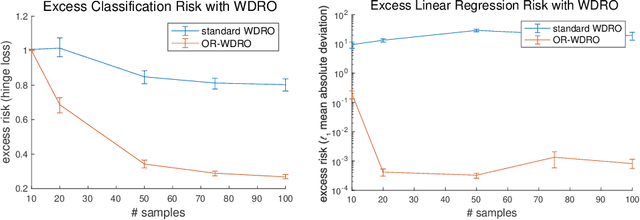
Distributionally robust optimization (DRO) is an effective approach for data-driven decision-making in the presence of uncertainty. Geometric uncertainty due to sampling or localized perturbations of data points is captured by Wasserstein DRO (WDRO), which seeks to learn a model that performs uniformly well over a Wasserstein ball centered around the observed data distribution. However, WDRO fails to account for non-geometric perturbations such as adversarial outliers, which can greatly distort the Wasserstein distance measurement and impede the learned model. We address this gap by proposing a novel outlier-robust WDRO framework for decision-making under both geometric (Wasserstein) perturbations and non-geometric (total variation (TV)) contamination that allows an $\varepsilon$-fraction of data to be arbitrarily corrupted. We design an uncertainty set using a certain robust Wasserstein ball that accounts for both perturbation types and derive minimax optimal excess risk bounds for this procedure that explicitly capture the Wasserstein and TV risks. We prove a strong duality result that enables tractable convex reformulations and efficient computation of our outlier-robust WDRO problem. When the loss function depends only on low-dimensional features of the data, we eliminate certain dimension dependencies from the risk bounds that are unavoidable in the general setting. Finally, we present experiments validating our theory on standard regression and classification tasks.