 Add to Chrome
 Add to Firefox
 Add to Edge
Wasserstein Distributionally Robust Online Learning
Feb 23, 2026
We study distributionally robust online learning, where a risk-averse learner updates decisions sequentially to guard against worst-case distributions drawn from a Wasserstein ambiguity set centered at past observations. While this paradigm is well understood in the offline setting through Wasserstein Distributionally Robust Optimization (DRO), its online extension poses significant challenges in both convergence and computation. In this paper, we address these challenges. First, we formulate the problem as an online saddle-point stochastic game between a decision maker and an adversary selecting worst-case distributions, and propose a general framework that converges to a robust Nash equilibrium coinciding with the solution of the corresponding offline Wasserstein DRO problem. Second, we address the main computational bottleneck, which is the repeated solution of worst-case expectation problems. For the important class of piecewise concave loss functions, we propose a tailored algorithm that exploits problem geometry to achieve substantial speedups over state-of-the-art solvers such as Gurobi. The key insight is a novel connection between the worst-case expectation problem, an inherently infinite-dimensional optimization problem, and a classical and tractable budget allocation problem, which is of independent interest.

RANSAC Revisited: An Improved Algorithm for Robust Subspace Recovery under Adversarial and Noisy Corruptions
Apr 13, 2025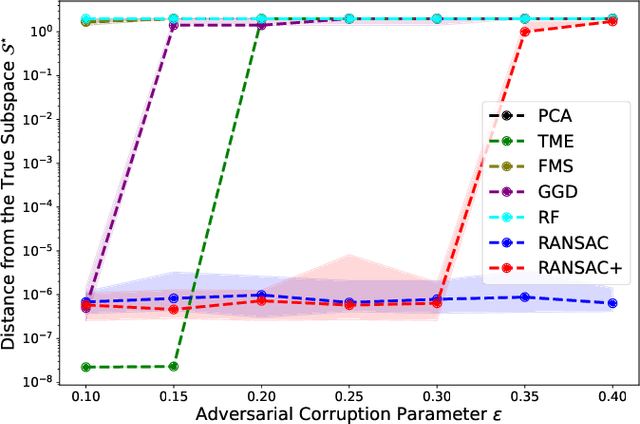
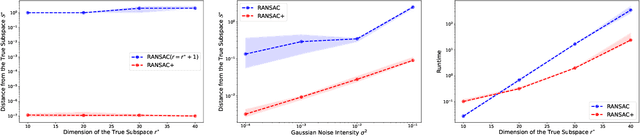
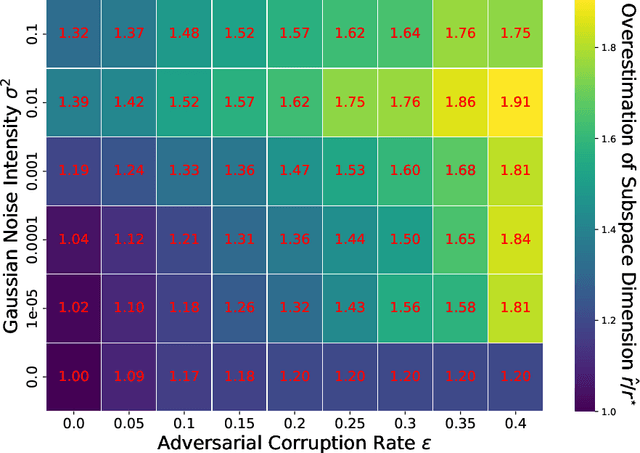
In this paper, we study the problem of robust subspace recovery (RSR) in the presence of both strong adversarial corruptions and Gaussian noise. Specifically, given a limited number of noisy samples -- some of which are tampered by an adaptive and strong adversary -- we aim to recover a low-dimensional subspace that approximately contains a significant fraction of the uncorrupted samples, up to an error that scales with the Gaussian noise. Existing approaches to this problem often suffer from high computational costs or rely on restrictive distributional assumptions, limiting their applicability in truly adversarial settings. To address these challenges, we revisit the classical random sample consensus (RANSAC) algorithm, which offers strong robustness to adversarial outliers, but sacrifices efficiency and robustness against Gaussian noise and model misspecification in the process. We propose a two-stage algorithm, RANSAC+, that precisely pinpoints and remedies the failure modes of standard RANSAC. Our method is provably robust to both Gaussian and adversarial corruptions, achieves near-optimal sample complexity without requiring prior knowledge of the subspace dimension, and is more efficient than existing RANSAC-type methods.