 Add to Chrome
 Add to Firefox
 Add to Edge
GaussianPOP: Principled Simplification Framework for Compact 3D Gaussian Splatting via Error Quantification
Feb 06, 2026
Existing 3D Gaussian Splatting simplification methods commonly use importance scores, such as blending weights or sensitivity, to identify redundant Gaussians. However, these scores are not driven by visual error metrics, often leading to suboptimal trade-offs between compactness and rendering fidelity. We present GaussianPOP, a principled simplification framework based on analytical Gaussian error quantification. Our key contribution is a novel error criterion, derived directly from the 3DGS rendering equation, that precisely measures each Gaussian's contribution to the rendered image. By introducing a highly efficient algorithm, our framework enables practical error calculation in a single forward pass. The framework is both accurate and flexible, supporting on-training pruning as well as post-training simplification via iterative error re-quantification for improved stability. Experimental results show that our method consistently outperforms existing state-of-the-art pruning methods across both application scenarios, achieving a superior trade-off between model compactness and high rendering quality.

Compression of 3D Gaussian Splatting with Optimized Feature Planes and Standard Video Codecs
Jan 06, 2025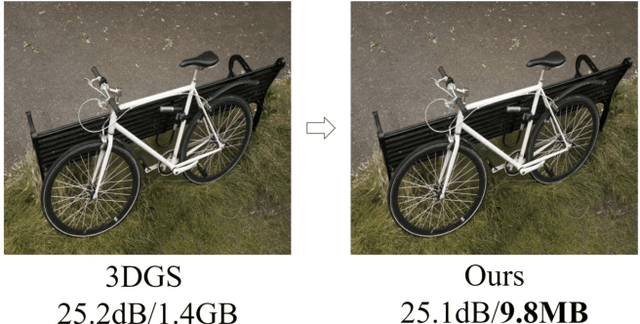
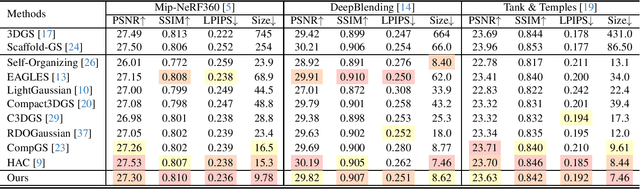
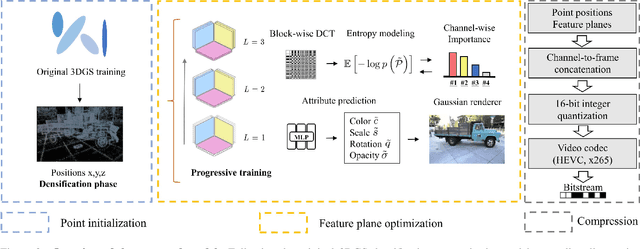
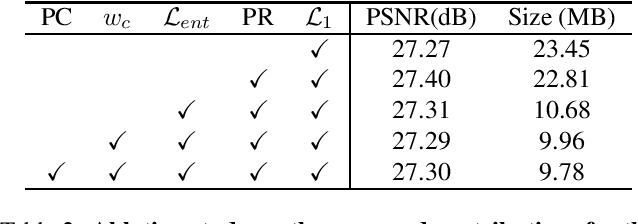
3D Gaussian Splatting is a recognized method for 3D scene representation, known for its high rendering quality and speed. However, its substantial data requirements present challenges for practical applications. In this paper, we introduce an efficient compression technique that significantly reduces storage overhead by using compact representation. We propose a unified architecture that combines point cloud data and feature planes through a progressive tri-plane structure. Our method utilizes 2D feature planes, enabling continuous spatial representation. To further optimize these representations, we incorporate entropy modeling in the frequency domain, specifically designed for standard video codecs. We also propose channel-wise bit allocation to achieve a better trade-off between bitrate consumption and feature plane representation. Consequently, our model effectively leverages spatial correlations within the feature planes to enhance rate-distortion performance using standard, non-differentiable video codecs. Experimental results demonstrate that our method outperforms existing methods in data compactness while maintaining high rendering quality. Our project page is available at https://fraunhoferhhi.github.io/CodecGS
ECRF: Entropy-Constrained Neural Radiance Fields Compression with Frequency Domain Optimization
Nov 23, 2023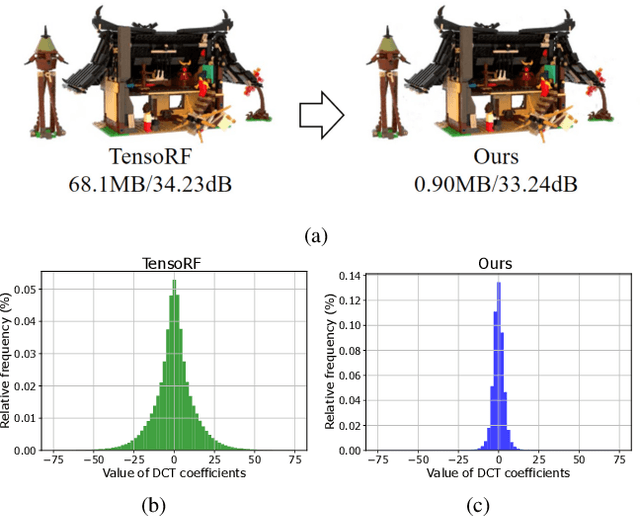
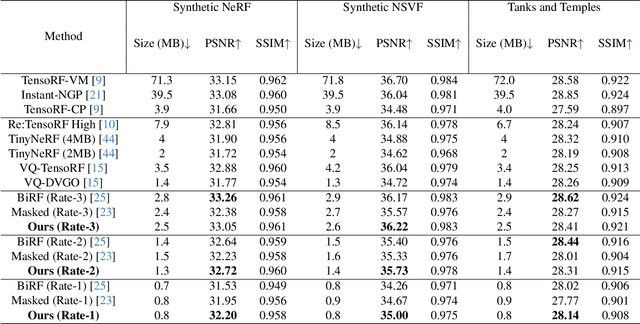
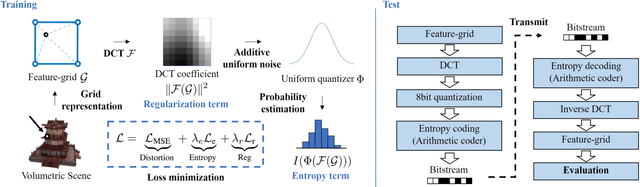
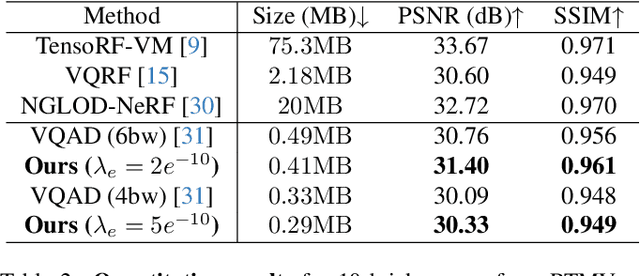
Explicit feature-grid based NeRF models have shown promising results in terms of rendering quality and significant speed-up in training. However, these methods often require a significant amount of data to represent a single scene or object. In this work, we present a compression model that aims to minimize the entropy in the frequency domain in order to effectively reduce the data size. First, we propose using the discrete cosine transform (DCT) on the tensorial radiance fields to compress the feature-grid. This feature-grid is transformed into coefficients, which are then quantized and entropy encoded, following a similar approach to the traditional video coding pipeline. Furthermore, to achieve a higher level of sparsity, we propose using an entropy parameterization technique for the frequency domain, specifically for DCT coefficients of the feature-grid. Since the transformed coefficients are optimized during the training phase, the proposed model does not require any fine-tuning or additional information. Our model only requires a lightweight compression pipeline for encoding and decoding, making it easier to apply volumetric radiance field methods for real-world applications. Experimental results demonstrate that our proposed frequency domain entropy model can achieve superior compression performance across various datasets. The source code will be made publicly available.