 Add to Chrome
 Add to Firefox
 Add to Edge
ImpactHO: Importance-Aware KV Cache Transfer for Multi-User Edge LLM Handover
Aug 11, 2026
Edge LLMs must preserve inference continuity when a user hands over between edge nodes, requiring key-value (KV) cache transfer to the target node. However, simultaneous handovers saturate the backhaul, preventing full cache delivery within the mobility-imposed transfer window. Rather than allocating bandwidth as if all cache entries were equally valuable, we order each user's KV cache by importance and transmit only its most informative fraction, turning token-level sparsity into communication savings. We cast the transfer as a multi-user backhaul allocation problem that maximizes average accuracy across users. Each user's partial-cache accuracy serves as its utility: a sigmoid that fits measurements on the RULER benchmark with $R^2>0.99$ across models and context lengths. Because importance ordering front-loads the high-value entries, the concave region of the accuracy curve spans nearly the entire cache. Our proposed allocator keeps served users within this region, making each per-slot allocation problem convex. The optimum is derived via a closed-form weighted water-filling solution that generalizes information-theoretic water-filling and enables online scheduling. The proposed allocator attains over 93.7% average accuracy in a 500ms transfer window, within 0.5pp of the full-cache ceiling, and reaches 98.2-99.5% of a clairvoyant upper bound.

Collaborative Edge-to-Server Inference for Vision-Language Models
Dec 18, 2025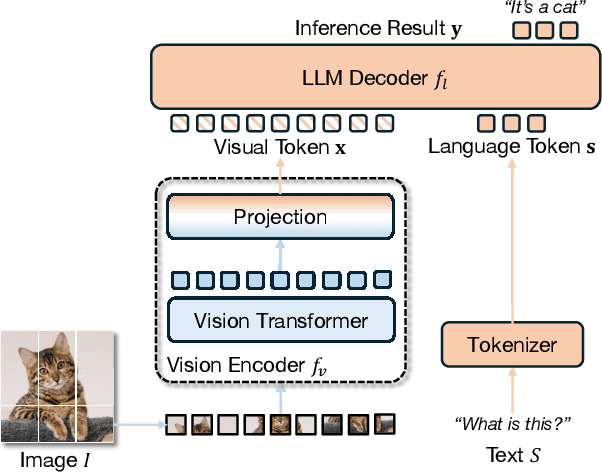
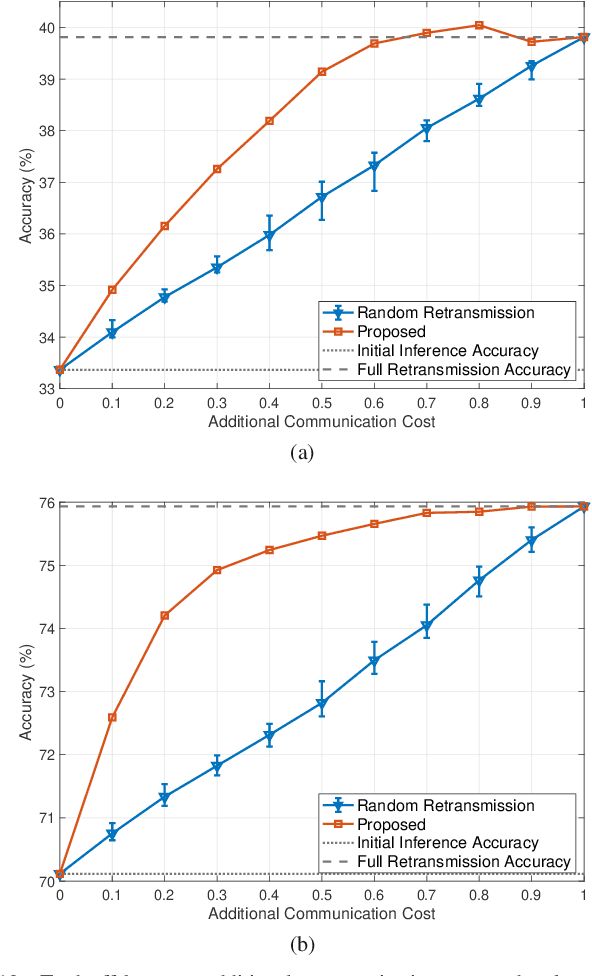

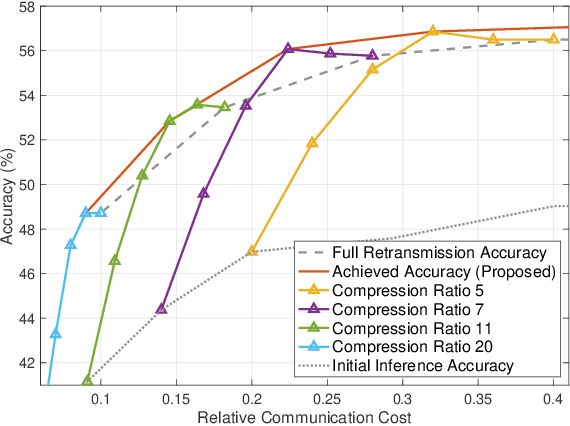
We propose a collaborative edge-to-server inference framework for vision-language models (VLMs) that reduces the communication cost while maintaining inference accuracy. In typical deployments, visual data captured at edge devices (clients) is transmitted to the server for VLM inference. However, resizing the original image (global image) to match the vision encoder's input resolution often discards fine-grained details, leading to accuracy degradation. To overcome this limitation, we design a two-stage framework. In the first stage, the server performs inference on the global image and identifies a region of interest (RoI) using the VLM's internal attention. The min-entropy of the output tokens is then computed as a confidence measure to determine whether retransmission is required. If the min-entropy exceeds a predefined threshold, the server requests the edge device to send a detail-preserved local image of the RoI. The server then refines its inference by jointly leveraging the global and local images. This selective retransmission strategy ensures that only essential visual content is transmitted. Experiments across multiple VLM architectures show that the proposed framework significantly reduces communication cost while maintaining inference accuracy.