 Add to Chrome
 Add to Firefox
 Add to Edge
"Oops! ChatGPT is Temporarily Unavailable!": A Diary Study on Knowledge Workers' Experiences of LLM Withdrawal
Mar 27, 2026
LLMs have become deeply embedded in knowledge work, raising concerns about growing dependency and the potential undermining of human skills. To investigate the pervasiveness of LLMs in work practices, we conducted a four-day diary study with frequent LLM users (N=10), observing how knowledge workers responded to a temporary withdrawal of LLMs. Our findings show how LLM withdrawal disrupted participants' workflows by identifying gaps in task execution, how self-directed work led participants to reclaim professional values, and how everyday practices revealed the extent to which LLM use had become inescapably normative. Conceptualizing LLMs as infrastructural to contemporary knowledge work, this research contributes empirical insights into the often invisible role of LLMs and proposes value-driven appropriation as an approach to supporting professional values in the current LLM-pervasive work environment.

Identity-preserving Distillation Sampling by Fixed-Point Iterator
Feb 27, 2025Score distillation sampling (SDS) demonstrates a powerful capability for text-conditioned 2D image and 3D object generation by distilling the knowledge from learned score functions. However, SDS often suffers from blurriness caused by noisy gradients. When SDS meets the image editing, such degradations can be reduced by adjusting bias shifts using reference pairs, but the de-biasing techniques are still corrupted by erroneous gradients. To this end, we introduce Identity-preserving Distillation Sampling (IDS), which compensates for the gradient leading to undesired changes in the results. Based on the analysis that these errors come from the text-conditioned scores, a new regularization technique, called fixed-point iterative regularization (FPR), is proposed to modify the score itself, driving the preservation of the identity even including poses and structures. Thanks to a self-correction by FPR, the proposed method provides clear and unambiguous representations corresponding to the given prompts in image-to-image editing and editable neural radiance field (NeRF). The structural consistency between the source and the edited data is obviously maintained compared to other state-of-the-art methods.
Reimagining Personal Data: Unlocking the Potential of AI-Generated Images in Personal Data Meaning-Making
Feb 26, 2025
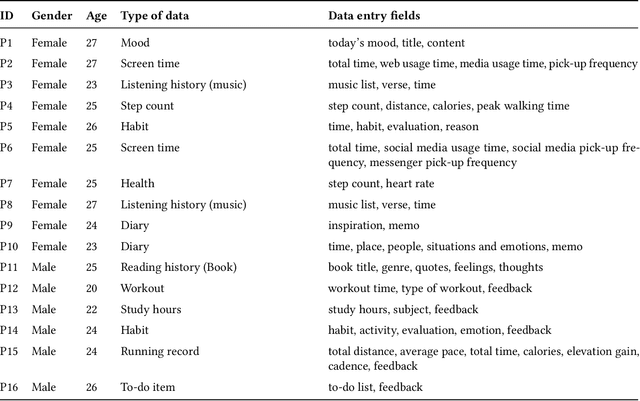

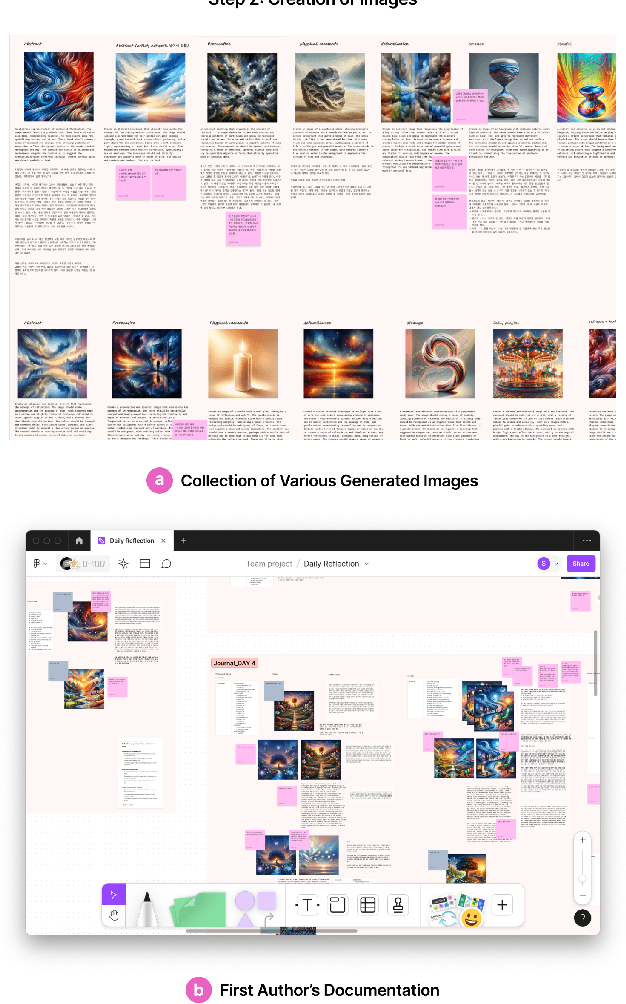
Image-generative AI provides new opportunities to transform personal data into alternative visual forms. In this paper, we illustrate the potential of AI-generated images in facilitating meaningful engagement with personal data. In a formative autobiographical design study, we explored the design and use of AI-generated images derived from personal data. Informed by this study, we designed a web-based application as a probe that represents personal data through generative images utilizing Open AI's GPT-4 model and DALL-E 3. We then conducted a 21-day diary study and interviews using the probe with 16 participants to investigate users' in-depth experiences with images generated by AI in everyday lives. Our findings reveal new qualities of experiences in users' engagement with data, highlighting how participants constructed personal meaning from their data through imagination and speculation on AI-generated images. We conclude by discussing the potential and concerns of leveraging image-generative AI for personal data meaning-making.