 Add to Chrome
 Add to Firefox
 Add to Edge
LOREN: Low Rank-Based Code-Rate Adaptation in Neural Receivers
Feb 11, 2026
Neural network based receivers have recently demonstrated superior system-level performance compared to traditional receivers. However, their practicality is limited by high memory and power requirements, as separate weight sets must be stored for each code rate. To address this challenge, we propose LOREN, a Low Rank-Based Code-Rate Adaptation Neural Receiver that achieves adaptability with minimal overhead. LOREN integrates lightweight low rank adaptation adapters (LOREN adapters) into convolutional layers, freezing a shared base network while training only small adapters per code rate. An end-to-end training framework over 3GPP CDL channels ensures robustness across realistic wireless environments. LOREN achieves comparable or superior performance relative to fully retrained base neural receivers. The hardware implementation of LOREN in 22nm technology shows more than 65% savings in silicon area and up to 15% power reduction when supporting three code rates.

Reliability Modeling for Beyond-5G Mission Critical Networks Using Effective Capacity
Jan 31, 2025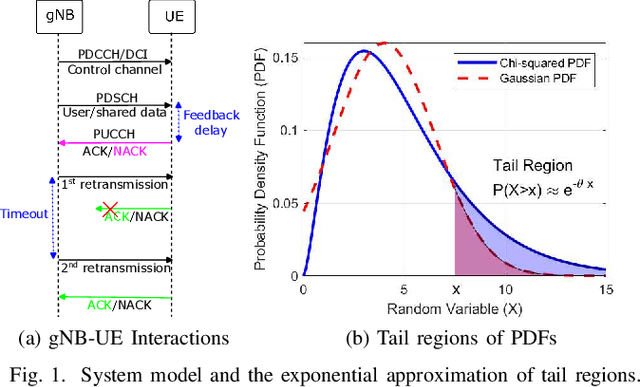
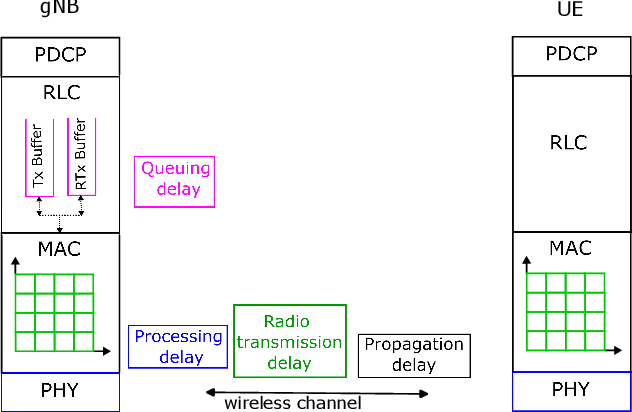
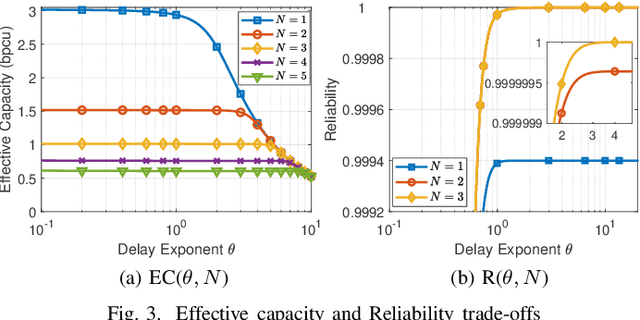
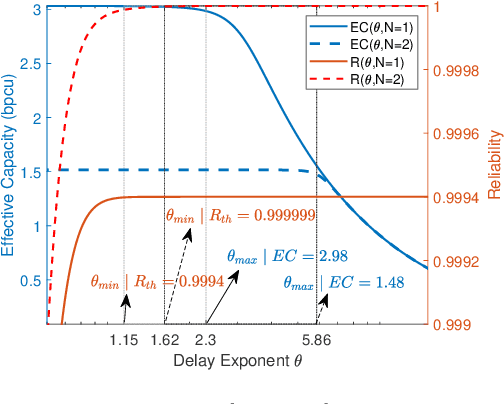
Accurate reliability modeling for ultra-reliable low latency communication (URLLC) and hyper-reliable low latency communication (HRLLC) networks is challenging due to the complex interactions between network layers required to meet stringent requirements. In this paper, we propose such a model. We consider the acknowledged mode of the radio link control (RLC) layer, utilizing separate buffers for transmissions and retransmissions, along with the behavior of physical channels. Our approach leverages the effective capacity (EC) framework, which quantifies the maximum constant arrival rate a time-varying wireless channel can support while meeting statistical quality of service (QoS) constraints. We derive a reliability model that incorporates delay violations, various latency components, and multiple transmission attempts. Our method identifies optimal operating conditions that satisfy URLLC/HRLLC constraints while maintaining near-optimal EC, ensuring the system can handle peak traffic with a guaranteed QoS. Our model reveals critical trade-offs between EC and reliability across various use cases, providing guidance for URLLC/HRLLC network design for service providers and system designers.