 Add to Chrome
 Add to Firefox
 Add to Edge
LOREN: Low Rank-Based Code-Rate Adaptation in Neural Receivers
Feb 11, 2026
Neural network based receivers have recently demonstrated superior system-level performance compared to traditional receivers. However, their practicality is limited by high memory and power requirements, as separate weight sets must be stored for each code rate. To address this challenge, we propose LOREN, a Low Rank-Based Code-Rate Adaptation Neural Receiver that achieves adaptability with minimal overhead. LOREN integrates lightweight low rank adaptation adapters (LOREN adapters) into convolutional layers, freezing a shared base network while training only small adapters per code rate. An end-to-end training framework over 3GPP CDL channels ensures robustness across realistic wireless environments. LOREN achieves comparable or superior performance relative to fully retrained base neural receivers. The hardware implementation of LOREN in 22nm technology shows more than 65% savings in silicon area and up to 15% power reduction when supporting three code rates.

LOKI: a 0.266 pJ/SOP Digital SNN Accelerator with Multi-Cycle Clock-Gated SRAM in 22nm
Nov 14, 2025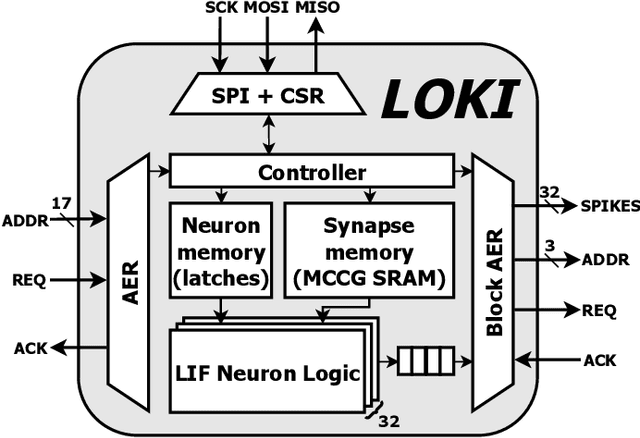
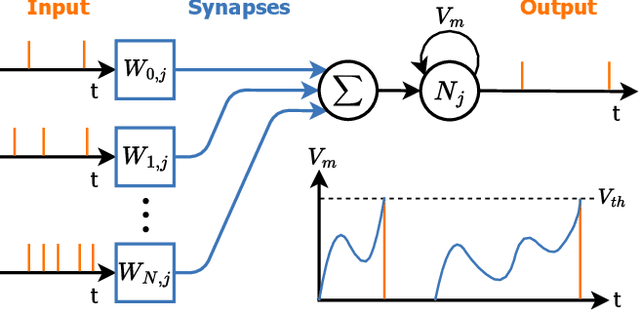
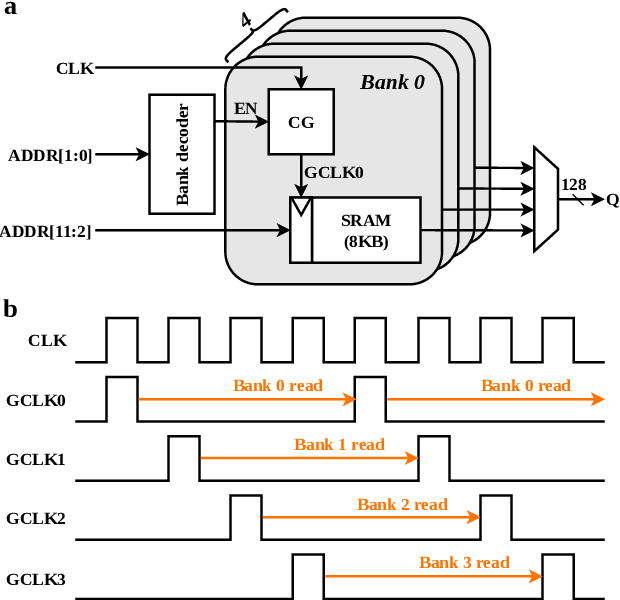
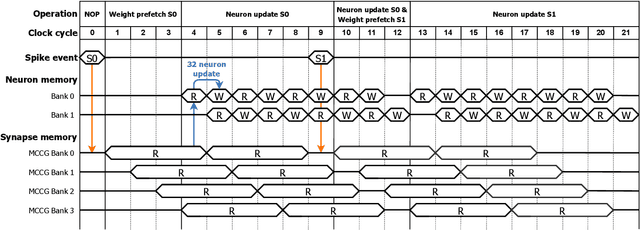
Bio-inspired sensors like Dynamic Vision Sensors (DVS) and silicon cochleas are often combined with Spiking Neural Networks (SNNs), enabling efficient, event-driven processing similar to biological sensory systems. To realize the low-power constraints of the edge, the SNN should run on a hardware architecture that can exploit the sparse nature of the spikes. In this paper, we introduce LOKI, a digital architecture for Fully-Connected (FC) SNNs. By using Multi-Cycle Clock-Gated (MCCG) SRAMs, LOKI can operate at 0.59 V, while running at a clock frequency of 667 MHz. At full throughput, LOKI only consumes 0.266 pJ/SOP. We evaluate LOKI on both the Neuromorphic MNIST (N-MNIST) and the Keyword Spotting k(KWS) tasks, achieving 98.0 % accuracy at 119.8 nJ/inference and 93.0 % accuracy at 546.5 nJ/inference respectively.
THOR -- A Neuromorphic Processor with 7.29G TSOP$^2$/mm$^2$Js Energy-Throughput Efficiency
Dec 03, 2022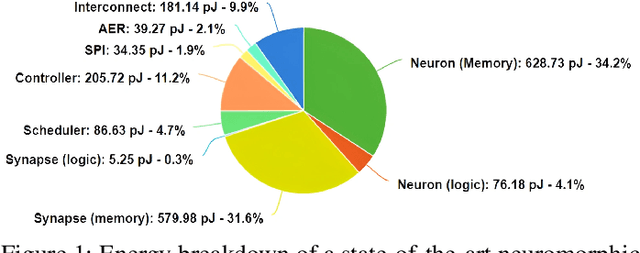
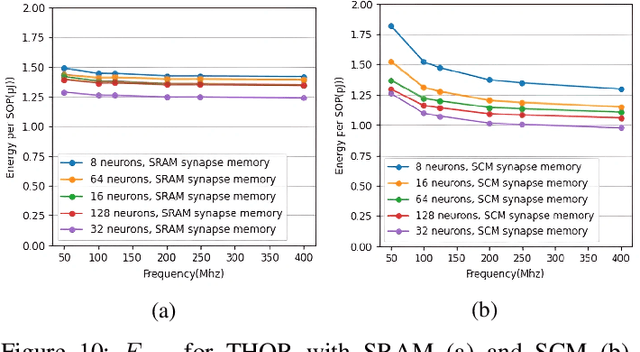
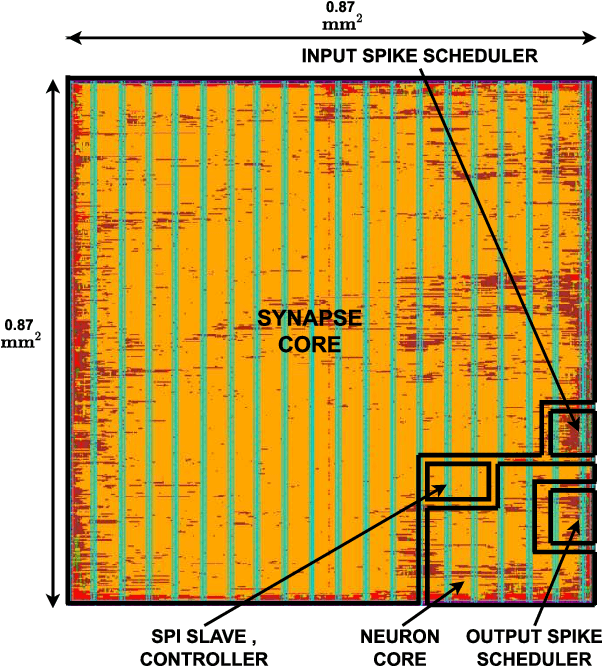
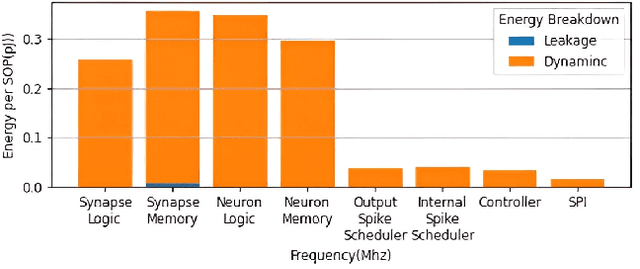
Neuromorphic computing using biologically inspired Spiking Neural Networks (SNNs) is a promising solution to meet Energy-Throughput (ET) efficiency needed for edge computing devices. Neuromorphic hardware architectures that emulate SNNs in analog/mixed-signal domains have been proposed to achieve order-of-magnitude higher energy efficiency than all-digital architectures, however at the expense of limited scalability, susceptibility to noise, complex verification, and poor flexibility. On the other hand, state-of-the-art digital neuromorphic architectures focus either on achieving high energy efficiency (Joules/synaptic operation (SOP)) or throughput efficiency (SOPs/second/area), resulting in poor ET efficiency. In this work, we present THOR, an all-digital neuromorphic processor with a novel memory hierarchy and neuron update architecture that addresses both energy consumption and throughput bottlenecks. We implemented THOR in 28nm FDSOI CMOS technology and our post-layout results demonstrate an ET efficiency of 7.29G $\text{TSOP}^2/\text{mm}^2\text{Js}$ at 0.9V, 400 MHz, which represents a 3X improvement over state-of-the-art digital neuromorphic processors.