 Add to Chrome
 Add to Firefox
 Add to Edge
Multicentric thrombus segmentation using an attention-based recurrent network with gradual modality dropout
Apr 01, 2026
Detecting and delineating tiny targets in 3D brain scans is a central yet under-addressed challenge in medical imaging.In ischemic stroke, for instance, the culprit thrombus is small, low-contrast, and variably expressed across modalities(e.g., susceptibility-weighted T2 blooming, diffusion restriction on DWI/ADC), while real-world multi-center dataintroduce domain shifts, anisotropy, and frequent missing sequences. We introduce a methodology that couples an attention-based recurrent segmentation network (UpAttLLSTM), a training schedule that progressively increases the difficulty of hetero-modal learning, with gradual modality dropout, UpAttLLSTM aggregates context across slices via recurrent units (2.5D) and uses attention gates to fuse complementary cues across available sequences, making it robust to anisotropy and class imbalance. Gradual modality dropout systematically simulates site heterogeneity,noise, and missing modalities during training, acting as both augmentation and regularization to improve multi-center generalization. On a monocentric cohort, our approach detects thrombi in >90% of cases with a Dice score of 0.65. In a multi-center setting with missing modalities, it achieves-80% detection with a Dice score around 0.35. Beyond stroke, the proposed methodology directly transfers to other small-lesion tasks in 3D medical imaging where targets are scarce, subtle, and modality-dependent

The Multiscenario Multienvironment BioSecure Multimodal Database (BMDB)
Nov 17, 2021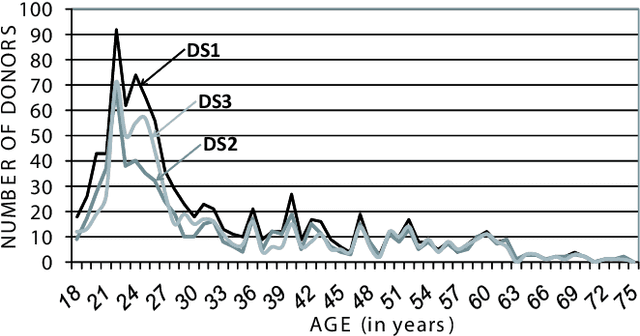
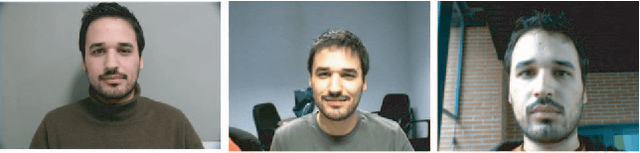
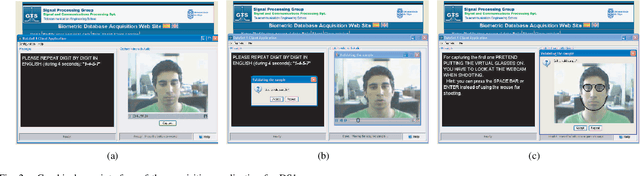
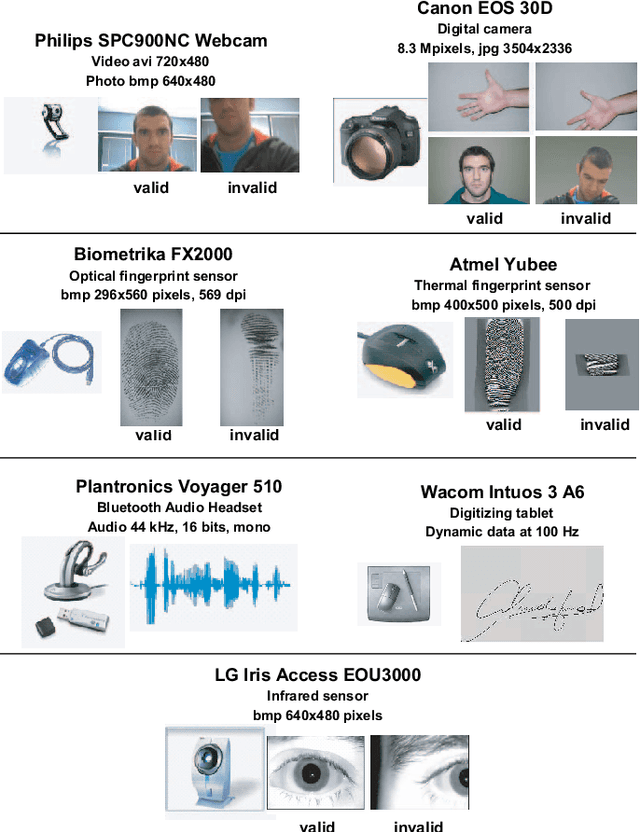
A new multimodal biometric database designed and acquired within the framework of the European BioSecure Network of Excellence is presented. It is comprised of more than 600 individuals acquired simultaneously in three scenarios: 1) over the Internet, 2) in an office environment with desktop PC, and 3) in indoor/outdoor environments with mobile portable hardware. The three scenarios include a common part of audio/video data. Also, signature and fingerprint data have been acquired both with desktop PC and mobile portable hardware. Additionally, hand and iris data were acquired in the second scenario using desktop PC. Acquisition has been conducted by 11 European institutions. Additional features of the BioSecure Multimodal Database (BMDB) are: two acquisition sessions, several sensors in certain modalities, balanced gender and age distributions, multimodal realistic scenarios with simple and quick tasks per modality, cross-European diversity, availability of demographic data, and compatibility with other multimodal databases. The novel acquisition conditions of the BMDB allow us to perform new challenging research and evaluation of either monomodal or multimodal biometric systems, as in the recent BioSecure Multimodal Evaluation campaign. A description of this campaign including baseline results of individual modalities from the new database is also given. The database is expected to be available for research purposes through the BioSecure Association during 2008