 Add to Chrome
 Add to Firefox
 Add to Edge
Multicentric thrombus segmentation using an attention-based recurrent network with gradual modality dropout
Apr 01, 2026
Detecting and delineating tiny targets in 3D brain scans is a central yet under-addressed challenge in medical imaging.In ischemic stroke, for instance, the culprit thrombus is small, low-contrast, and variably expressed across modalities(e.g., susceptibility-weighted T2 blooming, diffusion restriction on DWI/ADC), while real-world multi-center dataintroduce domain shifts, anisotropy, and frequent missing sequences. We introduce a methodology that couples an attention-based recurrent segmentation network (UpAttLLSTM), a training schedule that progressively increases the difficulty of hetero-modal learning, with gradual modality dropout, UpAttLLSTM aggregates context across slices via recurrent units (2.5D) and uses attention gates to fuse complementary cues across available sequences, making it robust to anisotropy and class imbalance. Gradual modality dropout systematically simulates site heterogeneity,noise, and missing modalities during training, acting as both augmentation and regularization to improve multi-center generalization. On a monocentric cohort, our approach detects thrombi in >90% of cases with a Dice score of 0.65. In a multi-center setting with missing modalities, it achieves-80% detection with a Dice score around 0.35. Beyond stroke, the proposed methodology directly transfers to other small-lesion tasks in 3D medical imaging where targets are scarce, subtle, and modality-dependent

Model and Deep learning based Dynamic Range Compression Inversion
Nov 07, 2024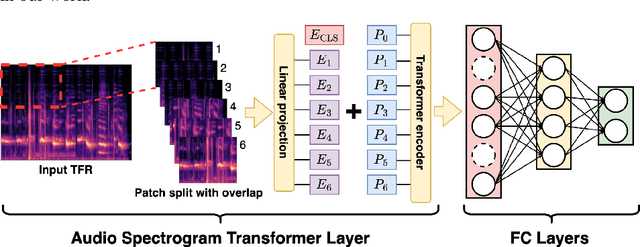
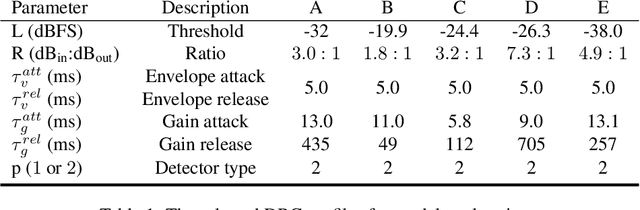
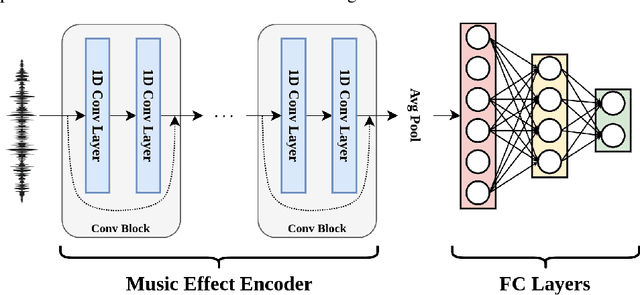

Dynamic Range Compression (DRC) is a popular audio effect used to control the dynamic range of a signal. Inverting DRC can also help to restore the original dynamics to produce new mixes and/or to improve the overall quality of the audio signal. Since, state-of-the-art DRC inversion techniques either ignore parameters or require precise parameters that are difficult to estimate, we fill the gap by combining a model-based approach with neural networks for DRC inversion. To this end, depending on the scenario, we use different neural networks to estimate DRC parameters. Then, a model-based inversion is completed to restore the original audio signal. Our experimental results show the effectiveness and robustness of the proposed method in comparison to several state-of-the-art methods, when applied on two music datasets.