 Add to Chrome
 Add to Firefox
 Add to Edge
Hidden Measurement Error in LLM Pipelines Distorts Annotation, Evaluation, and Benchmarking
Apr 15, 2026
LLM evaluations drive which models get deployed, which safety standards get adopted, and which research conclusions get published. Yet these scores carry hidden uncertainty: rephrasing the prompt, switching the judge model, or changing the temperature can shift results enough to flip rankings and reverse conclusions. Standard confidence intervals ignore this variance, producing under-coverage that worsens with more data. The same unmeasured variance creates an exploitable surface for benchmarks: model developers can optimize against measurement noise rather than genuine performance (some have infamously done so, see \citep{boyeau2025leaderboard}). This paper decomposes LLM pipeline uncertainty into its sources, distinguishes variance that shrinks with more data from sensitivity to researcher design choices, and uses design-study projections to reduce total error. Across ideology annotation, safety classification, MMLU benchmarking, and a human-validated propaganda audit, the decomposition reveals that the dominant variance source differs by domain and scoring method. On MMLU, optimized budget allocation halves estimation error at equivalent cost. On the propaganda task, the recommended pipeline outperforms 73\% of single-configuration alternatives against a human baseline. A small-sample pilot is sufficient to derive confidence intervals that approach nominal coverage and to identify which design changes yield the largest precision gains.

Decomposing and Reducing Hidden Measurement Error in LLM Evaluation Pipelines
Apr 13, 2026LLM evaluations drive which models get deployed, which safety standards get adopted, and which research conclusions get published. Yet these scores carry hidden uncertainty: rephrasing the prompt, switching the judge model, or changing the temperature can shift results enough to flip rankings and reverse conclusions. Standard confidence intervals ignore this variance, producing under-coverage that worsens with more data. The unmeasured variance also creates an exploitable surface: model developers can optimize against measurement noise rather than genuine capability. This paper decomposes LLM pipeline uncertainty into its sources, distinguishes variance that shrinks with more data from sensitivity to researcher design choices, and projects the most efficient path to reducing total error. For benchmark builders, the same decomposition identifies which design choices contribute exploitable surface for gaming and prescribes designs that minimize it. Across ideology annotation, safety classification, MMLU benchmarking, and a human-validated propaganda audit, projection-optimized pipelines outperform 73\% of possible naive pipelines against a human baseline. On MMLU, optimized budget allocation halves estimation error compared to standard single-prompt evaluation at equivalent cost. A small-sample variance estimation exercise is sufficient to derive confidence intervals that approach nominal coverage when the model includes the relevant pipeline facets, and to generate recommendations for reducing measurement error and improving benchmark robustness.
Concept-Guided Chain-of-Thought Prompting for Pairwise Comparison Scaling of Texts with Large Language Models
Oct 18, 2023Existing text scaling methods often require a large corpus, struggle with short texts, or require labeled data. We develop a text scaling method that leverages the pattern recognition capabilities of generative large language models (LLMs). Specifically, we propose concept-guided chain-of-thought (CGCoT), which uses prompts designed to summarize ideas and identify target parties in texts to generate concept-specific breakdowns, in many ways similar to guidance for human coder content analysis. CGCoT effectively shifts pairwise text comparisons from a reasoning problem to a pattern recognition problem. We then pairwise compare concept-specific breakdowns using an LLM. We use the results of these pairwise comparisons to estimate a scale using the Bradley-Terry model. We use this approach to scale affective speech on Twitter. Our measures correlate more strongly with human judgments than alternative approaches like Wordfish. Besides a small set of pilot data to develop the CGCoT prompts, our measures require no additional labeled data and produce binary predictions comparable to a RoBERTa-Large model fine-tuned on thousands of human-labeled tweets. We demonstrate how combining substantive knowledge with LLMs can create state-of-the-art measures of abstract concepts.
Large Language Models Can Be Used to Estimate the Ideologies of Politicians in a Zero-Shot Learning Setting
Mar 22, 2023


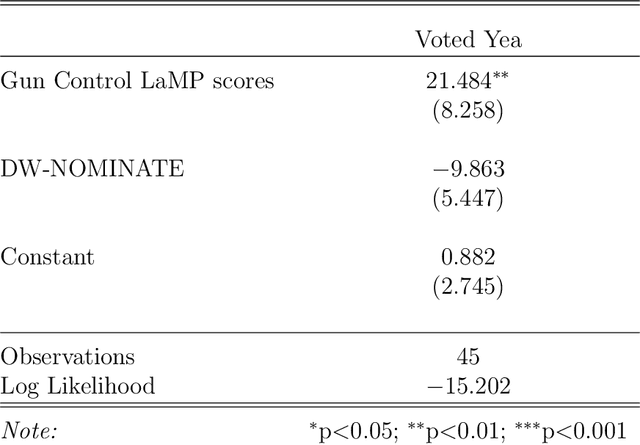
The mass aggregation of knowledge embedded in large language models (LLMs) holds the promise of new solutions to problems of observability and measurement in the social sciences. We examine the utility of one such model for a particularly difficult measurement task: measuring the latent ideology of lawmakers, which allows us to better understand functions that are core to democracy, such as how politics shape policy and how political actors represent their constituents. We scale the senators of the 116th United States Congress along the liberal-conservative spectrum by prompting ChatGPT to select the more liberal (or conservative) senator in pairwise comparisons. We show that the LLM produced stable answers across repeated iterations, did not hallucinate, and was not simply regurgitating information from a single source. This new scale strongly correlates with pre-existing liberal-conservative scales such as NOMINATE, but also differs in several important ways, such as correctly placing senators who vote against their party for far-left or far-right ideological reasons on the extreme ends. The scale also highly correlates with ideological measures based on campaign giving and political activists' perceptions of these senators. In addition to the potential for better-automated data collection and information retrieval, our results suggest LLMs are likely to open new avenues for measuring latent constructs like ideology that rely on aggregating large quantities of data from public sources.