 Add to Chrome
 Add to Firefox
 Add to Edge
Bet on Features: Anytime-Valid and Feature-Aware Auditing of Conditional Quantile Forecasters
Jul 13, 2026
Black-box conditional quantile forecasts are widely used for sequential decisions under asymmetric costs, such as inventory planning in supply chain management. Once deployed, such forecasters must be monitored continuously as data streams drift and regimes change; this invalidates standard, fixed-horizon backtests for calibration. Further, existing backtests do not take into account that the notion of calibration is, in fact, information-dependent: forecasts can look calibrated to an auditor with coarse information while being miscalibrated to an auditor with richer information. We develop a distribution-free and game-theoretic testing framework for continuously auditing black-box conditional quantile forecasters with non-i.i.d. losses, such that the resulting evidence process is powerful against predictably chosen alternatives specified by the features available to the auditor. We first formalize notions of conditional quantile calibration when different sets of features are available to the auditor, establishing that the coarseness of the auditor's information set determines the hardness of the testing problem. We then identify the sets of alternatives for which the auditor can achieve power, and focusing on contextual bets linear in the features, we derive finite-time detection guarantees for such alternatives, all without an i.i.d. assumption. The resulting evidence processes are interpretable at the feature level, as they quantify fine-grained, "feature-aware" evidence for miscalibration. We empirically validate these methods on simulated and real data, finding that a popular time series forecaster (Chronos-2) is highly miscalibrated w.r.t. multiple relevant features.

In-Context Learning for Data-Driven Censored Inventory Control
May 14, 2026We study inventory control with decision-dependent censoring, focusing on the censored or repeated newsvendor (R-NV), where each order quantity determines whether demand is fully observed or censored by sales. Existing approaches based on parametric Thompson sampling (TS) can be brittle under prior mismatch, while offline imputation methods need not transfer to online learning. Motivated by the predictive view of decision making, we combine these ideas by taking oracle actions on learned completions of latent demand. We propose in-context generative posterior sampling (ICGPS), which uses modern generative models that are meta-trained offline and deployed online by in-context autoregressive generation. Theoretically, we show that the Bayesian regret of ICGPS with a learned completion kernel is bounded by the Bayesian regret of a TS benchmark with the ideal completion kernel plus a deployment penalty scaling as $\sqrt{T}$ times the square root of the completion mismatch. This yields a plug-in template for operational problems with known TS regret bounds. For R-NV, we derive sublinear Bayesian regret by reducing censored feedback to bandit convex optimization feedback. We also show that, under reasonable coverage and stability assumptions, the online completion mismatch is controlled by the offline censored predictive mismatch, so offline predictive quality transfers to online performance. Practically, we instantiate ICGPS with ChronosFlow, which combines a frozen time-series transformer backbone with a trainable conditional normalizing-flow head for fast censoring-consistent sampling. In benchmark experiments, ChronosFlow-ICGPS matches correctly specified TS, outperforms myopic and UCB-style baselines, and is robust to prior mismatch and distribution shift. ChronosFlow-ICGPS also performs well for the real-world SuperStore dataset, especially under heavy censoring.
Locally Adaptive Federated Learning via Stochastic Polyak Stepsizes
Jul 12, 2023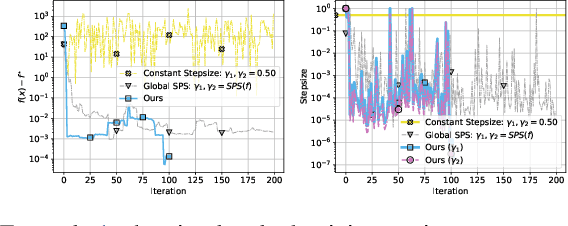
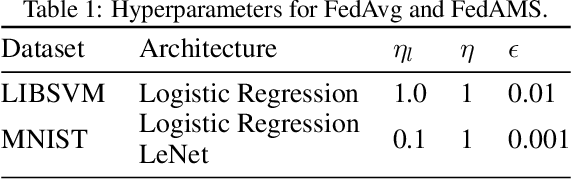
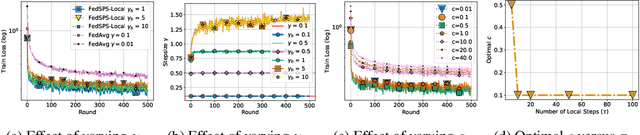
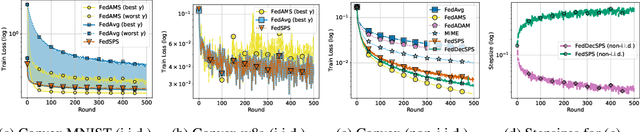
State-of-the-art federated learning algorithms such as FedAvg require carefully tuned stepsizes to achieve their best performance. The improvements proposed by existing adaptive federated methods involve tuning of additional hyperparameters such as momentum parameters, and consider adaptivity only in the server aggregation round, but not locally. These methods can be inefficient in many practical scenarios because they require excessive tuning of hyperparameters and do not capture local geometric information. In this work, we extend the recently proposed stochastic Polyak stepsize (SPS) to the federated learning setting, and propose new locally adaptive and nearly parameter-free distributed SPS variants (FedSPS and FedDecSPS). We prove that FedSPS converges linearly in strongly convex and sublinearly in convex settings when the interpolation condition (overparametrization) is satisfied, and converges to a neighborhood of the solution in the general case. We extend our proposed method to a decreasing stepsize version FedDecSPS, that converges also when the interpolation condition does not hold. We validate our theoretical claims by performing illustrative convex experiments. Our proposed algorithms match the optimization performance of FedAvg with the best tuned hyperparameters in the i.i.d. case, and outperform FedAvg in the non-i.i.d. case.
Fingertip Detection and Tracking for Recognition of Air-Writing in Videos
Sep 09, 2018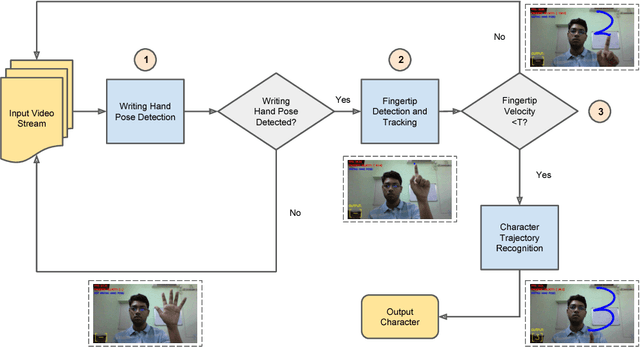
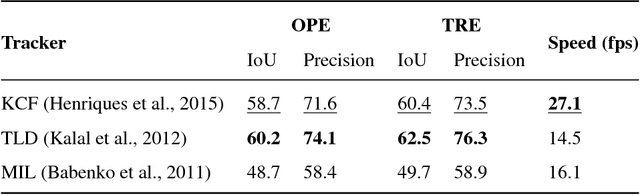
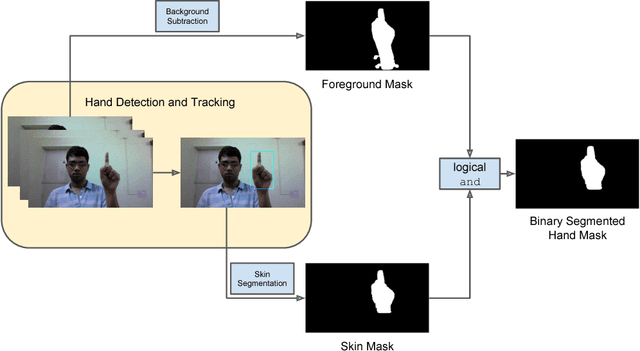
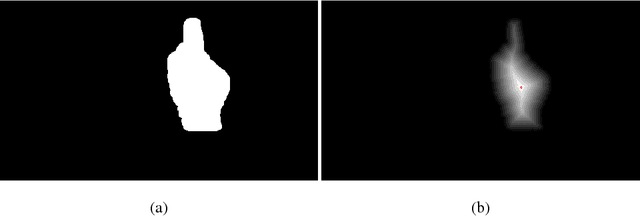
Air-writing is the process of writing characters or words in free space using finger or hand movements without the aid of any hand-held device. In this work, we address the problem of mid-air finger writing using web-cam video as input. In spite of recent advances in object detection and tracking, accurate and robust detection and tracking of the fingertip remains a challenging task, primarily due to small dimension of the fingertip. Moreover, the initialization and termination of mid-air finger writing is also challenging due to the absence of any standard delimiting criterion. To solve these problems, we propose a new writing hand pose detection algorithm for initialization of air-writing using the Faster R-CNN framework for accurate hand detection followed by hand segmentation and finally counting the number of raised fingers based on geometrical properties of the hand. Further, we propose a robust fingertip detection and tracking approach using a new signature function called distance-weighted curvature entropy. Finally, a fingertip velocity-based termination criterion is used as a delimiter to mark the completion of the air-writing gesture. Experiments show the superiority of the proposed fingertip detection and tracking algorithm over state-of-the-art approaches giving a mean precision of 73.1 % while achieving real-time performance at 18.5 fps, a condition which is of vital importance to air-writing. Character recognition experiments give a mean accuracy of 96.11 % using the proposed air-writing system, a result which is comparable to that of existing handwritten character recognition systems.