 Add to Chrome
 Add to Firefox
 Add to Edge
Policy-Based Deep Reinforcement Learning Hyperheuristics for Job-Shop Scheduling Problems
Jan 16, 2026
This paper proposes a policy-based deep reinforcement learning hyper-heuristic framework for solving the Job Shop Scheduling Problem. The hyper-heuristic agent learns to switch scheduling rules based on the system state dynamically. We extend the hyper-heuristic framework with two key mechanisms. First, action prefiltering restricts decision-making to feasible low-level actions, enabling low-level heuristics to be evaluated independently of environmental constraints and providing an unbiased assessment. Second, a commitment mechanism regulates the frequency of heuristic switching. We investigate the impact of different commitment strategies, from step-wise switching to full-episode commitment, on both training behavior and makespan. Additionally, we compare two action selection strategies at the policy level: deterministic greedy selection and stochastic sampling. Computational experiments on standard JSSP benchmarks demonstrate that the proposed approach outperforms traditional heuristics, metaheuristics, and recent neural network-based scheduling methods

Policy-Based Reinforcement Learning with Action Masking for Dynamic Job Shop Scheduling under Uncertainty: Handling Random Arrivals and Machine Failures
Jan 14, 2026We present a novel framework for solving Dynamic Job Shop Scheduling Problems under uncertainty, addressing the challenges introduced by stochastic job arrivals and unexpected machine breakdowns. Our approach follows a model-based paradigm, using Coloured Timed Petri Nets to represent the scheduling environment, and Maskable Proximal Policy Optimization to enable dynamic decision-making while restricting the agent to feasible actions at each decision point. To simulate realistic industrial conditions, dynamic job arrivals are modeled using a Gamma distribution, which captures complex temporal patterns such as bursts, clustering, and fluctuating workloads. Machine failures are modeled using a Weibull distribution to represent age-dependent degradation and wear-out dynamics. These stochastic models enable the framework to reflect real-world manufacturing scenarios better. In addition, we study two action-masking strategies: a non-gradient approach that overrides the probabilities of invalid actions, and a gradient-based approach that assigns negative gradients to invalid actions within the policy network. We conduct extensive experiments on dynamic JSSP benchmarks, demonstrating that our method consistently outperforms traditional heuristic and rule-based approaches in terms of makespan minimization. The results highlight the strength of combining interpretable Petri-net-based models with adaptive reinforcement learning policies, yielding a resilient, scalable, and explainable framework for real-time scheduling in dynamic and uncertain manufacturing environments.
Flexible Manufacturing Systems Intralogistics: Dynamic Optimization of AGVs and Tool Sharing Using Coloured-Timed Petri Nets and Actor-Critic RL with Actions Masking
Jan 08, 2026Flexible Manufacturing Systems (FMS) are pivotal in optimizing production processes in today's rapidly evolving manufacturing landscape. This paper advances the traditional job shop scheduling problem by incorporating additional complexities through the simultaneous integration of automated guided vehicles (AGVs) and tool-sharing systems. We propose a novel approach that combines Colored-Timed Petri Nets (CTPNs) with actor-critic model-based reinforcement learning (MBRL), effectively addressing the multifaceted challenges associated with FMS. CTPNs provide a formal modeling structure and dynamic action masking, significantly reducing the action search space, while MBRL ensures adaptability to changing environments through the learned policy. Leveraging the advantages of MBRL, we incorporate a lookahead strategy for optimal positioning of AGVs, improving operational efficiency. Our approach was evaluated on small-sized public benchmarks and a newly developed large-scale benchmark inspired by the Taillard benchmark. The results show that our approach matches traditional methods on smaller instances and outperforms them on larger ones in terms of makespan while achieving a tenfold reduction in computation time. To ensure reproducibility, we propose a gym-compatible environment and an instance generator. Additionally, an ablation study evaluates the contribution of each framework component to its overall performance.
Introducing PetriRL: An Innovative Framework for JSSP Resolution Integrating Petri nets and Event-based Reinforcement Learning
Jan 23, 2024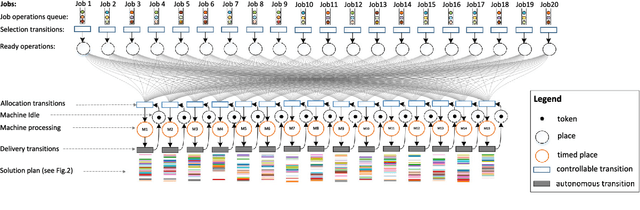
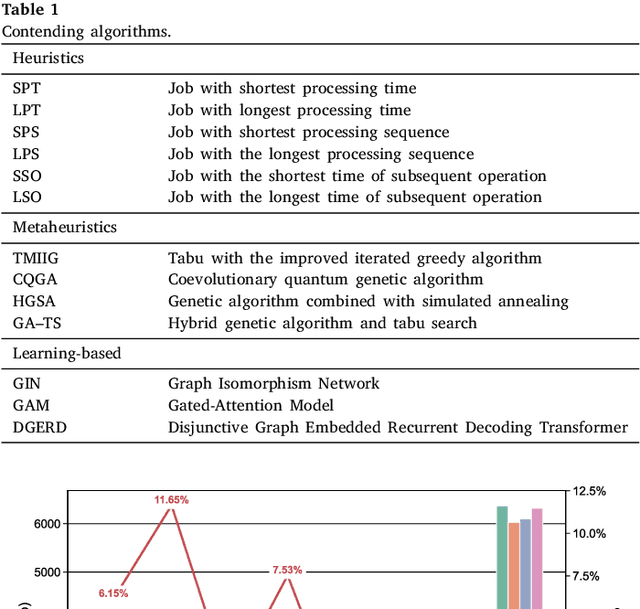
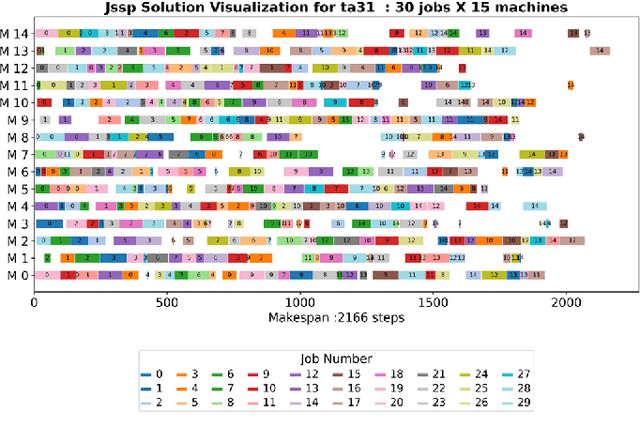
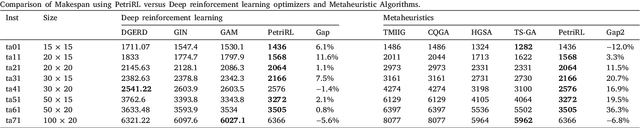
Quality scheduling in industrial job shops is crucial. Although neural networks excel in solving these problems, their limited explainability hinders their widespread industrial adoption. In this research, we introduce an innovative framework for solving job shop scheduling problems (JSSP). Our methodology leverages Petri nets to model the job shop, not only improving explainability but also enabling direct incorporation of raw data without the need to preprocess JSSP instances into disjunctive graphs. The Petri net, with its controlling capacities, also governs the automated components of the process, allowing the agent to focus on critical decision-making, particularly resource allocation. The integration of event-based control and action masking in our approach yields competitive performance on public test benchmarks. Comparative analyses across a wide spectrum of optimization solutions, including heuristics, metaheuristics, and learning-based algorithms, highlight the competitiveness of our approach in large instances and its superiority over all competitors in small to medium-sized scenarios. Ultimately, our approach not only demonstrates a robust ability to generalize across various instance sizes but also leverages the Petri net's graph nature to dynamically add job operations during the inference phase without the need for agent retraining, thereby enhancing flexibility.