 Add to Chrome
 Add to Firefox
 Add to Edge
Reasoning or Rhetoric? An Empirical Analysis of Moral Reasoning Explanations in Large Language Models
Mar 23, 2026
Do large language models reason morally, or do they merely sound like they do? We investigate whether LLM responses to moral dilemmas exhibit genuine developmental progression through Kohlberg's stages of moral development, or whether alignment training instead produces reasoning-like outputs that superficially resemble mature moral judgment without the underlying developmental trajectory. Using an LLM-as-judge scoring pipeline validated across three judge models, we classify more than 600 responses from 13 LLMs spanning a range of architectures, parameter scales, and training regimes across six classical moral dilemmas, and conduct ten complementary analyses to characterize the nature and internal coherence of the resulting patterns. Our results reveal a striking inversion: responses overwhelmingly correspond to post-conventional reasoning (Stages 5-6) regardless of model size, architecture, or prompting strategy, the effective inverse of human developmental norms, where Stage 4 dominates. Most strikingly, a subset of models exhibit moral decoupling: systematic inconsistency between stated moral justification and action choice, a form of logical incoherence that persists across scale and prompting strategy and represents a direct reasoning consistency failure independent of rhetorical sophistication. Model scale carries a statistically significant but practically small effect; training type has no significant independent main effect; and models exhibit near-robotic cross-dilemma consistency producing logically indistinguishable responses across semantically distinct moral problems. We posit that these patterns constitute evidence for moral ventriloquism: the acquisition, through alignment training, of the rhetorical conventions of mature moral reasoning without the underlying developmental trajectory those conventions are meant to represent.

From Prejudice to Parity: A New Approach to Debiasing Large Language Model Word Embeddings
Feb 20, 2024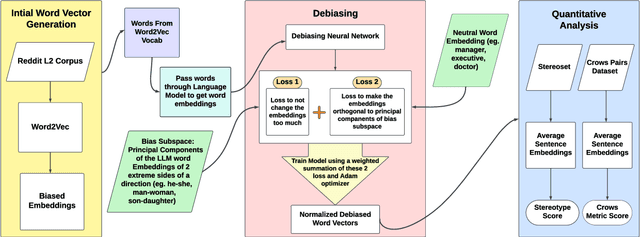
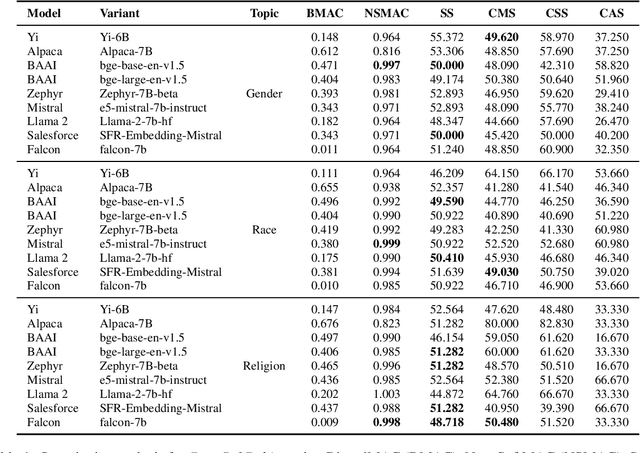
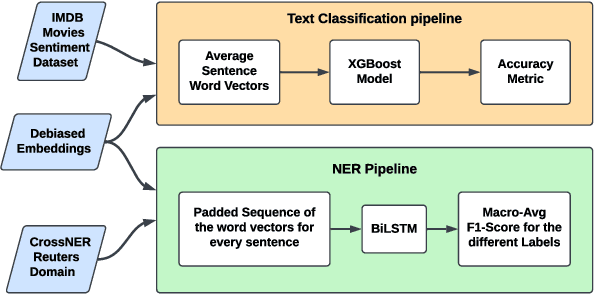
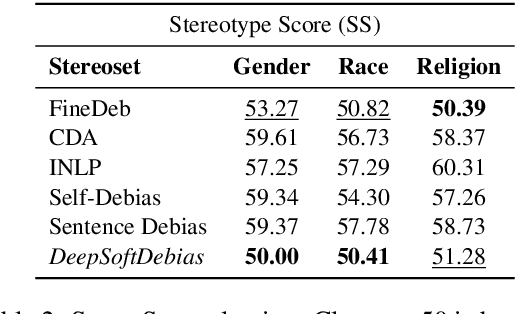
Embeddings play a pivotal role in the efficacy of Large Language Models. They are the bedrock on which these models grasp contextual relationships and foster a more nuanced understanding of language and consequently perform remarkably on a plethora of complex tasks that require a fundamental understanding of human language. Given that these embeddings themselves often reflect or exhibit bias, it stands to reason that these models may also inadvertently learn this bias. In this work, we build on the seminal previous work and propose DeepSoftDebias, an algorithm that uses a neural network to perform 'soft debiasing'. We exhaustively evaluate this algorithm across a variety of SOTA datasets, accuracy metrics, and challenging NLP tasks. We find that DeepSoftDebias outperforms the current state-of-the-art methods at reducing bias across gender, race, and religion.
Language Models (Mostly) Do Not Consider Emotion Triggers When Predicting Emotion
Nov 16, 2023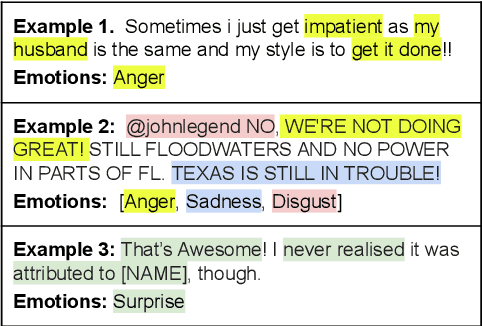
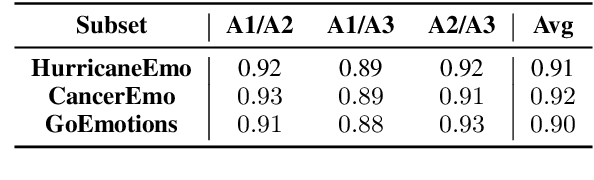
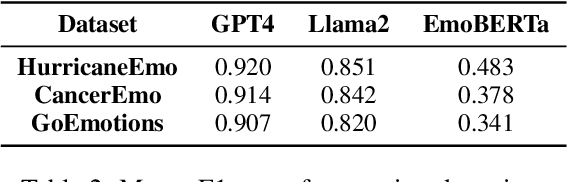
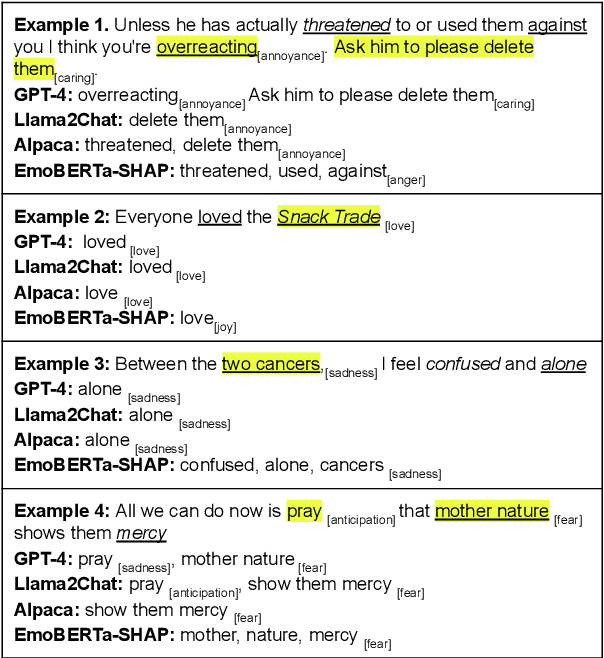
Situations and events evoke emotions in humans, but to what extent do they inform the prediction of emotion detection models? Prior work in emotion trigger or cause identification focused on training models to recognize events that trigger an emotion. Instead, this work investigates how well human-annotated emotion triggers correlate with features that models deemed salient in their prediction of emotions. First, we introduce a novel dataset EmoTrigger, consisting of 900 social media posts sourced from three different datasets; these were annotated by experts for emotion triggers with high agreement. Using EmoTrigger, we evaluate the ability of large language models (LLMs) to identify emotion triggers, and conduct a comparative analysis of the features considered important for these tasks between LLMs and fine-tuned models. Our analysis reveals that emotion triggers are largely not considered salient features for emotion prediction models, instead there is intricate interplay between various features and the task of emotion detection.