 Add to Chrome
 Add to Firefox
 Add to Edge
An Agency-Transferring Model-Free Policy Enhancement Technique
Jun 08, 2026
Training reinforcement learning (RL) policies from scratch is costly: it requires careful reward and environment design, extensive tuning, and substantial computation. Yet many control problems already have a functional but suboptimal policy available as a baseline. This paper proposes a method for embedding such a baseline into the RL training process, simultaneously improving training efficiency relative to from-scratch methods and producing a learning policy that outperforms the baseline. At each step, the method arbitrates between the baseline policy and a trainable learning policy, initially relying strongly on the baseline policy and then progressively transferring agency to the learning policy. By the end of training, the learning policy is a standalone neural network that operates without baseline policy support. The paper formalizes what it means for the baseline policy to be functional: under this policy, the agent reaches a goal set and remains there with high probability. The proposed arbitration mechanism is designed to exploit this property during training, yielding high goal-reaching rates right from the beginning of training. A theoretical analysis provides a formal interpretation of this behavior under stated assumptions and extends it to the final baseline-free regime, where explicit lower bounds are derived for the goal-reaching probability of the standalone learning policy. Empirical results on continuous-control benchmarks show that the proposed method achieves returns that match or exceed those of competitive approaches, while maintaining the highest goal-reaching rates throughout training among the compared methods -- including in the final stage, where the learning policy operates without any baseline support.

Benchmarking Reinforcement Learning via Stochastic Converse Optimality: Generating Systems with Known Optimal Policies
Mar 18, 2026The objective comparison of Reinforcement Learning (RL) algorithms is notoriously complex as outcomes and benchmarking of performances of different RL approaches are critically sensitive to environmental design, reward structures, and stochasticity inherent in both algorithmic learning and environmental dynamics. To manage this complexity, we introduce a rigorous benchmarking framework by extending converse optimality to discrete-time, control-affine, nonlinear systems with noise. Our framework provides necessary and sufficient conditions, under which a prescribed value function and policy are optimal for constructed systems, enabling the systematic generation of benchmark families via homotopy variations and randomized parameters. We validate it by automatically constructing diverse environments, demonstrating our framework's capacity for a controlled and comprehensive evaluation across algorithms. By assessing standard methods against a ground-truth optimum, our work delivers a reproducible foundation for precise and rigorous RL benchmarking.
Critic as Lyapunov function (CALF): a model-free, stability-ensuring agent
Sep 15, 2024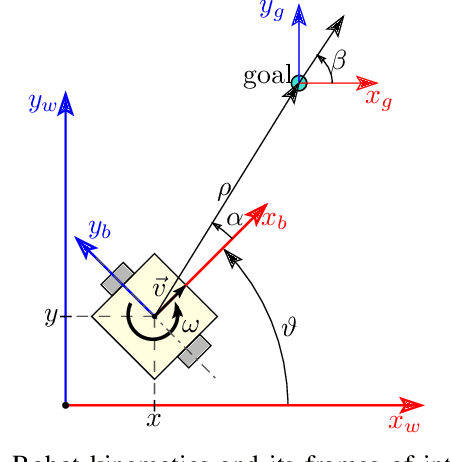
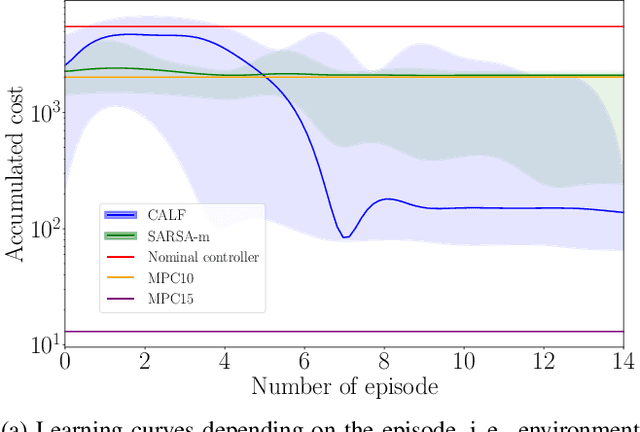
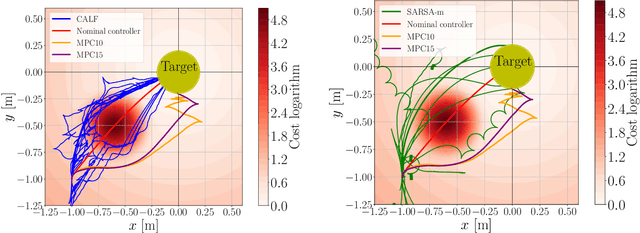
This work presents and showcases a novel reinforcement learning agent called Critic As Lyapunov Function (CALF) which is model-free and ensures online environment, in other words, dynamical system stabilization. Online means that in each learning episode, the said environment is stabilized. This, as demonstrated in a case study with a mobile robot simulator, greatly improves the overall learning performance. The base actor-critic scheme of CALF is analogous to SARSA. The latter did not show any success in reaching the target in our studies. However, a modified version thereof, called SARSA-m here, did succeed in some learning scenarios. Still, CALF greatly outperformed the said approach. CALF was also demonstrated to improve a nominal stabilizer provided to it. In summary, the presented agent may be considered a viable approach to fusing classical control with reinforcement learning. Its concurrent approaches are mostly either offline or model-based, like, for instance, those that fuse model-predictive control into the agent.