 Add to Chrome
 Add to Firefox
 Add to Edge
Adaptive Bandit Algorithms for Contextual Matching Markets
May 27, 2026
We study bandit learning in matching markets, where players and arms constitute the two market sides, and the players' utilities are linear in the arm contexts. In each round, new arms arrive with observable contexts. Then, the algorithm matches them to players, aiming to minimize each player's regret against a stable matching benchmark. This contextual structure creates significant complexity: subtle context shifts can slightly alter one player's utility while completely reconfiguring the underlying benchmark, causing large regret spikes for others. We address this in two settings: stochastic contexts, drawn from a latent distribution, and adversarial contexts, which may be arbitrary. For the stochastic case, we introduce a novel minimum preference gap to capture learning difficulty and provide a fully adaptive algorithm with an instance-dependent poly-logarithmic regret upper bound. We also establish matching instance-independent regret upper and lower bounds under a mild distributional assumption. For the adversarial setting, we propose a tractable regret notion that remains valid under arbitrary contexts and achieves an instance-independent sublinear regret bound via an adaptive algorithm.

Stable Matching with Ties: Approximation Ratios and Learning
Nov 05, 2024We study the problem of matching markets with ties, where one side of the market does not necessarily have strict preferences over members at its other side. For example, workers do not always have strict preferences over jobs, students can give the same ranking for different schools and more. In particular, assume w.l.o.g. that workers' preferences are determined by their utility from being matched to each job, which might admit ties. Notably, in contrast to classical two-sided markets with strict preferences, there is no longer a single stable matching that simultaneously maximizes the utility for all workers. We aim to guarantee each worker the largest possible share from the utility in her best possible stable matching. We call the ratio between the worker's best possible stable utility and its assigned utility the \emph{Optimal Stable Share} (OSS)-ratio. We first prove that distributions over stable matchings cannot guarantee an OSS-ratio that is sublinear in the number of workers. Instead, randomizing over possibly non-stable matchings, we show how to achieve a tight logarithmic OSS-ratio. Then, we analyze the case where the real utility is not necessarily known and can only be approximated. In particular, we provide an algorithm that guarantees a similar fraction of the utility compared to the best possible utility. Finally, we move to a bandit setting, where we select a matching at each round and only observe the utilities for matches we perform. We show how to utilize our results for approximate utilities to gracefully interpolate between problems without ties and problems with statistical ties (small suboptimality gaps).
Approximability of Monotone Submodular Function Maximization under Cardinality and Matroid Constraints in the Streaming Model
Feb 13, 2020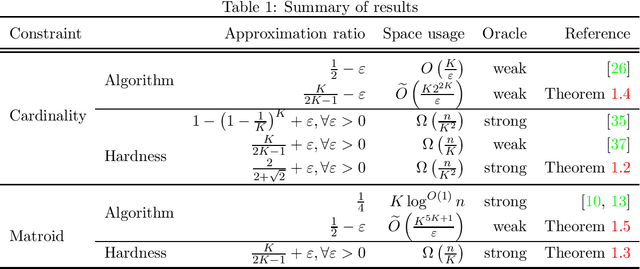

Maximizing a monotone submodular function under various constraints is a classical and intensively studied problem. However, in the single-pass streaming model, where the elements arrive one by one and an algorithm can store only a small fraction of input elements, there is much gap in our knowledge, even though several approximation algorithms have been proposed in the literature. In this work, we present the first lower bound on the approximation ratios for cardinality and matroid constraints that beat $1-\frac{1}{e}$ in the single-pass streaming model. Let $n$ be the number of elements in the stream. Then, we prove that any (randomized) streaming algorithm for a cardinality constraint with approximation ratio $\frac{2}{2+\sqrt{2}}+\varepsilon$ requires $\Omega\left(\frac{n}{K^2}\right)$ space for any $\varepsilon>0$, where $K$ is the size limit of the output set. We also prove that any (randomized) streaming algorithm for a (partition) matroid constraint with approximation ratio $\frac{K}{2K-1}+\varepsilon$ requires $\Omega\left(\frac{n}{K}\right)$ space for any $\varepsilon>0$, where $K$ is the rank of the given matroid. In addition, we give streaming algorithms when we only have a weak oracle with which we can only evaluate function values on feasible sets. Specifically, we show weak-oracle streaming algorithms for cardinality and matroid constraints with approximation ratios $\frac{K}{2K-1}$ and $\frac{1}{2}$, respectively, whose space complexity is exponential in $K$ but is independent of $n$. The former one exactly matches the known inapproximability result for a cardinality constraint in the weak oracle model. The latter one almost matches our lower bound of $\frac{K}{2K-1}$ for a matroid constraint, which almost settles the approximation ratio for a matroid constraint that can be obtained by a streaming algorithm whose space complexity is independent of $n$.