 Add to Chrome
 Add to Firefox
 Add to Edge
Beyond Inference-Only Deployment: Comparing Weight-Based Consolidation Against Cascading Compaction
May 23, 2026
Major LLM platforms deploy models in an inference-only configuration: the model serves requests but never updates per-user weights. Users must repeatedly re-teach preferences, corrections, and project context, and context-based workarounds consume context-window space and degrade under cascading compaction. We evaluate an alternative: nightly consolidation of interaction knowledge into model weights via reflection, synthesis, and Low-Rank Adaptation (LoRA) fine-tuning on a single consumer GPU. Across ten realistic software development conversations (n = 10, 1,146 test questions across three memory types), three cycles of cascading compaction retain 36.8 +/- 3.0% of knowledge (between an 11.8% no-context floor and a 90.1% full-context ceiling), while consolidation retains 80.4 +/- 1.3% -- a 43.6 pp gain (paired t(9) = 14.8, p < 0.001) that more than doubles what compaction preserves, with the largest gains on procedural corrections (36.3% -> 74.6%) and episodic project facts (31.5% -> 78.2%). As a methodological aside, mean per-token validation cross-entropy is negatively correlated with LLM-judged accuracy (r = -0.51) while median per-token validation cross-entropy tracks accuracy almost exactly (r = +0.99): under evaluators that tolerate surface-form variation, the mean is misleading and a heavy-tail-robust statistic is the faithful signal. Persistent personalization requires moving beyond inference-only deployment toward architectures that consolidate knowledge into weights.

When Mean CE Fails: Median CE Can Better Track Language Model Quality
May 23, 2026Mean cross-entropy is the standard validation metric for language models, but it can fail to track model quality during training. We examine this in two common scenarios. First, in Qwen2.5-1.5B SFT on synthetic fact-learning, we find that mean CE rises substantially after the initial learning phase while held-out fact-recall accuracy remains near its peak. Second, we find that in top-K distillation on TinyStories, decreasing K improves median CE while worsening mean CE; the Top-5 student attains the highest LLM-judge score and crosses below its teacher on median CE, despite having the worst mean CE. In both cases, median CE correlates much more closely with task performance than does mean CE. Analyzing how bulk and tail percentile CE move during training reveals that training reshapes the empirical per-token CE distribution. In top-K distillation, smaller K yields a distribution with more mass at both extremes, decreasing the median and increasing the mean. In Qwen SFT, the bulk saturates quickly while the tail extends in the latter half of training. In both, the task-evaluation metric appears more sensitive to the bulk than to the tail. Practically, we recommend reporting a small set of percentile CE summaries alongside the mean, and using concordance among them as a tool to keep track of distribution reshaping, as well as a low-cost diagnostic for when mean and median CE disagree on model selection.
Compiling Agentic Workflows into LLM Weights: Near-Frontier Quality at Two Orders of Magnitude Less Cost
May 21, 2026Agent orchestration frameworks have proliferated, collectively exceeding 290,000 GitHub stars across LangGraph, CrewAI, Google ADK, OpenAI Agents SDK, Semantic Kernel, Strands, and LlamaIndex. All follow the same pattern: an external orchestrator above the LLM, injecting instructions and routing decisions every turn. Recent work has shown this architecture is dominated for procedural tasks by simply providing the procedure in a frontier model's system prompt [Dennis et al., 2026a], at the cost of consuming the context window, requiring a frontier model for every conversation, and exposing proprietary procedures to third-party providers. Compiling the procedure into the weights of a small fine-tuned model -- creating a subterranean agent -- should resolve all of these concerns, and prior work (SimpleTOD, FireAct, SynTOD, WorkflowLLM, Agent Lumos) has shown the technique works. Yet developer adoption has overwhelmingly favored orchestration. We identify three perceived barriers and address each empirically across travel booking (14 nodes), Zoom support (14 nodes, product-specific knowledge), and insurance claims (55 nodes, 6 decision hubs).
The Dynamical Principles of Storytelling
Sep 29, 2023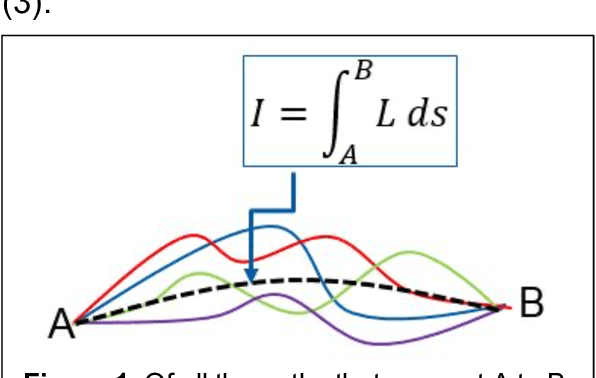
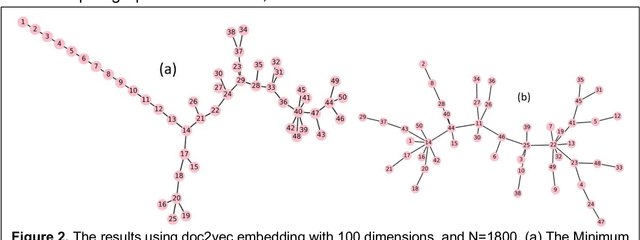
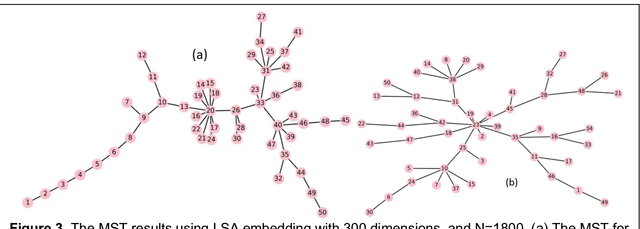
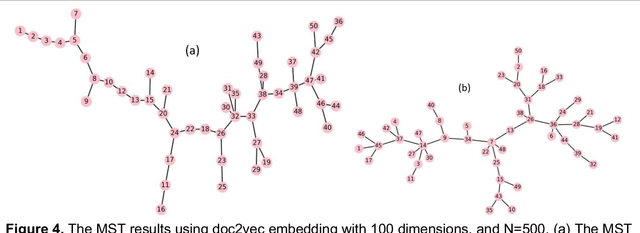
When considering the opening part of 1800 short stories, we find that the first dozen paragraphs of the average narrative follow an action principle as defined in arXiv:2309.06600. When the order of the paragraphs is shuffled, the average no longer exhibits this property. The findings show that there is a preferential direction we take in semantic space when starting a story, possibly related to a common Western storytelling tradition as implied by Aristotle in Poetics.
Narrative as a Dynamical System
Sep 06, 2023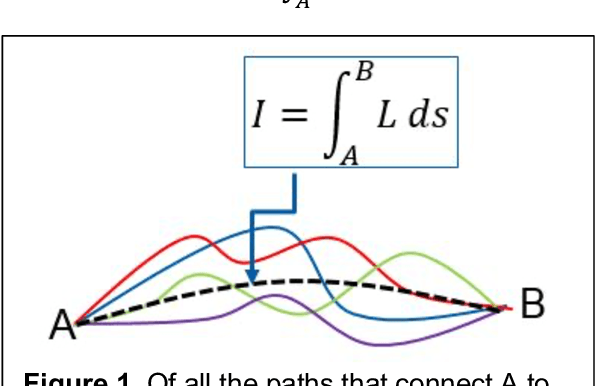
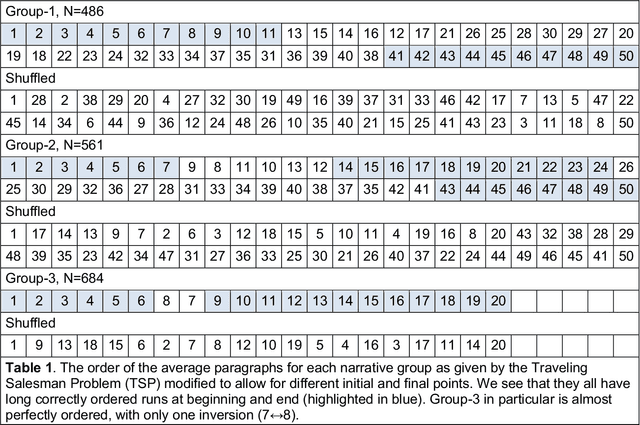
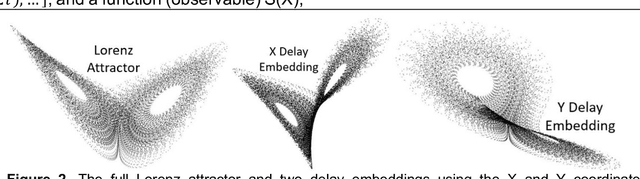
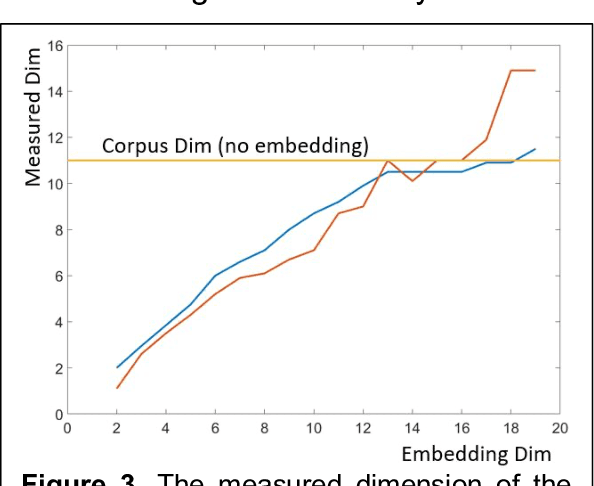
There is increasing evidence that human activity in general, and narrative in particular, can be treated as a dynamical system in the physics sense; a system whose evolution is described by an action integral, such that the average of all possible paths from point A to point B is given by the extremum of the action. We create by construction three such paths by averaging about 500 different narratives, and we show that the average path is consistent with an action principle.