 Add to Chrome
 Add to Firefox
 Add to Edge
Reconstructing Unobservable Temperature Fields via Simulation-Aided Intelligent Sensing
Jun 03, 2026
Real-time monitoring of the temperature distribution within components and sub-structures is a challenging topic in many systems due to restrictions on feasible sensor locations. While machine learning (ML) proves a versatile tool in many applications, its adoption for high-resolution thermal monitoring is hindered by the availability of high-quality datasets for training. In this work, we propose a novel approach for generating datasets for industrial applications based on randomized physics-based simulations. We demonstrate the approach in a proof-of-concept hardware setup: A neural network (NN) trained only on such a synthetic dataset, is used to reconstruct the internal temperature field from sparse sensors embedded in the hardware. The NN-based reconstructions do not only outperform Kriging in robustness but also enable real-time inference, making the method suitable for online monitoring of otherwise unobservable thermal states.

Advancing Spatio-Temporal Processing in Spiking Neural Networks through Adaptation
Aug 14, 2024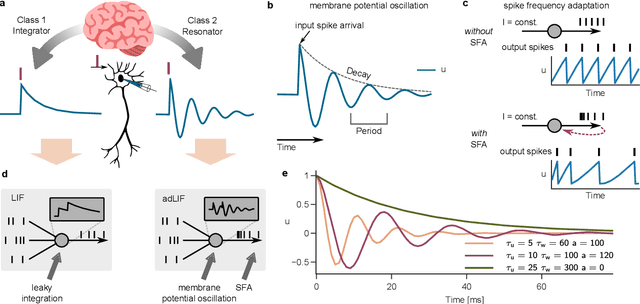

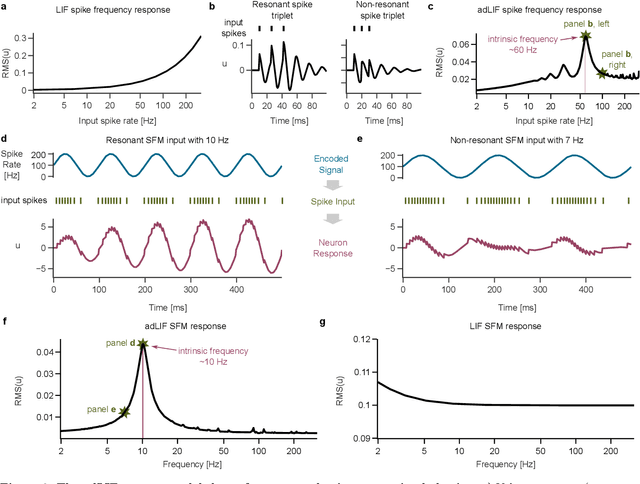

Efficient implementations of spiking neural networks on neuromorphic hardware promise orders of magnitude less power consumption than their non-spiking counterparts. The standard neuron model for spike-based computation on such neuromorphic systems has long been the leaky integrate-and-fire (LIF) neuron. As a promising advancement, a computationally light augmentation of the LIF neuron model with an adaptation mechanism experienced a recent upswing in popularity, caused by demonstrations of its superior performance on spatio-temporal processing tasks. The root of the superiority of these so-called adaptive LIF neurons however, is not well understood. In this article, we thoroughly analyze the dynamical, computational, and learning properties of adaptive LIF neurons and networks thereof. We find that the frequently observed stability problems during training of such networks can be overcome by applying an alternative discretization method that results in provably better stability properties than the commonly used Euler-Forward method. With this discretization, we achieved a new state-of-the-art performance on common event-based benchmark datasets. We also show that the superiority of networks of adaptive LIF neurons extends to the prediction and generation of complex time series. Our further analysis of the computational properties of networks of adaptive LIF neurons shows that they are particularly well suited to exploit the spatio-temporal structure of input sequences. Furthermore, these networks are surprisingly robust to shifts of the mean input strength and input spike rate, even when these shifts were not observed during training. As a consequence, high-performance networks can be obtained without any normalization techniques such as batch normalization or batch-normalization through time.