 Add to Chrome
 Add to Firefox
 Add to Edge
Reconstructing Unobservable Temperature Fields via Simulation-Aided Intelligent Sensing
Jun 03, 2026
Real-time monitoring of the temperature distribution within components and sub-structures is a challenging topic in many systems due to restrictions on feasible sensor locations. While machine learning (ML) proves a versatile tool in many applications, its adoption for high-resolution thermal monitoring is hindered by the availability of high-quality datasets for training. In this work, we propose a novel approach for generating datasets for industrial applications based on randomized physics-based simulations. We demonstrate the approach in a proof-of-concept hardware setup: A neural network (NN) trained only on such a synthetic dataset, is used to reconstruct the internal temperature field from sparse sensors embedded in the hardware. The NN-based reconstructions do not only outperform Kriging in robustness but also enable real-time inference, making the method suitable for online monitoring of otherwise unobservable thermal states.

Approximating the full-field temperature evolution in 3D electronic systems from randomized "Minecraft" systems
Sep 21, 2022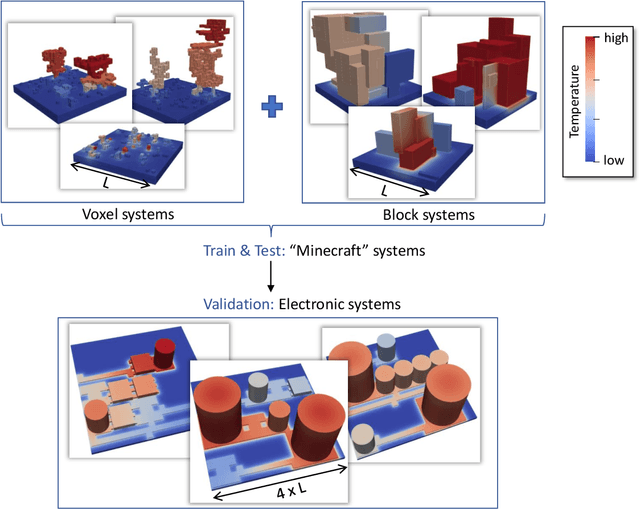
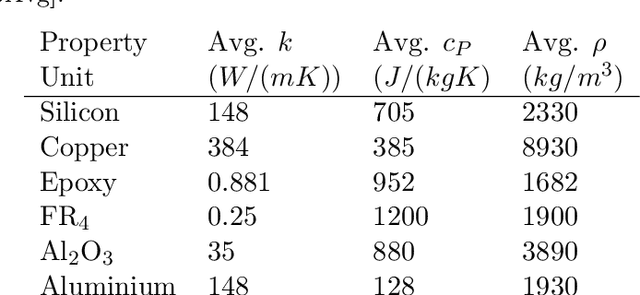
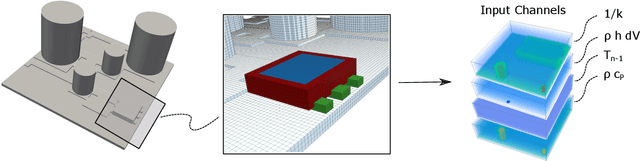
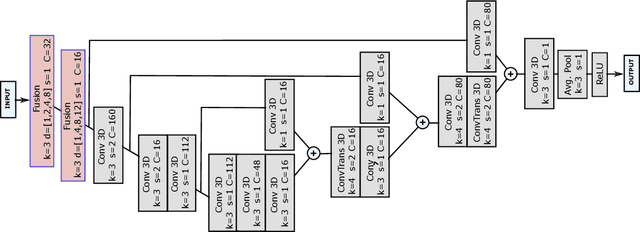
Neural Networks as fast physics simulators have a large potential for many engineering design tasks. Prerequisites for a wide-spread application are an easy-to-use workflow for generating training datasets in a reasonable time, and the capability of the network to generalize to unseen systems. In contrast to most previous works where training systems are similar to the evaluation dataset, we propose to adapt the type of training system to the network architecture. Specifically, we apply a fully convolutional network and, thus, design 3D systems of randomly located voxels with randomly assigned physical properties. The idea is tested for the transient heat diffusion in electronic systems. Training only on random "Minecraft" systems, we obtain good generalization to electronic systems four times as large as the training systems (one-step prediction error of 0.07% vs 0.8%).
Towards Real Time Thermal Simulations for Design Optimization using Graph Neural Networks
Sep 21, 2022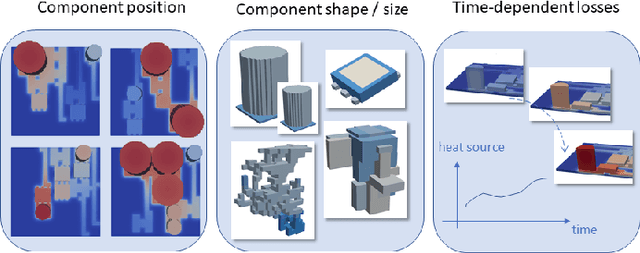
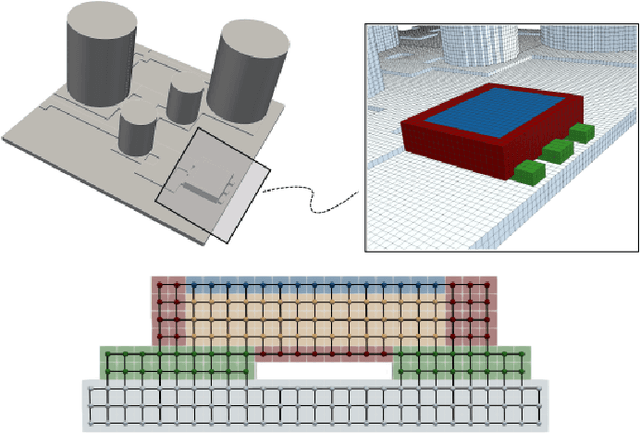

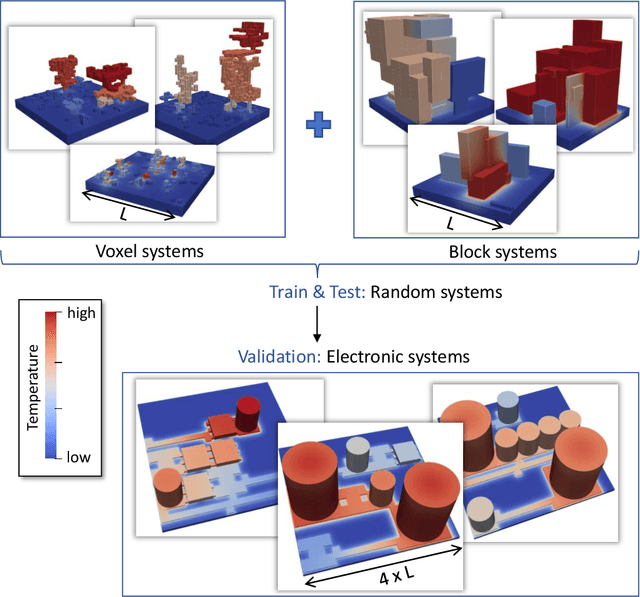
This paper presents a method to simulate the thermal behavior of 3D systems using a graph neural network. The method discussed achieves a significant speed-up with respect to a traditional finite-element simulation. The graph neural network is trained on a diverse dataset of 3D CAD designs and the corresponding finite-element simulations, representative of the different geometries, material properties and losses that appear in the design of electronic systems. We present for the transient thermal behavior of a test system. The accuracy of the network result for one-step predictions is remarkable (\SI{0.003}{\%} error). After 400 time steps, the accumulated error reaches \SI{0.78}{\%}. The computing time of each time step is \SI{50}{ms}. Reducing the accumulated error is the current focus of our work. In the future, a tool such as the one we are presenting could provide nearly instantaneous approximations of the thermal behavior of a system that can be used for design optimization.