 Add to Chrome
 Add to Firefox
 Add to Edge
Deep Invertible Autoencoders for Dimensionality Reduction of Dynamical Systems
Mar 13, 2026
Constructing reduced-order models (ROMs) capable of efficiently predicting the evolution of high-dimensional, parametric systems is crucial in many applications in engineering and applied sciences. A popular class of projection-based ROMs projects the high-dimensional full-order model (FOM) dynamics onto a low-dimensional manifold. These projection-based ROMs approaches often rely on classical model reduction techniques such as proper orthogonal decomposition (POD) or, more recently, on neural network architectures such as autoencoders (AEs). In the case that the ROM is constructed by the POD, one has approximation guaranteed based based on the singular values of the problem at hand. However, POD-based techniques can suffer from slow decay of the singular values in transport- and advection-dominated problems. In contrast to that, AEs allow for better reduction capabilities than the POD, often with the first few modes, but at the price of theoretical considerations. In addition, it is often observed, that AEs exhibits a plateau of the projection error with the increment of the dimension of the trial manifold. In this work, we propose a deep invertible AE architecture, named inv-AE, that improves upon the stagnation of the projection error typical of traditional AE architectures, e.g., convolutional, and the reconstructions quality. Inv-AE is composed of several invertible neural network layers that allows for gradually recovering more information about the FOM solutions the more we increase the dimension of the reduced manifold. Through the application of inv-AE to a parametric 1D Burgers' equation and a parametric 2D fluid flow around an obstacle with variable geometry, we show that (i) inv-AE mitigates the issue of the characteristic plateau of (convolutional) AEs and (ii) inv-AE can be combined with popular projection-based ROM approaches to improve their accuracy.

Leveraging time and parameters for nonlinear model reduction methods
Jan 07, 2025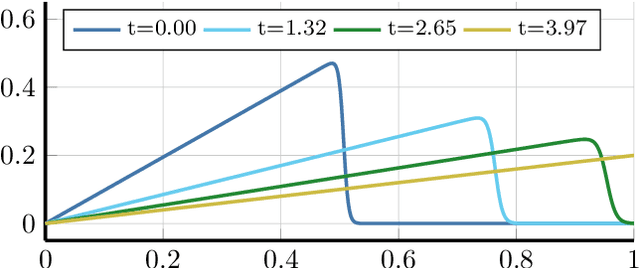
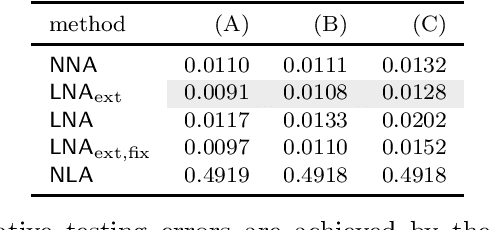
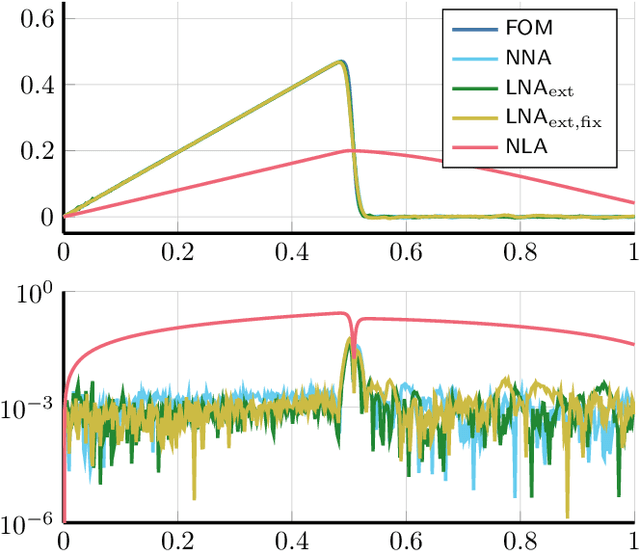

In this paper, we consider model order reduction (MOR) methods for problems with slowly decaying Kolmogorov $n$-widths as, e.g., certain wave-like or transport-dominated problems. To overcome this Kolmogorov barrier within MOR, nonlinear projections are used, which are often realized numerically using autoencoders. These autoencoders generally consist of a nonlinear encoder and a nonlinear decoder and involve costly training of the hyperparameters to obtain a good approximation quality of the reduced system. To facilitate the training process, we show that extending the to-be-reduced system and its corresponding training data makes it possible to replace the nonlinear encoder with a linear encoder without sacrificing accuracy, thus roughly halving the number of hyperparameters to be trained.
Symplectic model reduction of Hamiltonian systems using data-driven quadratic manifolds
May 24, 2023This work presents two novel approaches for the symplectic model reduction of high-dimensional Hamiltonian systems using data-driven quadratic manifolds. Classical symplectic model reduction approaches employ linear symplectic subspaces for representing the high-dimensional system states in a reduced-dimensional coordinate system. While these approximations respect the symplectic nature of Hamiltonian systems, the linearity of the approximation imposes a fundamental limitation to the accuracy that can be achieved. We propose two different model reduction methods based on recently developed quadratic manifolds, each presenting its own advantages and limitations. The addition of quadratic terms in the state approximation, which sits at the heart of the proposed methodologies, enables us to better represent intrinsic low-dimensionality in the problem at hand. Both approaches are effective for issuing predictions in settings well outside the range of their training data while providing more accurate solutions than the linear symplectic reduced-order models.
The Oracle of DLphi
Jan 27, 2019We present a novel technique based on deep learning and set theory which yields exceptional classification and prediction results. Having access to a sufficiently large amount of labelled training data, our methodology is capable of predicting the labels of the test data almost always even if the training data is entirely unrelated to the test data. In other words, we prove in a specific setting that as long as one has access to enough data points, the quality of the data is irrelevant.