 Add to Chrome
 Add to Firefox
 Add to Edge
FEKAN: Feature-Enriched Kolmogorov-Arnold Networks
Feb 18, 2026
Kolmogorov-Arnold Networks (KANs) have recently emerged as a compelling alternative to multilayer perceptrons, offering enhanced interpretability via functional decomposition. However, existing KAN architectures, including spline-, wavelet-, radial-basis variants, etc., suffer from high computational cost and slow convergence, limiting scalability and practical applicability. Here, we introduce Feature-Enriched Kolmogorov-Arnold Networks (FEKAN), a simple yet effective extension that preserves all the advantages of KAN while improving computational efficiency and predictive accuracy through feature enrichment, without increasing the number of trainable parameters. By incorporating these additional features, FEKAN accelerates convergence, increases representation capacity, and substantially mitigates the computational overhead characteristic of state-of-the-art KAN architectures. We investigate FEKAN across a comprehensive set of benchmarks, including function-approximation tasks, physics-informed formulations for diverse partial differential equations (PDEs), and neural operator settings that map between input and output function spaces. For function approximation, we systematically compare FEKAN against a broad family of KAN variants, FastKAN, WavKAN, ReLUKAN, HRKAN, ChebyshevKAN, RBFKAN, and the original SplineKAN. Across all tasks, FEKAN demonstrates substantially faster convergence and consistently higher approximation accuracy than the underlying baseline architectures. We also establish the theoretical foundations for FEKAN, showing its superior representation capacity compared to KAN, which contributes to improved accuracy and efficiency.

Anant-Net: Breaking the Curse of Dimensionality with Scalable and Interpretable Neural Surrogate for High-Dimensional PDEs
May 07, 2025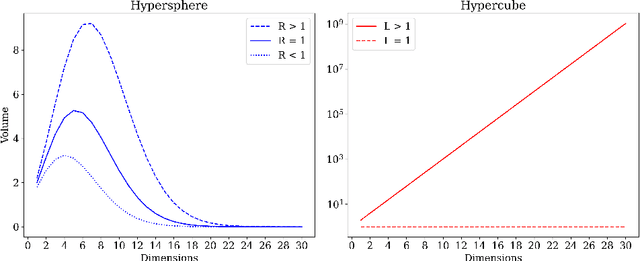

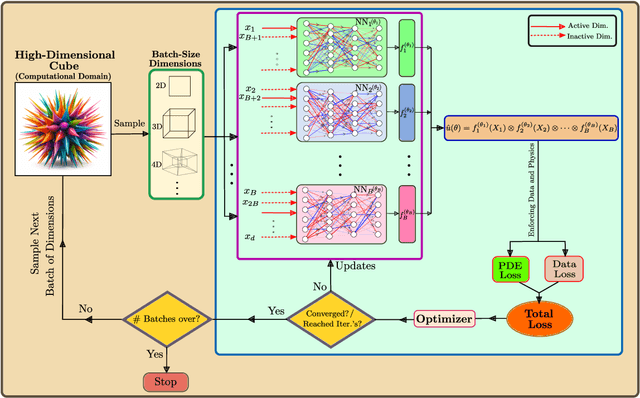

High-dimensional partial differential equations (PDEs) arise in diverse scientific and engineering applications but remain computationally intractable due to the curse of dimensionality. Traditional numerical methods struggle with the exponential growth in computational complexity, particularly on hypercubic domains, where the number of required collocation points increases rapidly with dimensionality. Here, we introduce Anant-Net, an efficient neural surrogate that overcomes this challenge, enabling the solution of PDEs in high dimensions. Unlike hyperspheres, where the internal volume diminishes as dimensionality increases, hypercubes retain or expand their volume (for unit or larger length), making high-dimensional computations significantly more demanding. Anant-Net efficiently incorporates high-dimensional boundary conditions and minimizes the PDE residual at high-dimensional collocation points. To enhance interpretability, we integrate Kolmogorov-Arnold networks into the Anant-Net architecture. We benchmark Anant-Net's performance on several linear and nonlinear high-dimensional equations, including the Poisson, Sine-Gordon, and Allen-Cahn equations, demonstrating high accuracy and robustness across randomly sampled test points from high-dimensional space. Importantly, Anant-Net achieves these results with remarkable efficiency, solving 300-dimensional problems on a single GPU within a few hours. We also compare Anant-Net's results for accuracy and runtime with other state-of-the-art methods. Our findings establish Anant-Net as an accurate, interpretable, and scalable framework for efficiently solving high-dimensional PDEs.