 Add to Chrome
 Add to Firefox
 Add to Edge
Lifted Schrödinger Bridges for Gaussian Mixture Endpoints: Projection Gaps and Path-Space Obstructions
May 24, 2026
We study stochastic density control between Gaussian-mixture endpoint distributions under Brownian prior dynamics. Since the direct Schrödinger bridge between Gaussian mixtures is generally not available in closed form, we introduce a lifted path-space construction in which each trajectory is augmented with a source--target component label. Consequently, the problem decomposes into Gaussian component-to-component Schrödinger bridges with explicit marginal, drift, and cost formulas, while the mixture-level assignment reduces to a finite-dimensional entropic coupling problem with a Sinkhorn scaling form. We then analyze the projection obtained by discarding or forgetting the label. By construction, the projected law satisfies the original Gaussian-mixture endpoint constraints, but its relative entropy generally differs from the lifted relative entropy by a nonnegative conditional label-information gap. This gap reveals a path-space obstruction: the lifted optimizer cannot, in general, be identified with the direct unlabeled Schrödinger bridge after projection. We also derive the posterior-averaged Markov drift associated with the projected marginal flow, prove a kinetic-energy upper bound, and identify a common path-potential condition under which the projection gap vanishes. Several numerical illustrations showing density and shape control are recorded for a self-contained exposition.

Globally Solving Unbalanced Optimal Transport and Density Control for Gaussian Distributions
May 05, 2026In this article, we study unbalanced optimal transport (UOT) and establish a control-theoretic dynamical extension, which we call the unbalanced density control (UDC), for a class of Gaussian reference measures. In the static setting, we consider UOT with quadratic transport cost and Kullback--Leibler penalties on the marginals relative to prescribed Gaussian measures. We show that the infinite-dimensional variational problem admits an exact Gaussian reduction, yielding a finite-dimensional optimization over masses, means, and covariances, together with a closed-form expression for the optimal transported mass. We then formulate UDC for discrete-time linear systems, where the initial and terminal state measures are imposed softly through KL penalties and the intermediate evolution is governed by controlled linear dynamics with quadratic control cost. For this problem, we prove that any feasible solution can be replaced, without loss of optimality, by a Gaussian initial measure and an affine-Gaussian control policy. This leads to an exact finite-dimensional reformulation and, after a standard covariance-steering lifting, to an SDP-based optimization for fixed mass, again coupled with a closed-form mass update. We further establish existence of optimal solutions and identify a sufficient condition under which the affine-Gaussian UDC policy is deterministic. These results provide globally optimal solution methods for both Gaussian UOT and Gaussian UDC. Finally, we illustrate our results with several numerical examples.
OT-DETECT: Optimal transport-driven attack detection in cyber-physical systems
Mar 17, 2026This article presents an optimal-transport (OT)-driven, distributionally robust attack detection algorithm, OT-DETECT, for cyber-physical systems (CPS) modeled as partially observed linear stochastic systems. The underlying detection problem is formulated as a minmax optimization problem using 1-Wasserstein ambiguity sets constructed from observer residuals under both the nominal (attack-free) and attacked regimes. We show that the minmax detection problem can be reduced to a finite-dimensional linear program for computing the worst-case distribution (WCD). Off-support residuals are handled via a kernel-smoothed score function that drives a CUSUM procedure for sequential detection. We also establish a non-asymptotic tail bound on the false-positive error of the CUSUM statistic under the nominal (attack-free) condition, under mild assumptions. Numerical illustrations are provided to evaluate the robustness properties of OT-DETECT.
Robust maximum hands-off optimal control: existence, maximum principle, and $L^{0}$-$L^1$ equivalence
Jan 12, 2026This work advances the maximum hands-off sparse control framework by developing a robust counterpart for constrained linear systems with parametric uncertainties. The resulting optimal control problem minimizes an $L^{0}$ objective subject to an uncountable, compact family of constraints, and is therefore a nonconvex, nonsmooth robust optimization problem. To address this, we replace the $L^{0}$ objective with its convex $L^{1}$ surrogate and, using a nonsmooth variant of the robust Pontryagin maximum principle, show that the $L^{0}$ and $L^{1}$ formulations have identical sets of optimal solutions -- we call this the robust hands-off principle. Building on this equivalence, we propose an algorithmic framework -- drawing on numerically viable techniques from the semi-infinite robust optimization literature -- to solve the resulting problems. An illustrative example is provided to demonstrate the effectiveness of the approach.
Formation Shape Control using the Gromov-Wasserstein Metric
Mar 27, 2025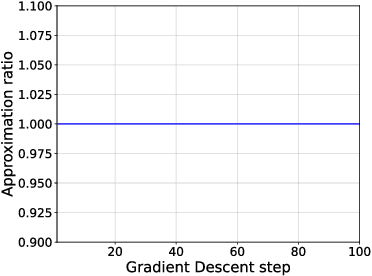
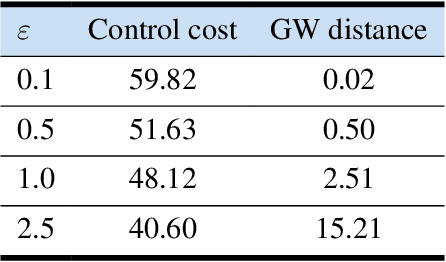
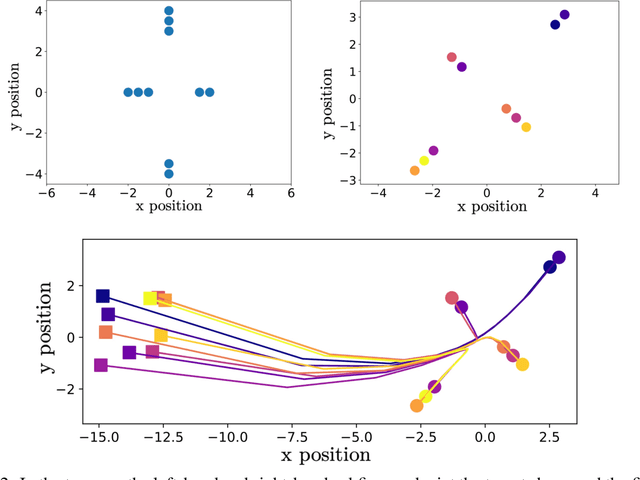
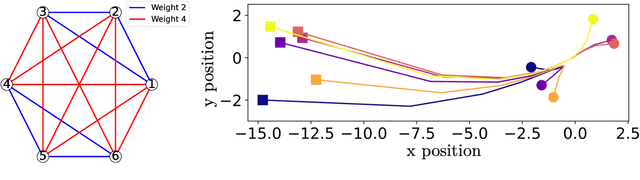
This article introduces a formation shape control algorithm, in the optimal control framework, for steering an initial population of agents to a desired configuration via employing the Gromov-Wasserstein distance. The underlying dynamical system is assumed to be a constrained linear system and the objective function is a sum of quadratic control-dependent stage cost and a Gromov-Wasserstein terminal cost. The inclusion of the Gromov-Wasserstein cost transforms the resulting optimal control problem into a well-known NP-hard problem, making it both numerically demanding and difficult to solve with high accuracy. Towards that end, we employ a recent semi-definite relaxation-driven technique to tackle the Gromov-Wasserstein distance. A numerical example is provided to illustrate our results.