 Add to Chrome
 Add to Firefox
 Add to Edge
Globally Solving Unbalanced Optimal Transport and Density Control for Gaussian Distributions
May 05, 2026
In this article, we study unbalanced optimal transport (UOT) and establish a control-theoretic dynamical extension, which we call the unbalanced density control (UDC), for a class of Gaussian reference measures. In the static setting, we consider UOT with quadratic transport cost and Kullback--Leibler penalties on the marginals relative to prescribed Gaussian measures. We show that the infinite-dimensional variational problem admits an exact Gaussian reduction, yielding a finite-dimensional optimization over masses, means, and covariances, together with a closed-form expression for the optimal transported mass. We then formulate UDC for discrete-time linear systems, where the initial and terminal state measures are imposed softly through KL penalties and the intermediate evolution is governed by controlled linear dynamics with quadratic control cost. For this problem, we prove that any feasible solution can be replaced, without loss of optimality, by a Gaussian initial measure and an affine-Gaussian control policy. This leads to an exact finite-dimensional reformulation and, after a standard covariance-steering lifting, to an SDP-based optimization for fixed mass, again coupled with a closed-form mass update. We further establish existence of optimal solutions and identify a sufficient condition under which the affine-Gaussian UDC policy is deterministic. These results provide globally optimal solution methods for both Gaussian UOT and Gaussian UDC. Finally, we illustrate our results with several numerical examples.

Formation Shape Control using the Gromov-Wasserstein Metric
Mar 27, 2025
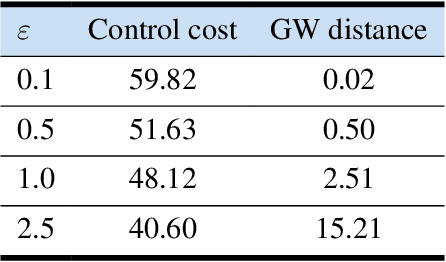
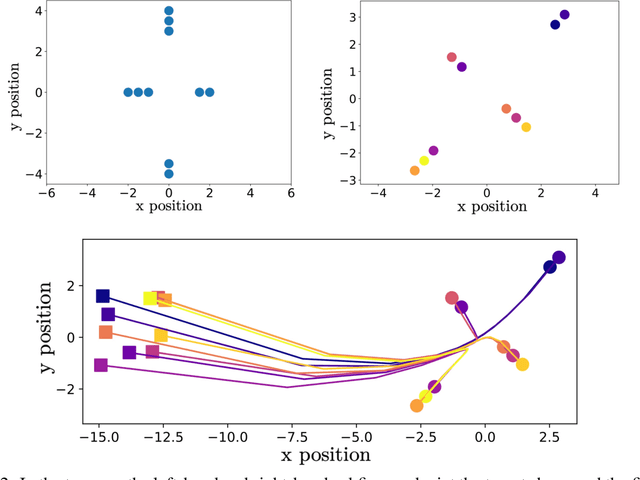
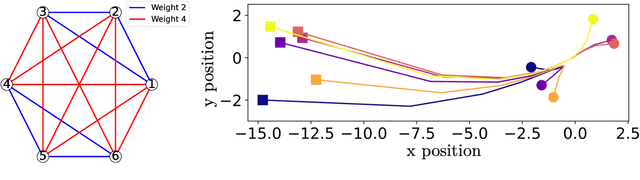
This article introduces a formation shape control algorithm, in the optimal control framework, for steering an initial population of agents to a desired configuration via employing the Gromov-Wasserstein distance. The underlying dynamical system is assumed to be a constrained linear system and the objective function is a sum of quadratic control-dependent stage cost and a Gromov-Wasserstein terminal cost. The inclusion of the Gromov-Wasserstein cost transforms the resulting optimal control problem into a well-known NP-hard problem, making it both numerically demanding and difficult to solve with high accuracy. Towards that end, we employ a recent semi-definite relaxation-driven technique to tackle the Gromov-Wasserstein distance. A numerical example is provided to illustrate our results.