 Add to Chrome
 Add to Firefox
 Add to Edge
HQF-Net: A Hybrid Quantum-Classical Multi-Scale Fusion Network for Remote Sensing Image Segmentation
Apr 08, 2026
Remote sensing semantic segmentation requires models that can jointly capture fine spatial details and high-level semantic context across complex scenes. While classical encoder-decoder architectures such as U-Net remain strong baselines, they often struggle to fully exploit global semantics and structured feature interactions. In this work, we propose HQF-Net, a hybrid quantum-classical multi-scale fusion network for remote sensing image segmentation. HQF-Net integrates multi-scale semantic guidance from a frozen DINOv3 ViT-L/16 backbone with a customized U-Net architecture through a Deformable Multiscale Cross-Attention Fusion (DMCAF) module. To enhance feature refinement, the framework further introduces quantum-enhanced skip connections (QSkip) and a Quantum bottleneck with Mixture-of-Experts (QMoE), which combines complementary local, global, and directional quantum circuits within an adaptive routing mechanism. Experiments on three remote sensing benchmarks show consistent improvements with the proposed design. HQF-Net achieves 0.8568 mIoU and 96.87% overall accuracy on LandCover.ai, 71.82% mIoU on OpenEarthMap, and 55.28% mIoU with 99.37% overall accuracy on SeasoNet. An architectural ablation study further confirms the contribution of each major component. These results show that structured hybrid quantum-classical feature processing is a promising direction for improving remote sensing semantic segmentation under near-term quantum constraints.
* 17 pages

AerOSeg: Harnessing SAM for Open-Vocabulary Segmentation in Remote Sensing Images
Apr 12, 2025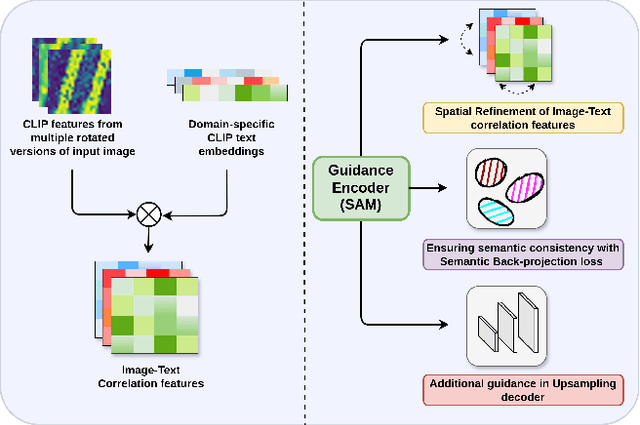
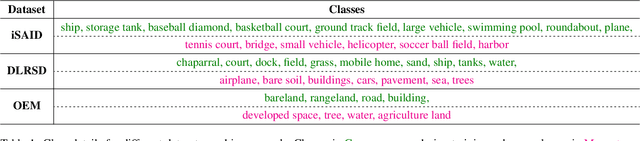
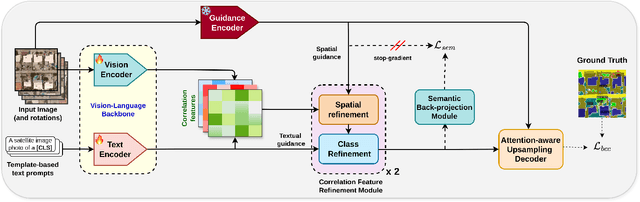
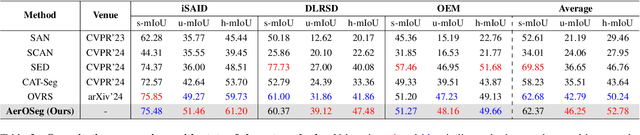
Image segmentation beyond predefined categories is a key challenge in remote sensing, where novel and unseen classes often emerge during inference. Open-vocabulary image Segmentation addresses these generalization issues in traditional supervised segmentation models while reducing reliance on extensive per-pixel annotations, which are both expensive and labor-intensive to obtain. Most Open-Vocabulary Segmentation (OVS) methods are designed for natural images but struggle with remote sensing data due to scale variations, orientation changes, and complex scene compositions. This necessitates the development of OVS approaches specifically tailored for remote sensing. In this context, we propose AerOSeg, a novel OVS approach for remote sensing data. First, we compute robust image-text correlation features using multiple rotated versions of the input image and domain-specific prompts. These features are then refined through spatial and class refinement blocks. Inspired by the success of the Segment Anything Model (SAM) in diverse domains, we leverage SAM features to guide the spatial refinement of correlation features. Additionally, we introduce a semantic back-projection module and loss to ensure the seamless propagation of SAM's semantic information throughout the segmentation pipeline. Finally, we enhance the refined correlation features using a multi-scale attention-aware decoder to produce the final segmentation map. We validate our SAM-guided Open-Vocabulary Remote Sensing Segmentation model on three benchmark remote sensing datasets: iSAID, DLRSD, and OpenEarthMap. Our model outperforms state-of-the-art open-vocabulary segmentation methods, achieving an average improvement of 2.54 h-mIoU.