 Add to Chrome
 Add to Firefox
 Add to Edge
SplatSearch: Instance Image Goal Navigation for Mobile Robots using 3D Gaussian Splatting and Diffusion Models
Nov 17, 2025
The Instance Image Goal Navigation (IIN) problem requires mobile robots deployed in unknown environments to search for specific objects or people of interest using only a single reference goal image of the target. This problem can be especially challenging when: 1) the reference image is captured from an arbitrary viewpoint, and 2) the robot must operate with sparse-view scene reconstructions. In this paper, we address the IIN problem, by introducing SplatSearch, a novel architecture that leverages sparse-view 3D Gaussian Splatting (3DGS) reconstructions. SplatSearch renders multiple viewpoints around candidate objects using a sparse online 3DGS map, and uses a multi-view diffusion model to complete missing regions of the rendered images, enabling robust feature matching against the goal image. A novel frontier exploration policy is introduced which uses visual context from the synthesized viewpoints with semantic context from the goal image to evaluate frontier locations, allowing the robot to prioritize frontiers that are semantically and visually relevant to the goal image. Extensive experiments in photorealistic home and real-world environments validate the higher performance of SplatSearch against current state-of-the-art methods in terms of Success Rate and Success Path Length. An ablation study confirms the design choices of SplatSearch.

4CNet: A Confidence-Aware, Contrastive, Conditional, Consistency Model for Robot Map Prediction in Multi-Robot Environments
Feb 27, 2024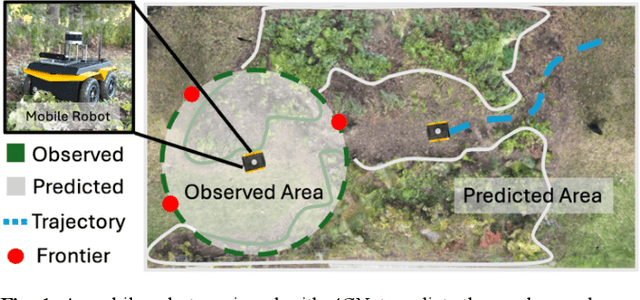
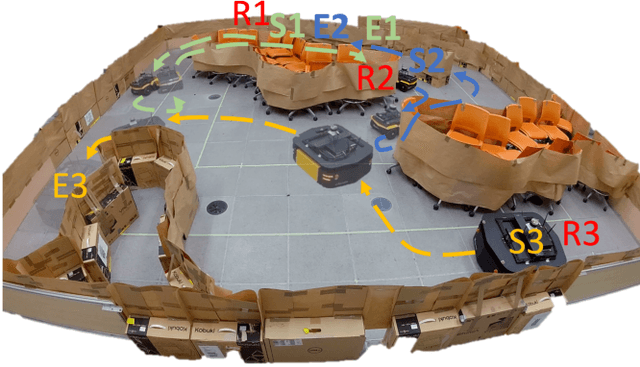
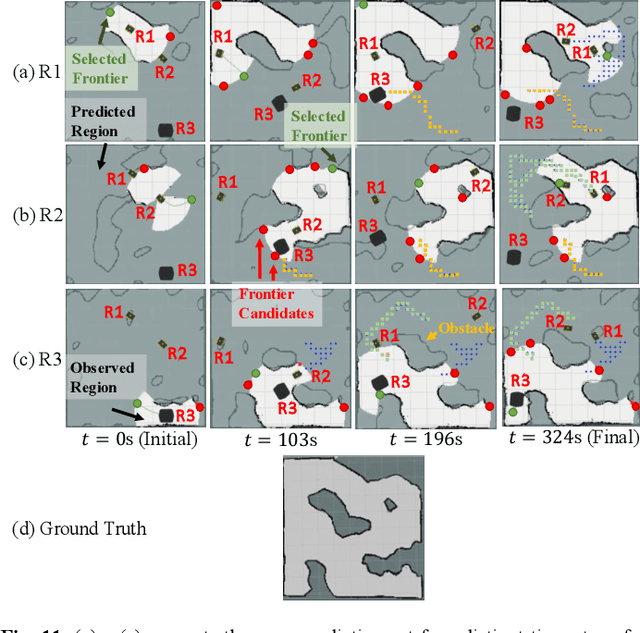
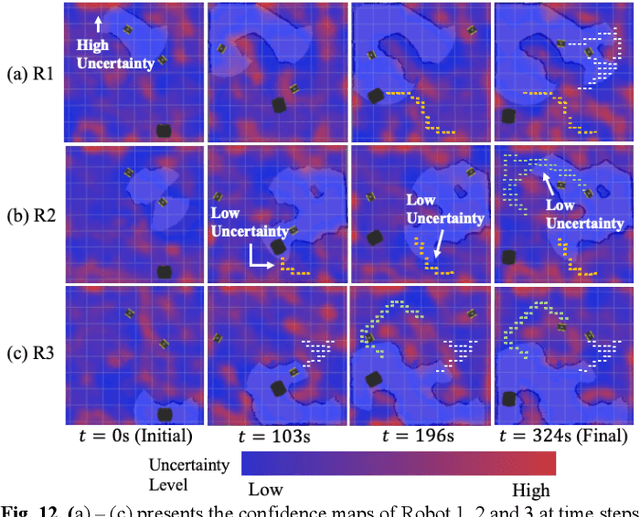
Mobile robots in unknown cluttered environments with irregularly shaped obstacles often face sensing, energy, and communication challenges which directly affect their ability to explore these environments. In this paper, we introduce a novel deep learning method, Confidence-Aware Contrastive Conditional Consistency Model (4CNet), for mobile robot map prediction during resource-limited exploration in multi-robot environments. 4CNet uniquely incorporates: 1) a conditional consistency model for map prediction in irregularly shaped unknown regions, 2) a contrastive map-trajectory pretraining framework for a trajectory encoder that extracts spatial information from the trajectories of nearby robots during map prediction, and 3) a confidence network to measure the uncertainty of map prediction for effective exploration under resource constraints. We incorporate 4CNet within our proposed robot exploration with map prediction architecture, 4CNet-E. We then conduct extensive comparison studies with 4CNet-E and state-of-the-art heuristic and learning methods to investigate both map prediction and exploration performance in environments consisting of uneven terrain and irregularly shaped obstacles. Results showed that 4CNet-E obtained statistically significant higher prediction accuracy and area coverage with varying environment sizes, number of robots, energy budgets, and communication limitations. Real-world mobile robot experiments were performed and validated the feasibility and generalizability of 4CNet-E for mobile robot map prediction and exploration.