 Add to Chrome
 Add to Firefox
 Add to Edge
Anti-Hyperspectral Anomaly Detection: A First Study on Stealthy Lipschitz-Forcing Perturbations Against Unknown Detectors
Jun 03, 2026
Hyperspectral imagery represents the best contemporary technology to remotely detect anomalous objects. Nevertheless, hyperspectral anomaly detection (HAD) technique makes ground facilities/situations completely exposed. For the first time, we develop the first anti-HAD (AHAD) technique rendering the key objects undetected, without perfect coordinate/position state information (CSI) of the detectors (e.g., reconnaissance aircraft). Our AHAD algorithm is generally applicable to defend against almost all the existing benchmark data-driven and model-driven HAD methods. AHAD is fundamentally different from conventional adversarial attacks, so novel theory is needed. We customize novel regularizers for assimilating real anomalies into the backgrounds (ARAB) and fooling the detectors with pseudo-anomalies, thereby optimizing an energy-efficient stealthy perturbation signal for AHAD. The ARAB regularization is mathematically interpretable as flattening the topology-enhanced anomaly/background structures in the feature space, hence termed Lipschitz-forcing perturbations. Considering the imperfect CSI, we further develop a robust AHAD criterion, where the uncertainty is mathematically described as matrix-shifting misalignment for statistically generating the robust perturbation. Comprehensive experiments demonstrate the effectiveness and robustness of our AHAD algorithm across diverse real-world datasets. Remarkably, our algorithm generates a single AHAD perturbation signal that can simultaneously evade almost all benchmark detectors, greatly enhancing its practicality, given that the reconnaissance detector type is usually unknown. To the best of our knowledge, this is the first formal AHAD study. As a side contribution, we propose a new quantitative performance index, ArmCBA, to evaluate the robustness of an HAD method against our AHAD signal.

Hyperspectral Anomaly Detection Using Einstein Fuzzy Computing and Quantum Neural Network
May 06, 2026In the remote sensing (RS) field, hyperspectral imagery provides rich spectral information and facilitates numerous critical applications, such as material identification. Among these applications, hyperspectral anomaly detection (HAD) aims to detect substances whose spectral characteristics deviate from background spectra, which are termed anomalies. However, many widely used HAD algorithms in the RS community identify anomalies by relying on a ``background reconstruction'' strategy. Furthermore, the lack of prior target hyperspectrum and real-world limitations collectively reduces the spectral discrepancy between anomaly and background, limiting the performance of mainstream detections. By exploring the widely applicable fuzzy theory in the RS field, this study develops an unsupervised hybrid quantum-fuzzy multi-criteria decision framework (HyFuHAD) to detect anomalies from multiple perspectives. In our HyFuHAD, each pixel is first fuzzified using multiple HAD-based membership functions (MFs), including morphological, geometrical, and statistical MFs, to obtain various types of fuzzy degrees. Then, a multi-fuzzy-rule system, empowered by Einstein fuzzy computing, infers the classical fuzzy detection from these fuzzy degrees with sub-second-level computing. The Einstein sum and product provide significantly smoother transitions compared to typical min-max-based fuzzy ``OR'' and ``AND'' during the fuzzy matching and inference steps, thereby enabling effective detections. Moreover, a lightweight quantum defuzzifier obtains the quantum fuzzy detection from fuzzy features derived from the proposed fuzzy feature aggregation network. Experiments demonstrate that our HyFuHAD algorithm achieves state-of-the-art performance by fusing the information from the quantum and classical detectors. The demo code will be publicly available at https://github.com/IHCLab/HyFuHAD.
Underdetermined Blind Source Separation via Weighted Simplex Shrinkage Regularization and Quantum Deep Image Prior
Mar 26, 2026As most optical satellites remotely acquire multispectral images (MSIs) with limited spatial resolution, multispectral unmixing (MU) becomes a critical signal processing technology for analyzing the pure material spectra for high-precision classification and identification. Unlike the widely investigated hyperspectral unmixing (HU) problem, MU is much more challenging as it corresponds to the underdetermined blind source separation (BSS) problem, where the number of sources is larger than the number of available multispectral bands. In this article, we transform MU into its overdetermined counterpart (i.e., HU) by inventing a radically new quantum deep image prior (QDIP), which relies on the virtual band-splitting task conducted on the observed MSI for generating the virtual hyperspectral image (HSI). Then, we perform HU on the virtual HSI to obtain the virtual hyperspectral sources. Though HU is overdetermined, it still suffers from the ill-posed issue, for which we employ the convex geometry structure of the HSI pixels to customize a weighted simplex shrinkage (WSS) regularizer to mitigate the ill-posedness. Finally, the virtual hyperspectral sources are spectrally downsampled to obtain the desired multispectral sources. The proposed geometry/quantum-empowered MU (GQ-$μ$) algorithm can also effectively obtain the spatial abundance distribution map for each source, where the geometric WSS regularization is adaptively and automatically controlled based on the sparsity pattern of the abundance tensor. Simulation and real-world data experiments demonstrate the practicality of our unsupervised GQ-$μ$ algorithm for the challenging MU task. Ablation study demonstrates the strength of QDIP, not achieved by classical DIP, and validates the mechanics-inspired WSS geometry regularizer.
* Published in: IEEE Transactions on Image Processing ( Volume: 35)
Spectral Super-Resolution via Adversarial Unfolding and Data-Driven Spectrum Regularization: From Multispectral Satellite Data to NASA Hyperspectral Image
Mar 01, 2026The European Space Agency's Sentinel-2 satellite provides global multispectral coverage for remote sensing (RS) applications. However, limited spectral resolution (12 bands) and non-unified spatial resolution (60/20/10 m) restrict their practicality. In contrast, the high spectral-spatial resolution sensor (e.g., NASA's AVIRIS-NG) covers only the American region due to practical considerations. This raises a fundamental question: ``Can a global hyperspectral coverage be achieved by reconstructing Sentinel-2 data to NASA hyperspectral images?'' This study aims to achieve spectral super-resolution from 12-to-186 and unify the spatial resolution of Sentinel-2 data to 5 m. To enable a reliable and efficient reconstruction, we formulate a novel deep unfolding framework regularized by a data-driven spectrum prior from PriorNet, instead of relying on implicit deep priors as conventional deep unfolding does. Moreover, an adversarial term is integrated into the unfolded architecture, enabling the discriminator to guide the reconstruction in both the training and testing phases; we term this novel concept unfolding adversarial learning (UAL). Experiments show that our UALNet outperforms the next-best Transformer in PSNR, SSIM, and SAM, while requiring only 15% MACs and 20 times fewer parameters. The associated code will be publicly available at https://sites.google.com/view/chiahsianglin/software.
HyperKING: Quantum-Classical Generative Adversarial Networks for Hyperspectral Image Restoration
Apr 16, 2025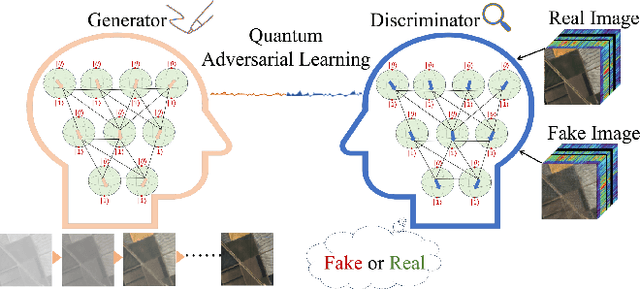
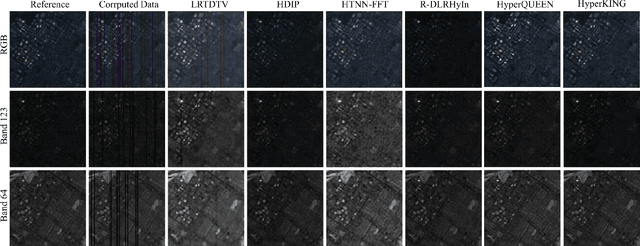
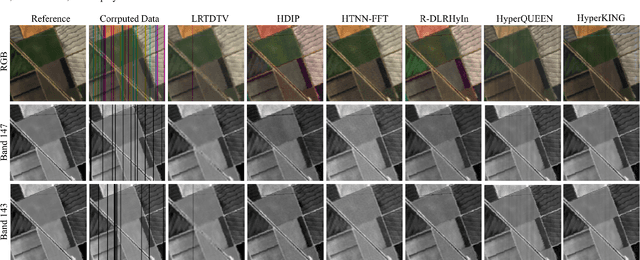
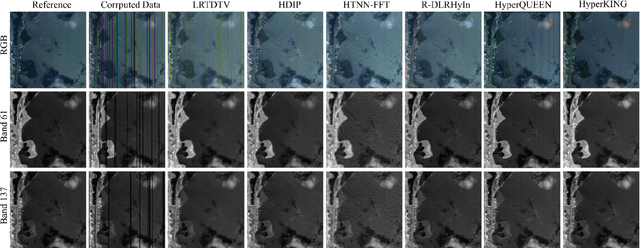
Quantum machine intelligence starts showing its impact on satellite remote sensing (SRS). Also, recent literature exhibits that quantum generative intelligences encompass superior potential than their classical counterpart, motivating us to develop quantum generative adversarial networks (GANs) for SRS. However, existing quantum GANs are restricted by the limited quantum bit (qubit) resources of current quantum computers and process merely a small 2x2 grayscale image, far from being applicable to SRS. Recently, the novel concept of hybrid quantum-classical GAN, a quantum generator with a classical discriminator, has upgraded the order to 28x28 (still grayscale), whereas it is still insufficient for SRS. This motivates us to design a radically new hybrid framework, where both generator and discriminator are hybrid architectures. We demonstrate this feasibility, leading to a breakthrough of processing 128x128 hyperspectral images for SRS. Specifically, we design the quantum part with mathematically provable quantum full expressibility (FE) to address core signal processing tasks, wherein the FE property allows the quantum network to realize any valid quantum operator with appropriate training. The classical part, composed of convolutional layers, treats the read-in (compressing the optical information into limited qubits) and read-out (addressing the quantum collapse effect) procedures. The proposed innovative hybrid quantum GAN, named Hyperspectral Knot-like IntelligeNt dIscrimiNator and Generator (HyperKING), where knot partly symbolizes the quantum entanglement and partly the compressed quantum domain in the central part of the network architecture. HyperKING significantly surpasses the classical approaches in hyperspectral tensor completion, mixed noise removal (about 3dB improvement), and blind source separation results.