 Add to Chrome
 Add to Firefox
 Add to Edge
Bridging Restoration and Generation Manifolds in One-Step Diffusion for Real-World Super-Resolution
Apr 27, 2026
Pretrained diffusion models have revolutionized real-world image super-resolution (Real-ISR) but suffer from computational bottlenecks due to iterative sampling. Recent single-step distillation accelerates inference but faces a stark perception-distortion trade-off due to rigid timestep initialization, distributional trajectory mismatches, and fragile stochastic modulation. To address this, we present Adaptive Inversion and Degradation-aware Sampling for Real-ISR (IDaS-SR), a one-step framework bridging the deterministic restoration and stochastic generation manifolds. At its core, the Manifold Inversion Noise Estimator (MINE) resolves these initialization and trajectory mismatches by predicting a severity-aware timestep and inversion noise, precisely anchoring low-quality latents onto the diffusion trajectory. Furthermore, to mitigate fragile stochastic modulation, we propose CHARIOT, a continuous generative steering mechanism. By rescheduling trajectories and interpolating noise, it enables explicit navigation of the perception-distortion boundary without compromising structural priors. Extensive experiments demonstrate that IDaS-SR outperforms state-of-the-art methods, seamlessly transitioning from a rigorous structural restorer to a sophisticated texture hallucinator in a single inference step.

Zero-shot Adaptation of Stable Diffusion via Plug-in Hierarchical Degradation Representation for Real-World Super-Resolution
Dec 11, 2025Real-World Image Super-Resolution (Real-ISR) aims to recover high-quality images from low-quality inputs degraded by unknown and complex real-world factors. Real-world scenarios involve diverse and coupled degradations, making it necessary to provide diffusion models with richer and more informative guidance. However, existing methods often assume known degradation severity and rely on CLIP text encoders that cannot capture numerical severity, limiting their generalization ability. To address this, we propose \textbf{HD-CLIP} (\textbf{H}ierarchical \textbf{D}egradation CLIP), which decomposes a low-quality image into a semantic embedding and an ordinal degradation embedding that captures ordered relationships and allows interpolation across unseen levels. Furthermore, we integrated it into diffusion models via classifier-free guidance (CFG) and proposed classifier-free projection guidance (CFPG). HD-CLIP leverages semantic cues to guide generative restoration while using degradation cues to suppress undesired hallucinations and artifacts. As a \textbf{plug-and-play module}, HD-CLIP can be seamlessly integrated into various super-resolution frameworks without training, significantly improving detail fidelity and perceptual realism across diverse real-world datasets.
Rethinking the Atmospheric Scattering-driven Attention via Channel and Gamma Correction Priors for Low-Light Image Enhancement
Sep 09, 2024Low-light image enhancement remains a critical challenge in computer vision, as does the lightweight design for edge devices with the computational burden for deep learning models. In this article, we introduce an extended version of Channel-Prior and Gamma-Estimation Network (CPGA-Net), termed CPGA-Net+, which incorporates an attention mechanism driven by a reformulated Atmospheric Scattering Model and effectively addresses both global and local image processing through Plug-in Attention with gamma correction. These innovations enable CPGA-Net+ to achieve superior performance on image enhancement tasks, surpassing lightweight state-of-the-art methods with high efficiency. Our results demonstrate the model's effectiveness and show the potential applications in resource-constrained environments.
A Lightweight Low-Light Image Enhancement Network via Channel Prior and Gamma Correction
Feb 28, 2024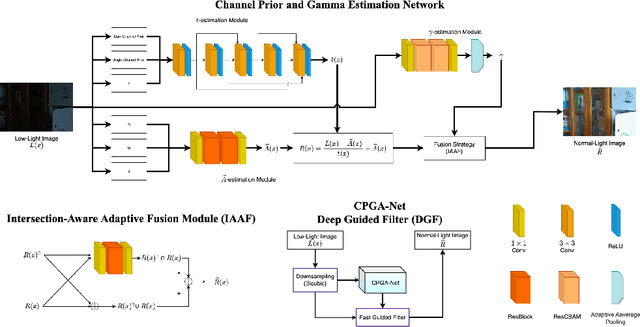
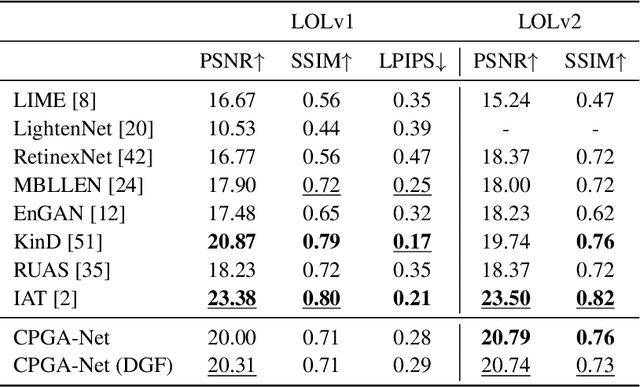

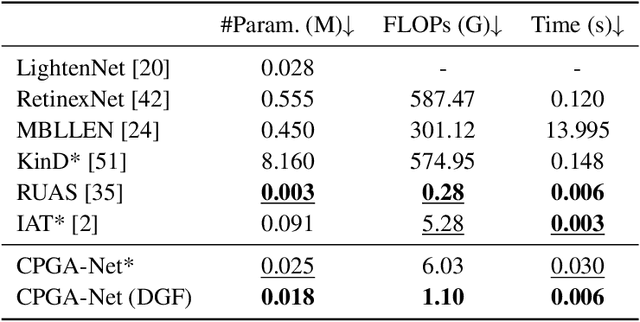
Human vision relies heavily on available ambient light to perceive objects. Low-light scenes pose two distinct challenges: information loss due to insufficient illumination and undesirable brightness shifts. Low-light image enhancement (LLIE) refers to image enhancement technology tailored to handle this scenario. We introduce CPGA-Net, an innovative LLIE network that combines dark/bright channel priors and gamma correction via deep learning and integrates features inspired by the Atmospheric Scattering Model and the Retinex Theory. This approach combines the use of traditional and deep learning methodologies, designed within a simple yet efficient architectural framework that focuses on essential feature extraction. The resulting CPGA-Net is a lightweight network with only 0.025 million parameters and 0.030 seconds for inference time, yet it achieves superior performance over existing LLIE methods on both objective and subjective evaluation criteria. Furthermore, we utilized knowledge distillation with explainable factors and proposed an efficient version that achieves 0.018 million parameters and 0.006 seconds for inference time. The proposed approaches inject new solution ideas into LLIE, providing practical applications in challenging low-light scenarios.