 Add to Chrome
 Add to Firefox
 Add to Edge
Tangent classes of matroids and wonderful compactifications
Jul 08, 2026
For every loopless matroid $M$ and every Feichtner--Yuzvinsky building set $\mathcal{G}$ containing the top flat, we construct an integral tangent class $T_{M,\mathcal{G}}^{\mathbb{Z}}\in K_{\mathbb{Z}}(M,\mathcal{G})$; in the realizable case it specializes to the class of the tangent bundle of the corresponding wonderful compactification, it recovers the Hilbert series of the Chow ring through Hirzebruch--Riemann--Roch, and it satisfies the expected Chern-alpha lower bounds. This reproduces the tangent class and its key properties studied by the first author in arXiv:2606.22650. The main body of this paper was produced autonomously, without human mathematical guidance, by Danus, an AI mathematical reasoning agent. Danus solved the problem before arXiv:2606.22650 was publicly available, demonstrating the potential of AI agents in mathematical research. We reproduce its output faithfully, adding only editorial comments; the experiment is documented in Appendix B.

Danus: Orchestrating Mathematical Reasoning Agents with Fact-Graph Memory
Jul 08, 2026Recent LLM-based mathematical reasoning agents have begun to tackle research-level problems and, in several cases, have contributed to the resolution of open problems. However, scaling and orchestrating such agents effectively remains challenging, due to the difficulty of coordinating parallel proof search while keeping intermediate claims organized and reliable. In this paper, we propose Danus, an orchestration system for research-level mathematical reasoning centered on a shared fact graph as a global memory-management mechanism. Danus consists of a main agent that performs planning and coordination, multiple worker agents that carry out proof search in parallel, and a stateless verifier that checks proposed mathematical claims before they are admitted into the fact graph. Each verified fact is stored together with its proof and logical dependencies, allowing the system to build long arguments incrementally while keeping the shared proof state organized. The main agent periodically summarizes the evolving proof state, redirects workers across promising directions, and supports interaction with human mathematicians through progress reports. We evaluate Danus through six research-level case studies in algebraic geometry, singularity theory, and combinatorics, illustrating how the fact-graph memory mechanism enables Danus to construct long, detailed mathematical proofs. Our results suggest that fact-graph-based orchestration provides an effective route toward scaling mathematical reasoning agents for long-horizon research problems. Danus is open source at https://github.com/frenzymath/Danus.
HiDiGen: Hierarchical Diffusion for B-Rep Generation with Explicit Topological Constraints
Apr 03, 2026Boundary representation (B-rep) is the standard 3D modeling format in CAD systems, encoding both geometric primitives and topological connectivity. Despite its prevalence, deep generative modeling of valid B-rep structures remains challenging due to the intricate interplay between discrete topology and continuous geometry. In this paper, we propose HiDiGen, a hierarchical generation framework that decouples geometry modeling into two stages, each guided by explicitly modeled topological constraints. Specifically, our approach first establishes face-edge incidence relations to define a coherent topological scaffold, upon which face proxies and initial edge curves are generated. Subsequently, multiple Transformer-based diffusion modules are employed to refine the geometry by generating precise face surfaces and vertex positions, with edge-vertex adjacencies dynamically established and enforced to preserve structural consistency. This progressive geometry hierarchy enables the generation of more novel and diverse shapes, while two-stage topological modeling ensures high validity. Experimental results show that HiDiGen achieves strong performance, generating novel, diverse, and topologically sound CAD models.
CM-Diff: A Single Generative Network for Bidirectional Cross-Modality Translation Diffusion Model Between Infrared and Visible Images
Mar 12, 2025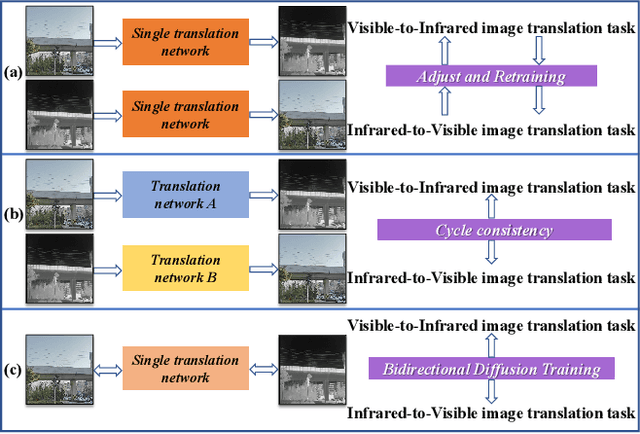
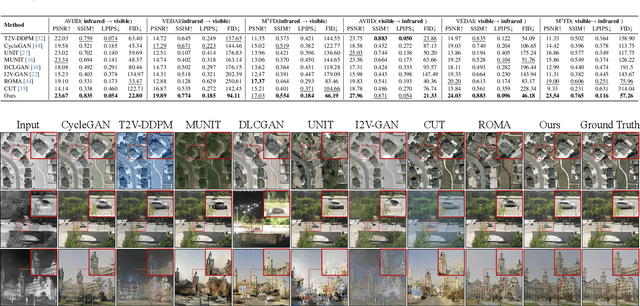
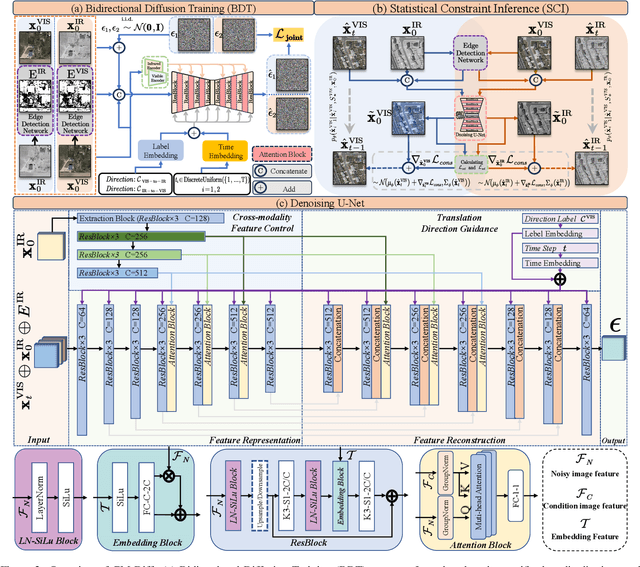

The image translation method represents a crucial approach for mitigating information deficiencies in the infrared and visible modalities, while also facilitating the enhancement of modality-specific datasets. However, existing methods for infrared and visible image translation either achieve unidirectional modality translation or rely on cycle consistency for bidirectional modality translation, which may result in suboptimal performance. In this work, we present the cross-modality translation diffusion model (CM-Diff) for simultaneously modeling data distributions in both the infrared and visible modalities. We address this challenge by combining translation direction labels for guidance during training with cross-modality feature control. Specifically, we view the establishment of the mapping relationship between the two modalities as the process of learning data distributions and understanding modality differences, achieved through a novel Bidirectional Diffusion Training (BDT) strategy. Additionally, we propose a Statistical Constraint Inference (SCI) strategy to ensure the generated image closely adheres to the data distribution of the target modality. Experimental results demonstrate the superiority of our CM-Diff over state-of-the-art methods, highlighting its potential for generating dual-modality datasets.