 Add to Chrome
 Add to Firefox
 Add to Edge
Bounded Deep Unfolding for Joint Beamforming and Scheduling in Multi-Cell MIMO Networks
Jun 03, 2026
This paper investigates the joint resource block group (RBG) scheduling and beamforming optimization problem for weighted sum-rate (WSR) maximization in multi-cell multiple-input multiple-output (MIMO) downlink networks. While the Fast Fractional Programming (FastFP) framework provides a reliable model-driven solution, it suffers from conservative continuous beamforming updates and prohibitive computational overhead during the discrete RBG matching phase. To address these bottlenecks, we propose a joint deep unfolding framework comprising two core modules: P-Net and K-Net. For continuous beamforming, P-Net learns an adaptive relaxation factor along the analytical FastFP update direction. By strictly constraining this factor within an ascent-preserving interval, P-Net accelerates the optimization trajectory while rigorously retaining monotonic improvement and stationary-point convergence guarantees. For discrete RBG scheduling, K-Net learns a long-horizon priority policy that guides a low-complexity greedy assignment, effectively preserving the assignment quality while bypassing the high complexity of Hungarian matching. Both networks leverage analytical algorithmic priors and utilize recurrent parameter sharing, enabling flexible inference beyond the training horizon. Extensive simulations demonstrate that the proposed joint framework achieves higher WSR and faster execution times than conventional model-driven baselines, while generalizing robustly across unseen network scales, antenna configurations, and channel conditions without retraining.

Trust, Geometry, and Rules: A Credibility-Aware Reinforcement Learning Framework for Safe USV Navigation under Uncertainty
May 28, 2026Autonomous navigation of Unmanned Surface Vehicles (USVs) that is safe and compliant with the International Regulations for Preventing Collisions at Sea (COLREGs) remains a formidable challenge in dynamic maritime environments, particularly when perception systems exhibit miscalibrated uncertainty. Existing Reinforcement Learning (RL)-based methods often falter because state-estimation errors induce unreliable belief states that mislead the value function, while discrete traffic rules introduce discontinuity in the learning objective. To address these challenges, we propose a framework integrating credibility-aware learning, geometric safety shielding, and continuous rule-aware embedding. First, Credibility-Weighted Value Learning (CW-VL) introduces a dynamic trust factor derived from the discrepancy between filter-estimated covariance and empirical error statistics to modulate the critic's heteroscedastic loss, preventing policy overfitting to noisy samples. Second, the Covariance-Inflated Velocity Obstacle (CI-VO) maps position-estimation uncertainty into set-wise angular margins, forming a conservative geometric shield that overrides hazardous exploratory actions. Third, Risk-Aware COLREGs Duty Embedding relaxes binary encounter duties into continuous rule-aware signals, providing smooth sector-transition information and suppressing oscillation from sparse rule rewards. Simulated encounter studies demonstrate improved training robustness against perceptual inconsistency and superior collision avoidance and COLREGs compliance over baselines.
Neural Nonlinear Shrinkage of Covariance Matrices for Minimum Variance Portfolio Optimization
Jan 22, 2026This paper introduces a neural network-based nonlinear shrinkage estimator of covariance matrices for the purpose of minimum variance portfolio optimization. It is a hybrid approach that integrates statistical estimation with machine learning. Starting from the Ledoit-Wolf (LW) shrinkage estimator, we decompose the LW covariance matrix into its eigenvalues and eigenvectors, and apply a lightweight transformer-based neural network to learn a nonlinear eigenvalue shrinkage function. Trained with portfolio risk as the loss function, the resulting precision matrix (the inverse covariance matrix) estimator directly targets portfolio risk minimization. By conditioning on the sample-to-dimension ratio, the approach remains scalable across different sample sizes and asset universes. Empirical results on stock daily returns from Standard & Poor's 500 Index (S&P500) demonstrate that the proposed method consistently achieves lower out-of-sample realized risk than benchmark approaches. This highlights the promise of integrating structural statistical models with data-driven learning.
DK-Root: A Joint Data-and-Knowledge-Driven Framework for Root Cause Analysis of QoE Degradations in Mobile Networks
Nov 13, 2025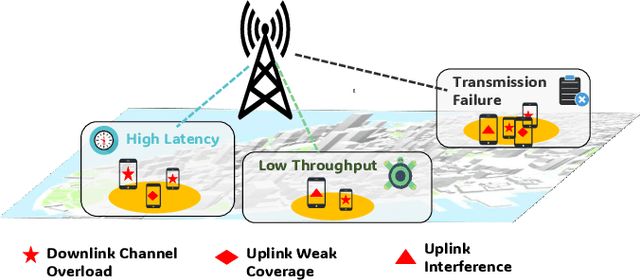
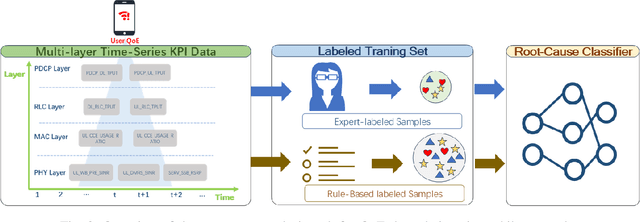
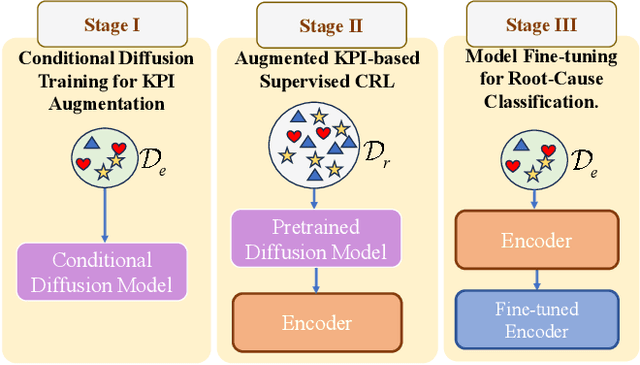
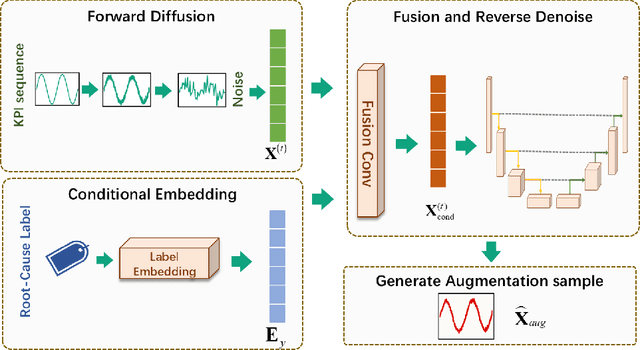
Diagnosing the root causes of Quality of Experience (QoE) degradations in operational mobile networks is challenging due to complex cross-layer interactions among kernel performance indicators (KPIs) and the scarcity of reliable expert annotations. Although rule-based heuristics can generate labels at scale, they are noisy and coarse-grained, limiting the accuracy of purely data-driven approaches. To address this, we propose DK-Root, a joint data-and-knowledge-driven framework that unifies scalable weak supervision with precise expert guidance for robust root-cause analysis. DK-Root first pretrains an encoder via contrastive representation learning using abundant rule-based labels while explicitly denoising their noise through a supervised contrastive objective. To supply task-faithful data augmentation, we introduce a class-conditional diffusion model that generates KPIs sequences preserving root-cause semantics, and by controlling reverse diffusion steps, it produces weak and strong augmentations that improve intra-class compactness and inter-class separability. Finally, the encoder and the lightweight classifier are jointly fine-tuned with scarce expert-verified labels to sharpen decision boundaries. Extensive experiments on a real-world, operator-grade dataset demonstrate state-of-the-art accuracy, with DK-Root surpassing traditional ML and recent semi-supervised time-series methods. Ablations confirm the necessity of the conditional diffusion augmentation and the pretrain-finetune design, validating both representation quality and classification gains.