 Add to Chrome
 Add to Firefox
 Add to Edge
Learning Optimal Dynamic Matching via Graph Neural Networks
Jul 31, 2026
Dynamic matching markets require decisions about whom to match and when: matching now yields value but removes participants who may create better future opportunities. We develop a value-based reinforcement-learning framework for this problem on finite, evolving weighted graphs. We study an infinite-horizon continuous-time model with stochastic arrivals, node-type transitions, edge realizations, and exogenous exits. We prove an event-time reduction: without loss of optimality, the planner acts immediately after each exogenous event and then waits for the next one. We further show that the optimal edge-wise $Q$-function is characterized by a single continuation-value function on post-decision residual graphs, reducing the learned object from state-action values to graph values. Exact action selection still requires combinatorial matching optimization; we approximate the value with a graph neural network, train it by temporal-difference learning, and use it in a forward-greedy matching heuristic. In a binary-type benchmark, the learned policy substantially outperforms immediate and threshold-greedy rules by preserving common nodes for rare arrivals of valuable matches while forming lower-value matches only in thick pools. In a kidney paired donation benchmark, it performs similarly to immediate greedy when exits are unpredictable, recovers the logic of patient matching when warnings are reliable, and outperforms the better of Immediate Greedy and Patient Greedy across intermediate warning probabilities. These results show that residual-graph value learning yields state-dependent dynamic matching policies that adapt to realized connectivity and exit information.

Designing Recommendation Exposure and Favorite Lists: A Field Experiment in a Spot-Work Platform
Jun 17, 2026How should recommender systems be designed when recommendations shape access to scarce, short-lived opportunities? We study this question in a production setting: Timee, Japan's largest platform for spot work, where workers favorite job templates and receive notifications when firms post shifts from those templates. Maximizing predicted favoriting can generate misdirected concentration: recommendations accumulate on popular templates that create few viable job openings, while templates with unmet labor demand receive too little exposure. We design exposure-control mechanisms for favorite-list management, reallocating template exposure based on posting activity and unfilled capacity. The proposed recommender, thresholded eligibility control (TEC), is fully parallelizable and suitable for large-scale digital platforms. In simulations calibrated to Timee data, TEC raises the per-round job-finding rate from 57.6% to 70.0%. A prefecture-level randomized field experiment increases realized matches and exposure per active template, reduces the share of low-exposure templates, and improves impression-level favoriting and downstream matching.
No Screening is More Efficient with Multiple Objects
Aug 19, 2024We study efficient mechanism design for allocating multiple heterogeneous objects. We aim to maximize the residual surplus, the total value generated from an allocation minus the costs for screening agents' values. We discover a robust trend indicating that no-screening mechanisms such as serial dictatorship with exogenous priority order tend to perform better as the variety of goods increases. We analyze the underlying reasons by characterizing efficient mechanisms in a stylized environment. We also apply an automated mechanism design approach to numerically derive efficient mechanisms and validate the trend in general environments. Building on this implication, we propose the register-invite-book system (RIB) as an efficient system for scheduling vaccination against pandemic diseases.
Deviation-Based Learning
Sep 20, 2021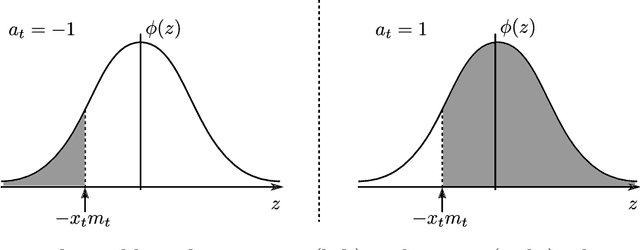
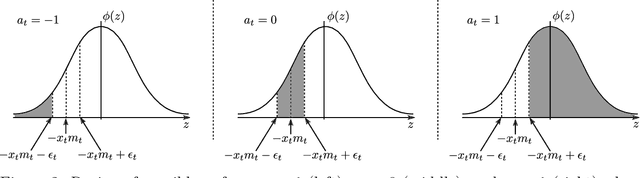
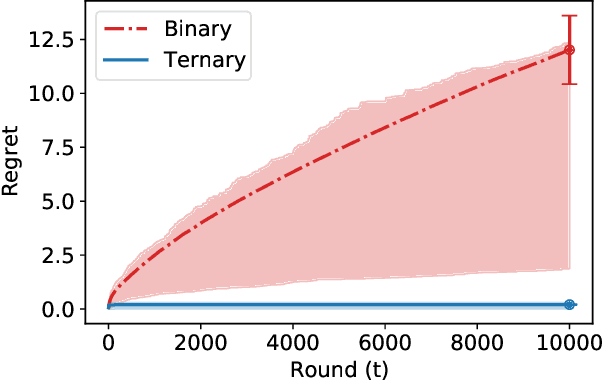
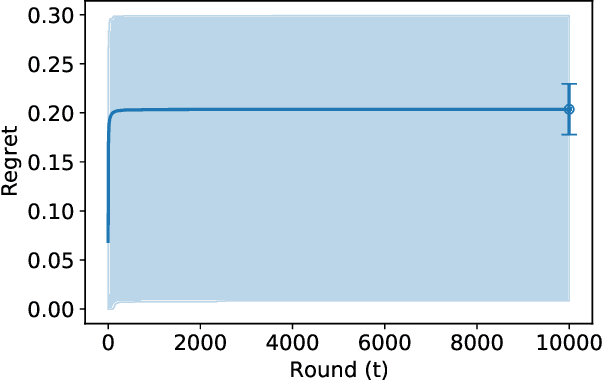
We propose deviation-based learning, a new approach to training recommender systems. In the beginning, the recommender and rational users have different pieces of knowledge, and the recommender needs to learn the users' knowledge to make better recommendations. The recommender learns users' knowledge by observing whether each user followed or deviated from her recommendations. We show that learning frequently stalls if the recommender always recommends a choice: users tend to follow the recommendation blindly, and their choices do not reflect their knowledge. Social welfare and the learning rate are improved drastically if the recommender abstains from recommending a choice when she predicts that multiple arms will produce a similar payoff.
On Statistical Discrimination as a Failure of Social Learning: A Multi-Armed Bandit Approach
Oct 28, 2020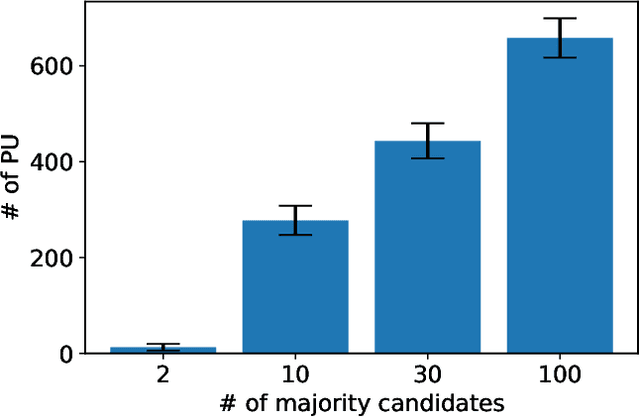
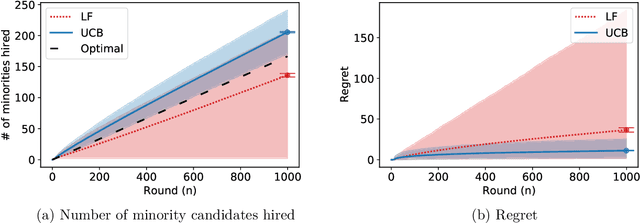
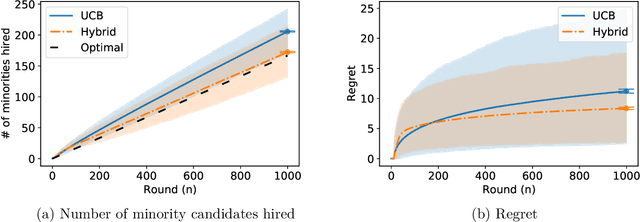
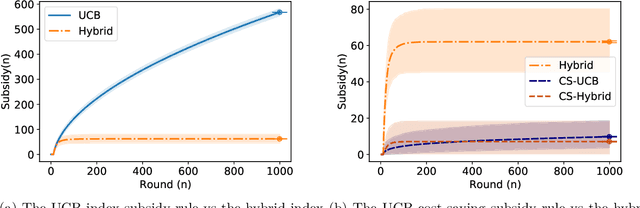
We analyze statistical discrimination using a multi-armed bandit model where myopic firms face candidate workers arriving with heterogeneous observable characteristics. The association between the worker's skill and characteristics is unknown ex ante; thus, firms need to learn it. In such an environment, laissez-faire may result in a highly unfair and inefficient outcome---myopic firms are reluctant to hire minority workers because the lack of data about minority workers prevents accurate estimation of their performance. Consequently, minority groups could be perpetually underestimated---they are never hired, and therefore, data about them is never accumulated. We proved that this problem becomes more serious when the population ratio is imbalanced, as is the case in many extant discrimination problems. We consider two affirmative-action policies for solving this dilemma: One is a subsidy rule that is based on the popular upper confidence bound algorithm, and another is the Rooney Rule, which requires firms to interview at least one minority worker for each hiring opportunity. Our results indicate temporary affirmative actions are effective for statistical discrimination caused by data insufficiency.